April 4, 2026
There’s a moment, somewhere between the Universal Studios construction zones and the Lake Nona medical city skyline, when you realize Central Florida isn’t just one of America’s great tourism destinations anymore.
It’s quietly become something much bigger.
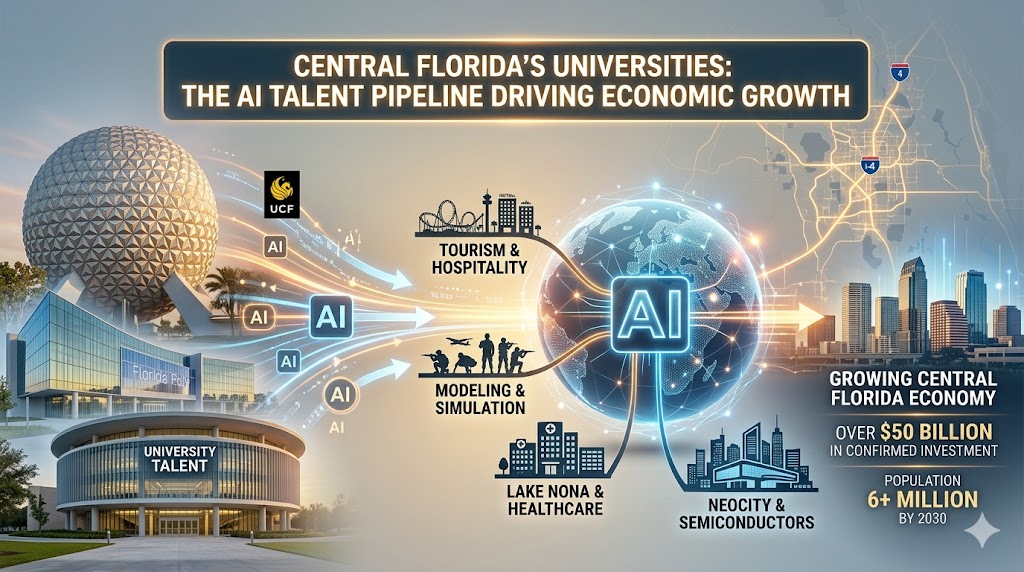
Over the past decade, Greater Orlando has transformed from a metropolitan area defined almost entirely by its theme parks into one of the most economically diversified, fastest-growing, and technologically ambitious regions in the southeastern United States. More than $50 billion in confirmed investment is flowing into Central Florida. Population is expected to leap from 4.5 million to over 6 million by 2030. The region’s identity now includes not just Disney, Universal, and SeaWorld but also healthcare research at Lake Nona, semiconductor manufacturing at NeoCity, modeling and simulation at the Central Florida Research Park, fintech startups across the I-4 corridor, and a rapidly maturing innovation ecosystem that increasingly competes with Austin, Raleigh-Durham, and other recognized American tech hubs.
But here’s what most observers are missing: none of this growth is sustainable without the talent pipeline to support it. And the talent pipeline depends almost entirely on what’s happening at Central Florida’s universities.
Quietly but systematically, the University of Central Florida (UCF), Rollins College, Stetson University, Florida Polytechnic University, Embry-Riddle Aeronautical University, Full Sail University, Valencia College, Seminole State College, Lake-Sumter State College, and a growing network of specialized institutions are aligning their programs with the realities of an AI-driven economy — building the workforce that will determine whether Central Florida’s current momentum compounds into a 30-year economic ascent or stalls because the talent infrastructure couldn’t keep up.
This article walks through how Central Florida’s universities are aligning with AI, what specific programs are leading the transformation, why this alignment matters distinctly to the region’s economy, and what students, employers, and civic leaders should understand about the strategic shift now underway.
Why Central Florida’s AI Alignment Story Is Distinct From Other Florida Regions
Before getting into specifics, it helps to understand what makes Central Florida’s situation distinctive. Tampa Bay’s AI story revolves around financial industry alignment. South Florida’s revolves around the “Wall Street South” migration and global finance. Northeast Florida’s revolves around logistics, fintech, and growth-corridor diversification.
Central Florida’s AI alignment story is different — and arguably more multi-dimensional than any other Florida region.
Tourism and Hospitality Reinvention
Central Florida’s massive tourism and hospitality economy — anchored by Walt Disney World, Universal Orlando (including the new $7 billion Epic Universe), SeaWorld, and a hospitality industry generating tens of billions in annual economic activity — is being fundamentally reshaped by AI. Personalized guest experiences, dynamic pricing, AI-augmented customer service, predictive maintenance, autonomous transportation, and dozens of other applications are transforming how the world’s most consequential entertainment economy actually operates.
Modeling, Simulation, and Defense
The Central Florida Research Park in east Orlando is one of the largest research parks in the United States and home to the world’s most concentrated modeling, simulation, and training industry — including major defense contractors, military training commands, and research organizations that develop AI-augmented training systems for the U.S. military and allied forces. This sector alone employs tens of thousands of highly skilled professionals.
Lake Nona and Health Innovation
The Lake Nona Medical City — a 17-square-mile master-planned community in southeast Orlando — has become one of the most consequential healthcare innovation districts in the United States, anchored by the Sanford-Burnham Medical Research Institute, the U.S. Department of Veterans Affairs Medical Center, the UCF College of Medicine, Nemours Children’s Hospital, the USTA National Campus, KPMG Lakehouse, and dozens of other major institutions.
Semiconductor Manufacturing and NeoCity
NeoCity in Osceola County has emerged as one of the most ambitious semiconductor manufacturing investments in the United States — a 500-acre planned technology district anchored by the BRIDG/SkyWater facility producing advanced semiconductor wafers. The federal CHIPS Act and broader semiconductor strategy positions NeoCity as a critical national infrastructure asset.
Aerospace and Space
With Kennedy Space Center on the Space Coast just east of Orlando, Embry-Riddle Aeronautical University in Daytona Beach to the north, the rapidly growing private space industry, and the broader aerospace sector across Central Florida, the region anchors one of the most consequential aerospace and space economies in the world.
Sports, Entertainment, and Esports
Beyond theme parks, Central Florida hosts the Orlando Magic, Orlando City SC, the proposed Orlando Dreamers MLB stadium, the USTA National Campus, and a growing esports and competitive gaming ecosystem — all sectors increasingly transformed by AI applications in performance analytics, broadcasting, fan engagement, and operations.
Logistics and Supply Chain
The Orlando area anchors a major logistics and distribution corridor, with Orlando International Airport, the Brightline rail expansion, and major distribution infrastructure supporting the broader Central Florida and statewide economy.
The result is one of the most diverse AI alignment opportunities of any American metropolitan region — and Central Florida’s universities are building programming designed to address all of it.
Brian’s Take: Central Florida’s AI Story Spans More Industries Than Almost Any Other American Region.
Most American metros have one or two AI-relevant industries that dominate their workforce conversations, but Central Florida has at least seven major sectors all simultaneously being reshaped by AI — tourism and hospitality, modeling and simulation, healthcare and life sciences, semiconductors, aerospace, sports and entertainment, and logistics. The universities aligning with all of those simultaneously are building one of the most distinctive AI talent infrastructures in the country, and the regional economic implications are enormous over the next 30 years.
— Brian
The University of Central Florida: The Anchor Institution Driving the Alignment
The single most important institution in Central Florida’s university alignment with AI is the University of Central Florida (UCF) — one of the largest universities in the United States with approximately 70,000 students and one of the most strategically positioned public research universities in Florida.
UCF’s scale alone makes it consequential, but the university’s deliberate alignment with the region’s AI economy distinguishes it as one of the most important talent infrastructure institutions anywhere in the southeastern United States.
UCF’s Comprehensive AI Investment
UCF has made substantial institutional investment in artificial intelligence, machine learning, and computing programming through multiple colleges and dedicated centers — recognizing that the region’s economic future depends on producing graduates equipped for the AI-driven economy across virtually every major industry sector.
The Institute for Simulation and Training (IST)
UCF’s Institute for Simulation and Training is one of the most consequential modeling and simulation research centers in the United States, with deep connections to the modeling and simulation industry concentrated in the Central Florida Research Park. AI-augmented simulation, training systems, virtual reality, augmented reality, and synthetic environments developed at IST shape how the U.S. military trains, how major industries develop talent, and how AI applications in simulated environments evolve.
Computer Science, Engineering, and Computing Programs at Scale
UCF’s Department of Computer Science and the broader College of Engineering and Computer Science produce computing graduates at scale — providing the foundational technical AI talent that the regional economy needs in volume.
AI in Healthcare Through the College of Medicine
The UCF College of Medicine — anchored at Lake Nona Medical City — increasingly integrates healthcare AI into medical education and research, leveraging proximity to the Sanford-Burnham Medical Research Institute, the VA Medical Center, Nemours Children’s Hospital, AdventHealth, and the broader Lake Nona healthcare ecosystem.
AI in Hospitality Through the Rosen College of Hospitality Management
The Rosen College of Hospitality Management is one of the most respected hospitality programs in the world, and its programming increasingly addresses how AI is reshaping hospitality operations, guest experience, revenue management, and the broader transformation underway across the tourism and hospitality industries that anchor Central Florida’s economy.
AI in Business Through the College of Business
UCF’s College of Business integrates AI and analytics across business education — producing the AI-fluent business graduates Central Florida’s increasingly diversified economy demands.
Aerospace and Engineering Programming
UCF’s aerospace engineering and broader engineering programs leverage proximity to Kennedy Space Center, the private space industry, and major aerospace employers across Central Florida.
Cybersecurity and Information Assurance
UCF has built substantial cybersecurity programming — addressing the surging demand for cybersecurity talent across virtually every sector of the regional economy, from healthcare to financial services to defense and government contracting.
Defense and Government Contracting Alignment
UCF maintains deep relationships with the modeling and simulation industry, defense contractors, and government agencies operating in the Central Florida Research Park — producing graduates with appropriate clearance pathways and specialized expertise for defense and government work.
Industry Partnership Density
UCF’s industry partnerships with major Central Florida employers — Walt Disney Company, Universal Orlando, Lockheed Martin, Northrop Grumman, AdventHealth, Orlando Health, and dozens of others — translate into internship pipelines, custom training programming, and direct talent pathways for graduates.
Continuing Education and Workforce Development
UCF’s continuing education programming offers AI upskilling for working professionals across the region, recognizing that workforce development can’t only happen at the undergraduate level.
Florida Polytechnic University: The State’s Dedicated STEM Institution
Florida Polytechnic University (Florida Poly) — located in Lakeland in eastern Polk County, technically along the I-4 corridor connecting Orlando and Tampa — is the State of Florida’s only university dedicated exclusively to STEM education.
What Florida Poly brings to Central Florida’s AI alignment:
Pure STEM Focus
Florida Poly offers degrees only in engineering, computer science, data science, and related STEM fields — meaning every graduate exits with deep technical preparation rather than the more diluted programming that characterizes general universities.
AI and Data Science Programming
Florida Poly has built substantial AI, machine learning, and data science programming reflecting the surging demand for these skills across Florida’s economy.
Engineering Programming
Florida Poly produces engineering graduates across multiple specializations — addressing workforce needs in semiconductors, aerospace, healthcare technology, and broader industrial sectors.
Industry Partnership Focus
Florida Poly maintains strong industry partnerships including connections to NeoCity’s semiconductor manufacturing ecosystem, Central Florida’s tech employers, and broader Florida industry.
Smaller Scale, Personalized Education
With substantially smaller enrollment than UCF, Florida Poly offers a more personalized educational experience while maintaining serious technical rigor.
Strategic Positioning Along the I-4 Corridor
Florida Poly’s location along the I-4 corridor positions it to serve both Tampa Bay and Central Florida employers — extending its workforce impact across the broader region.
Brian’s Take: Florida Poly’s Pure STEM Focus Is a Genuine Asset for Central Florida’s AI Alignment.
Most American regions don’t have a dedicated public STEM university anchoring their workforce development efforts, but Florida Poly’s existence along the I-4 corridor gives Central Florida an institution with no liberal arts distractions — every graduate exits with serious technical AI, engineering, or data science preparation. For students who know they want technical careers in Central Florida’s growing industries and for employers who need reliable technical talent at scale, Florida Poly represents one of the smartest higher education bets in the entire region.
— Brian
Embry-Riddle Aeronautical University: Aerospace and AI Excellence
Embry-Riddle Aeronautical University — anchored in Daytona Beach with a campus in Prescott, Arizona, and worldwide online programming — represents one of the most distinctive contributions to Central Florida’s AI alignment story.
What Embry-Riddle brings:
Global Leader in Aerospace Education
Embry-Riddle is widely recognized as one of the world’s leading aerospace and aviation universities, producing graduates in pilot training, aerospace engineering, aviation management, air traffic management, and related fields.
AI Applications in Aviation and Aerospace
The university increasingly integrates AI applications into aerospace education — autonomous flight systems, aviation operations analytics, predictive maintenance, drone and unmanned aerial systems, space situational awareness, and dozens of other applications.
Cybersecurity and Aviation Security
Embry-Riddle has built substantial cybersecurity programming addressing the unique cyber threat environment facing aerospace and aviation industries.
Research Partnerships
The university maintains extensive research partnerships with NASA, the FAA, major aerospace contractors, airlines, and the broader aviation and space industry — providing students with research and internship opportunities at the leading edge of aerospace AI.
Connections to Kennedy Space Center and the Space Coast
Embry-Riddle’s proximity to Kennedy Space Center, Cape Canaveral Space Force Station, and the rapidly growing private space industry creates distinctive opportunities for students interested in space, aerospace, and aviation careers.
Rollins College and Stetson University: Liberal Arts Excellence Meeting AI
Central Florida’s liberal arts and private university landscape contributes distinctive but equally important programming to the broader AI alignment story.
Rollins College (Winter Park)
Rollins College — anchored in Winter Park just north of Orlando — is one of the most respected liberal arts colleges in the southeastern United States. While Rollins doesn’t compete with UCF or Florida Poly on technical AI programming scale, the college contributes:
- Strong undergraduate business programs through the Crummer Graduate School of Business and the broader business curriculum
- Liberal arts foundations that increasingly prove essential in AI-augmented economies — critical thinking, ethics, communication, interdisciplinary problem-solving, cultural awareness
- Computer science and quantitative programming providing technical foundations students need
- Industry partnerships connecting students to Central Florida’s broader economy
- Strong placement networks for graduates entering the regional and national economy
Stetson University (DeLand)
Stetson University — anchored in DeLand in Volusia County, just north of Orlando — contributes:
- Strong business programming including Florida’s first business school
- Computer science and data science programming at the undergraduate level
- Industry partnerships including connections to Florida’s growing tech sector
- Law school programming in Gulfport (Tampa Bay area) addressing AI’s legal implications
- Liberal arts foundations complementary to technical AI programming
- Smaller-scale, personalized education with strong placement networks
For students who want strong liberal arts foundations combined with growing technical capability — and for employers who value the broader thinking skills these institutions emphasize — Rollins and Stetson contribute meaningfully to the region’s overall higher education infrastructure.
Full Sail University: Specialized Entertainment and Media AI
Full Sail University — anchored in Winter Park — represents one of the most distinctive contributions to Central Florida’s AI alignment story. Full Sail specializes in entertainment, media, arts, and emerging technology education — fields being fundamentally reshaped by AI.
What Full Sail brings:
Entertainment Industry Specialization
Full Sail has built deep connections to the entertainment, gaming, film, music, and media industries — including substantial connections to Central Florida’s massive entertainment economy.
AI in Creative Industries
The university addresses how AI is reshaping creative industries — game development, film production, music production, animation, visual effects, and broader media.
Game Development and Esports
Full Sail’s game development and esports programming positions students for careers in one of the most rapidly growing sectors of the entertainment economy.
Audio Production and Music Technology
Full Sail’s audio and music programming addresses both traditional music industry careers and emerging AI-augmented music production.
Practical, Industry-Aligned Education
Full Sail’s educational model emphasizes practical, industry-aligned education with substantial real-world project work — preparing graduates for direct entry into entertainment industry careers.
Brian’s Take: Full Sail University’s Specialization Is Quietly One of the Smartest Higher Education Bets in Central Florida.
While most universities try to be everything to everyone, Full Sail has built a genuinely differentiated position by specializing exclusively in entertainment, media, and emerging technology — exactly the industries Central Florida is increasingly known for and exactly the industries being most dramatically reshaped by AI. The students who choose Full Sail and graduate with serious AI-augmented entertainment industry capabilities are positioned for careers in one of the most consequential creative economies in the world, and the university’s specialization is exactly the kind of strategic focus that distinguishes great regional higher education infrastructure.
— Brian
Valencia College, Seminole State College, and Lake-Sumter State College: Workforce Development at Scale
Beyond the four-year institutions, Central Florida’s community college system plays a critical workforce development role:
Valencia College
Valencia College is one of the largest community colleges in the United States, serving Orange and Osceola counties with approximately 70,000 students. Valencia has built substantial:
- Information technology and cybersecurity programming
- AI and machine learning training
- Healthcare technology and informatics programming
- Business analytics and data programming
- Bachelor’s degrees in select technology fields
- Industry partnerships including connections to Lake Nona, the modeling and simulation industry, healthcare systems, and major Central Florida employers
- Continuing education and workforce development for working professionals
- Bilingual and multilingual programming appropriate to Central Florida’s diverse population
Seminole State College
Seminole State College serves Seminole County with substantial:
- Information technology and computing programming
- Healthcare technology training
- Business and analytics programming
- Engineering technology
- Transfer pathways to UCF and other four-year institutions
- Workforce development for the rapidly growing Seminole County economy
Lake-Sumter State College
Lake-Sumter State College serves Lake and Sumter counties — including the rapidly growing communities of The Villages, Clermont, and surrounding areas — with workforce development programming addressing the technology and healthcare skills increasingly demanded by employers in these high-growth communities.
The community college layer is particularly important because it broadens the talent pipeline beyond traditional four-year graduates — including older students returning for new skills, working professionals upskilling, and students whose pathways don’t fit traditional residential models.
Industry-Academic Partnerships Driving Central Florida’s Alignment
The university alignment isn’t happening in isolation. It’s increasingly driven by deep industry-academic partnerships connecting Central Florida’s universities with the employers actually hiring AI talent:
Tourism and Hospitality Partnerships
With Walt Disney Company, Universal Orlando, SeaWorld, the major hotel and resort companies, and the broader hospitality industry, universities are building partnerships that connect student learning to hospitality industry AI needs.
- Internship programs placing students with major hospitality employers
- Capstone projects structured around real hospitality industry challenges
- Executive-in-residence programs bringing hospitality industry leaders into university classrooms
- Custom training programs developing specific skills employers need
Modeling, Simulation, and Defense Partnerships
With the modeling and simulation industry concentrated in the Central Florida Research Park, including major defense contractors and military training commands, universities — particularly UCF — maintain deep partnerships translating directly into student opportunities and graduate placement.
Healthcare and Lake Nona Partnerships
With AdventHealth, Orlando Health, Nemours Children’s Hospital, the Sanford-Burnham Medical Research Institute, the VA Medical Center, and the broader Lake Nona healthcare ecosystem, universities are building partnerships connecting healthcare AI learning to actual healthcare delivery.
Aerospace and Space Industry Partnerships
With NASA, Kennedy Space Center, the major aerospace contractors, and the rapidly growing private space industry across the Space Coast, universities — particularly Embry-Riddle and UCF — maintain partnerships supporting one of the world’s most consequential aerospace economies.
Semiconductor and NeoCity Partnerships
With NeoCity’s semiconductor manufacturing ecosystem and the broader high-tech manufacturing sector, universities are building partnerships connecting engineering and technology programming to one of the most strategically important manufacturing investments in the United States.
Entertainment Industry Partnerships
With the major entertainment companies, gaming studios, film and media production, and the broader Central Florida entertainment economy, universities — particularly Full Sail and UCF — maintain partnerships connecting student learning to entertainment industry careers.
Corporate Innovation Partnerships
Major Central Florida employers across multiple sectors are establishing direct relationships with regional universities through custom training programs, joint research initiatives, executive education, and dedicated talent development partnerships.
Brian’s Take: The Industry-Academic Partnership Density Across Central Florida Is Genuinely Impressive.
The breadth of industry-academic partnerships across Central Florida — connecting UCF, Florida Poly, Embry-Riddle, Full Sail, Rollins, Stetson, Valencia, and the broader regional ecosystem to tourism giants, defense contractors, healthcare systems, semiconductor manufacturers, aerospace companies, entertainment industries, and major corporate employers — produces compounding talent infrastructure advantages that will distinguish the region’s economic position for decades. Each new partnership strengthens the broader ecosystem, and the cumulative effect is increasingly hard for competing metros to replicate.
— Brian
What the Alignment Means for Students
For students considering Central Florida universities, the AI alignment translates into specific practical advantages:
Currency of Programming
Programs aligned with current AI industry practice produce graduates with genuinely relevant skills.
Internship and Experiential Learning Access
Deep industry partnerships mean students access high-quality internship and co-op experiences with major Central Florida employers across multiple industries.
Career Placement Networks
Strong industry relationships translate into stronger job placement networks for graduates entering Central Florida’s diversifying economy.
AI Fluency Across Disciplines
Whether studying business, hospitality, healthcare, aerospace, computer science, entertainment, or virtually any other field, Central Florida universities are increasingly building AI fluency into the curriculum.
Multiple Pathways at Multiple Price Points
From UCF’s public university scale to Florida Poly’s specialized STEM focus to Full Sail’s entertainment specialization to the community college system’s accessible workforce development, students can find AI-aligned pathways at virtually any commitment level and price point.
Connection to the Broader Economy
Studying at Central Florida universities increasingly means being plugged into one of the most dynamically growing regional economies in the United States.
Continuing Education for Working Professionals
Multiple institutions offer continuing education and graduate programming for working professionals seeking to upskill without leaving Central Florida.
Geographic Concentration With Statewide Reach
Central Florida’s central position in the state means students at UCF, Florida Poly, Embry-Riddle, and other institutions can easily access statewide opportunities while remaining anchored to one of Florida’s most consequential metro areas.
What the Alignment Means for Employers
For Central Florida employers and out-of-state employers considering relocation, the university alignment translates into specific competitive advantages:
Talent Pipeline Reliability
Aligned programs produce graduates with genuinely relevant AI skills, reducing the costly post-hire training gap.
Custom Training Capabilities
Regional universities increasingly partner with employers on custom training addressing specific workforce needs.
Continuing Education Access
Existing employees can access AI continuing education without relocating.
Research Partnership Opportunities
Employers with research needs find sophisticated research partnership opportunities — particularly through UCF’s Institute for Simulation and Training, Florida Poly’s STEM focus, and Embry-Riddle’s aerospace expertise.
Diversity of Talent Sources
The combination of UCF’s scale, Florida Poly’s STEM focus, Embry-Riddle’s aerospace expertise, Rollins and Stetson’s liberal arts excellence, Full Sail’s entertainment specialization, and the community college system’s workforce development reach produces a meaningfully diverse talent pool addressing virtually any workforce need.
Sector-Specific Talent Production
Unlike regions with concentrated industries, Central Florida’s universities produce talent specifically aligned with the region’s distinctive industry mix — tourism and hospitality, modeling and simulation, healthcare, aerospace, semiconductors, entertainment, and beyond.
Rising Reputation
As Central Florida universities continue building AI programming, the region’s reputation as a talent source rises — attracting both employers and additional university investment in a virtuous cycle.
What the Alignment Means for Central Florida’s Future
The cumulative effect of Central Florida’s university alignment with AI is, over time, transformational for the regional economy:
Continued Economic Diversification
Beyond tourism, AI alignment supports continued diversification into healthcare technology, modeling and simulation, semiconductors, aerospace, entertainment technology, fintech, and other knowledge-intensive sectors.
Tourism Industry Reinvention
For the tourism and hospitality industries that have anchored Central Florida’s economy for decades, AI alignment supports continued evolution — keeping the region’s signature industries globally competitive.
Rising Wage Levels
AI-aligned roles command higher wages than traditional services and tourism roles. As more of these jobs become available, regional wage levels rise.
Innovation Ecosystem Maturation
Universities aligned with AI tend to spawn startups, attract venture capital, generate intellectual property, and drive broader innovation ecosystem development.
Resilience to Economic Shifts
Knowledge-intensive economies are more resilient to economic downturns and structural shifts than economies dependent on a single industry.
Population Growth Sustainability
As Central Florida’s population continues growing toward 6 million by 2030, AI-aligned universities ensure the region can support that growth with appropriate workforce development.
National Recognition
As programming strengthens, Central Florida increasingly enters conversations about America’s leading regional economies — supporting continued investment, talent attraction, and reputation building.
Cultural and Civic Leadership
Universities aligned with AI contribute to broader civic leadership, public policy thinking, and the kind of institutional infrastructure that distinguishes well-positioned regions.
Brian’s Take: Central Florida’s University Alignment With AI Is the Most Underrated Regional Economic Story in Florida.
While Tampa Bay’s “Wall Street South” finance migration and South Florida’s supertall towers get the headlines, Central Florida’s universities — UCF, Florida Poly, Embry-Riddle, Full Sail, Rollins, Stetson, Valencia, and the broader regional ecosystem — are quietly building one of the most diverse and consequential AI talent infrastructures of any American region. The region’s economic future across tourism, defense, healthcare, semiconductors, aerospace, and entertainment depends on this alignment continuing to compound, and the civic leaders, philanthropists, and corporate partners supporting it are making bets that will distinguish Central Florida’s economic trajectory for the next 30 years.
— Brian
What Civic Leaders and Policymakers Should Understand
For Central Florida civic leaders, policymakers, and economic development professionals, the university alignment story carries specific implications:
Sustained Investment Matters
Continued public and private investment in higher education infrastructure is essential.
Industry-Academic Partnership Compounds
Each new partnership makes the next one easier. Civic leaders should support partnership development across all major regional industries.
Affordable Access Is Essential
Maintaining affordable access to AI training across the educational ecosystem — including community colleges and continuing education — supports broadly shared prosperity.
K-12 Pipeline Matters
University programs depend on K-12 students arriving prepared. Investment in K-12 STEM education, computer science programming, and digital literacy directly affects what universities can accomplish.
Diverse Industry Approach Should Continue
Central Florida’s distinctive advantage is the breadth of industries the region supports. Civic leaders should resist the temptation to pick favorites — supporting AI alignment across tourism, defense, healthcare, semiconductors, aerospace, entertainment, and other sectors simultaneously.
Cross-Regional Coordination Matters
Universities and educational institutions across Central Florida benefit from coordinated rather than competing approaches.
Brand Building Translates Into Reputation
As programming strengthens, civic leaders should support efforts to build national and international recognition.
The Bottom Line: Central Florida Is Building the Diverse AI Workforce of the Next 30 Years
The most important story shaping Central Florida’s economic future isn’t a theme park expansion, a downtown construction project, or a population growth statistic — though all of those matter. The most important story is the systematic alignment of the region’s universities with the AI economy across an unusually diverse set of industries, and that alignment is now genuinely impressive in scope, ambition, and likely impact.
The University of Central Florida anchors the alignment with massive scale, the Institute for Simulation and Training, Lake Nona-anchored medical programming, Rosen College hospitality excellence, deep industry partnerships across virtually every major regional industry, and a public research university footprint that genuinely competes with the largest in America.
Florida Polytechnic University contributes pure STEM focus along the I-4 corridor, producing technical graduates aligned with the region’s growing semiconductor, engineering, and technology industries.
Embry-Riddle Aeronautical University anchors aerospace and aviation excellence, contributing AI talent to Kennedy Space Center, Cape Canaveral, the private space industry, and the broader aerospace economy.
Full Sail University specializes in entertainment, media, gaming, and emerging technology — exactly the industries Central Florida is increasingly known for.
Rollins College and Stetson University contribute liberal arts excellence and strong business programming complementing the technical institutions.
Valencia College, Seminole State College, and Lake-Sumter State College provide accessible AI workforce development at the scale needed to broaden the region’s talent base.
Industry partnerships with Disney, Universal, the modeling and simulation industry, healthcare systems, aerospace contractors, semiconductor manufacturers, and dozens of other major regional employers translate university programming into real-world workforce capability.
For students, the result is access to genuinely relevant AI programming across virtually any career interest at multiple price points and commitment levels.
For employers, the result is access to a steadily strengthening talent pipeline aligned with how the AI-augmented economy actually works.
For civic leaders, the result is the slow, steady, compounding development of the workforce infrastructure that will determine Central Florida’s competitive position for the next 30 years.
For the region’s broader economy, the result is the gradual but genuine evolution from tourism-and-services dominance to a more diversified knowledge-intensive economy that retains tourism strength while adding meaningful capability across modeling and simulation, healthcare, aerospace, semiconductors, entertainment technology, and beyond.
The construction cranes rising across Central Florida are visible. The university programs aligning with AI are largely invisible. But the universities are arguably the more important story — because the cranes will eventually finish, but the talent pipeline keeps producing graduates year after year, decade after decade.
Central Florida’s smartest civic, business, and educational leaders understand this. The region’s universities are quietly building the workforce of 2030, 2040, and 2050. And the metro that emerges from this alignment will be genuinely different — more economically diverse, more technically capable, more resilient to disruption, and more attractive to the employers and talent that determine regional success in the AI economy.
That’s the Central Florida story most observers aren’t yet telling.
But it’s the story that matters most.
The alignment is underway. The programs are expanding. The industry partnerships are deepening. The students are arriving. The graduates are entering the workforce.
Central Florida is preparing for the AI economy through its universities — and the dividends on that investment will compound for decades across more industries than virtually any other American region can claim.
That’s a Florida story worth watching.
Resources & Further Reading
- University of Central Florida — Official website for one of the largest universities in the United States, with information on the Institute for Simulation and Training, the College of Medicine at Lake Nona, the Rosen College of Hospitality Management, and the broader academic programming.
- Florida Polytechnic University — Official website for Florida’s only dedicated STEM university, with engineering, computer science, and data science programming along the I-4 corridor.
- Embry-Riddle Aeronautical University — Official website for the world’s leading aerospace and aviation university with major Daytona Beach campus operations.
- Full Sail University — Official website for the Winter Park-based university specializing in entertainment, media, arts, and emerging technology education.
- Rollins College — Official website for Winter Park’s leading liberal arts college with strong business and undergraduate programming.
- Valencia College — Official website for one of America’s largest community colleges, providing accessible AI and digital infrastructure workforce development across Orange and Osceola counties.
- Orlando Economic Partnership — Central Florida’s regional economic development organization with information on industry partnerships, workforce development, and the broader regional economy.
About The Author