Market Insight Report | Central Florida Commercial Real Estate Marketplace
The commercial real estate landscape of Central Florida is undergoing a profound structural metamorphosis. Driven by historic population growth, unprecedented injections of out-of-state institutional capital, and an aggressive pipeline of mega-scale infrastructure and mixed-use developments, the corridor spanning Orlando, Tampa, and the Space Coast has solidified its position as one of the nation’s premier economic engines. However, this period of extraordinary expansion is operating within an altered macroeconomic environment. Shifting interest rates, sticky construction input costs, and evolving capital markets are reshaping investment strategies, recalibrating risk tolerances, and forcing developers to pivot—particularly within the once-bulletproof multi-family sector. This comprehensive analysis evaluates the intersection of mega-construction projects, cross-border corporate investments, and monetary policy dynamics defining Central Florida’s commercial property sectors today.
The Macro-Economic Backdrop and the Golden Corridor
For the past decade, Central Florida has consistently outperformed national averages across core economic indicators, including job creation, net inward migration, and gross regional product growth. The region’s geographic advantages—complemented by the expansion of the Brightline higher-speed rail system connecting Miami to Orlando and soon targeting Tampa—have turned individual metropolitan statistical areas (MSAs) into a highly integrated economic megaregion often referred to as the Interstate-4 Corridor.
Historically anchored by tourism, hospitality, and agriculture, the modern Central Florida economy boasts significant diversification into aerospace, defense, financial technology, medical life sciences, and advanced logistics. As thousands of new residents arrive weekly from high-cost states such as New York, New Jersey, California, and Illinois, the fundamental demand for real estate assets has soared. This demographic tailwind has shielded the region from some of the severe real estate contractions witnessed in legacy northern or western gateways.
Yet, Central Florida does not operate in an economic vacuum. The rapid rate-hiking cycle initiated by the Federal Reserve to combat post-pandemic inflation, followed by extended plateau periods and subtle calibration adjustments, has permanently altered the cost of leverage. In a marketplace where debt structures dictate project viability, the transition from an era of near-zero interest rates to a normalized, higher-for-longer rate framework has disrupted historical valuation metrics, expanded capitalization rates, and forced a re-examination of underwriting assumptions across all asset classes.
Major Regional Construction Projects Defining the Skyline
Nowhere is the momentum and structural shift of Central Florida more visible than in its monumental construction pipeline. Massive public-private partnerships, master-planned urban expansions, and multi-billion-dollar corporate expansions are actively redrawing urban and suburban maps alike.
In downtown Orlando, the ongoing execution of the Creative Village master plan represents a major paradigm shift in urban revitalization. Spanning 68 acres on the former site of the Amway Arena, this $1.5 billion public-private partnership is establishing a thriving innovation district. By co-locating the University of Central Florida (UCF) Downtown and Valencia College campuses with high-density commercial office space, digital media studios, and mixed-income residential towers, Creative Village has successfully attracted corporate tenants seeking direct access to tech-focused human capital. The upcoming phases of the project emphasize deep institutional and technology integration, requiring sophisticated commercial space built to handle advanced digital infrastructure.
Simultaneously, the tourism and entertainment district continues to catalyze massive spillover construction. The highly anticipated opening of Universal Orlando Resort’s Epic Universe theme park has triggered a colossal real estate wave along the Universal Boulevard and International Drive corridors. Beyond the park’s immediate boundaries, billions of dollars are flowing into supporting infrastructure, including major road expansions, innovative pedestrian bridges, and extensive utility networks. For commercial real estate investors, this development has sparked an intense premium on surrounding parcels, driving the development of new convention-focused hotels, experiential retail hubs, and logistics fulfillment facilities designed to service the massive influx of tourists and permanent hospitality staff.
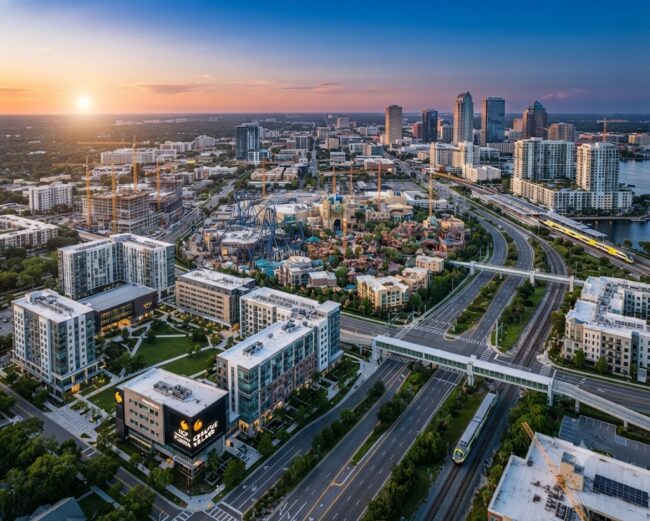
Further west along the I-4 corridor, Tampa’s urban core continues its dramatic evolution through Water Street Tampa, a multi-phase, multi-billion-dollar wellness-focused development spearheaded by Strategic Property Partners (a joint venture between Cascade Investment and Jeff Vinik). Water Street Tampa has fundamentally altered the city’s relationship with its waterfront, establishing a highly walkable, LEED-ND certified neighborhood that seamlessly integrates luxury hospitality, high-performance corporate office spaces, and premium residential units. The success of Water Street’s early phases has set a new benchmark for rental rates and commercial land values across the Southeast, proving that highly curated, experiential urban environments can command premium pricing even amidst broader macroeconomic volatility.
Market Insight Note: The integration of infrastructure projects like the Brightline rail expansion has transformed Central Florida from a collection of isolated cities into a cohesive economic megaregion. Properties located within a 15-minute radius of active transit hubs are commanding a historical premium of 18% to 24% over comparable suburban submarkets.
The Influx of Out-of-State Corporate Capital
The structural growth of Central Florida’s commercial sectors is heavily funded by external capital sources. Historically, local and regional syndicators or private family offices dominated the acquisition and development of Central Florida real estate. Today, the landscape is increasingly dictated by institutional behemoths, sovereign wealth funds, and national private equity firms originating from tier-one financial gateways like New York, Boston, Chicago, and global financial centers.
This migration of capital is driven by two primary forces: a flight to growth and yield optimization. As legacy metropolitan markets grapple with sluggish post-pandemic office occupancy, regulatory hurdles, high tax structures, and stagnant population trends, institutional fund managers have reallocated significant portions of their portfolios toward Sunbelt markets. Central Florida offers a highly attractive environment featuring pro-business local governance, no state personal income tax, and a rapidly expanding labor pool.
This corporate capital influx manifests through major portfolio acquisitions, direct joint-venture developments, and corporate relocations or expansions. Large-scale financial institutions and asset managers have established substantial regional footprints in the market. Companies like KPMG, with its massive Lake Nona training facility, and major financial service operations in North Orlando and Tampa, highlight the corporate vote of confidence. When national corporations establish permanent hubs, institutional real estate capital inevitably follows to acquire the office buildings, net-leased retail centers, industrial distribution warehouses, and residential developments that support these corporate ecosystems.
However, the arrival of institutional capital has altered market dynamics for domestic market participants. Capitalization rates—the ratio of net operating income to property asset value—compressed rapidly during the peak investment cycle, driven by intense bidding wars among well-capitalized funds. While the subsequent rise in interest rates has forced a decompression of cap rates nationally, Central Florida has demonstrated remarkable resilience. Institutional investors are willing to accept lower initial yields here than in midwestern or rust-belt markets because they are underwriting aggressive long-term rent growth backed by indisputable population inflows. This has created a highly competitive environment where local operators must either partner with national capital or target niche, highly specialized submarkets where large funds cannot easily deploy scale.
Shifting Interest Rates Altering Multi-Family Developments
While the industrial and hospitality sectors remain highly robust, Central Florida’s multi-family sector is navigating a complex period of recalibration directly tied to the shifting monetary policy of the Federal Reserve. For years, the multi-family sector was the absolute darling of the real estate investment world, with developers breaking ground on tens of thousands of units across Orlando, Tampa, and suburban nodes like Kissimmee, Clermont, and Riverview.
The mechanics of the multi-family development pipeline are highly sensitive to interest rates. When rates rose sharply, the financial model for new ground-up construction projects faced severe pressure. Construction financing, which typically utilizes floating-rate debt tied to benchmarks like the Secured Overnight Financing Rate (SOFR), became dramatically more expensive. A developer who underwrote an apartment project in 2021 with a total interest expense projection of 3% to 4% suddenly faced construction loan rates peaking between 7% and 9%.
This surge in debt service costs has coincided with a substantial wave of new supply hitting the market—the result of projects initiated during the peak of the development boom. As these new units deliver simultaneously, landlords are experiencing a temporary shift in leverage back toward tenants. Rent growth, which spiked at unsustainable double-digit annual percentages in 2021 and 2022, has flattened or experienced minor contractions in specific oversupplied submarkets. Concessions, such as offering one or two months of free rent to secure leases, have returned as a standard leasing strategy for stabilized properties and new lease-ups alike.
| Central Florida Submarket | Units Delivered (Last 24 Mos) | Average Cap Rate (%) | Y-o-Y Rent Growth Trend |
| Orlando Urban Core / Creative Village | 3,450 | 5.15% | +1.2% (Stabilizing) |
| Lake Nona / Medical City Corridor | 4,200 | 4.95% | +2.8% (Robust) |
| Tampa / Water Street & Downtown | 2,900 | 5.05% | +1.9% (Steady) |
| Suburban I-4 Corridor (Polk County) | 5,100 | 5.65% | -0.8% (Supply Drag) |
The combination of elevated financing costs, flat rental income, and soaring property insurance premiums across the state of Florida has created a margin squeeze. This environment has led to a significant divergence in strategy between well-capitalized institutional sponsors and highly leveraged merchant builders.
Merchant builders—developers who rely on short-term debt to build, stabilize, and immediately sell a property—are facing structural headwinds. Many who utilized short-term, floating-rate bridge loans with expiration dates in the current window are finding that refinancing into permanent, fixed-rate agency debt (such as Fannie Mae or Freddie Mac) requires unexpected injections of fresh equity. This is because higher interest rates reduce the debt service coverage ratio (DSCR), meaning properties cannot support the same loan amounts they could under lower-rate environments. This gap, often referred to as an “equity shortfall,” has forced some developers into distressed sales, recapitalizations, or rescue equity arrangements with institutional partners.
Conversely, institutional capital with a long-term horizon views this disruption as a premier acquisition window. Cash-rich institutional buyers are stepping in to acquire nearly completed or recently stabilized multi-family assets from distressed developers at a discount relative to replacement cost. Furthermore, because the high interest rate environment has caused a dramatic drop in new construction starts over the past 12 to 18 months, forward-looking investors anticipate a significant supply shortage of multi-family units by late 2027 and 2028. Once the current wave of deliveries is fully absorbed by the region’s relentless population growth, vacancy rates are projected to decline sharply, positioning existing assets for another wave of strong, sustainable rent growth.
Industrial and Logistics Sectors: The Backing of Central Florida Growth
While multi-family adapts to capital market changes, Central Florida’s industrial and logistics market remains highly active, anchored by the region’s expanding role as a distribution hub. The geography of the Florida peninsula dictates that to service the state’s 23-plus million residents efficiently, logistics networks must center around the I-4 corridor. This reality has insulated the industrial sector from the macro-driven anxieties affecting other property categories.
Major institutional developments continue to expand outward along Highway 27, the Florida Turnpike, and the eastern reaches of Polk County. Mega-distribution hubs exceeding one million square feet are regularly absorbed by e-commerce operators, third-party logistics (3PL) providers, and national retail distributors. The rise of same-day and next-day delivery expectations has transformed submarkets like Lakeland, Davenport, and Ocala into critical logistics nodes.
The industrial sector has not been entirely immune to interest rate movements; capital costs have increased for industrial developers, and cap rates have adjusted upward accordingly. However, the fundamental demand metrics—characterized by low vacancy rates and sustained tenant requirements—have allowed industrial landlords to successfully pass on increased costs to tenants via higher base rents and annual escalation clauses. This structural strength continues to attract out-of-state corporate capital, which views Central Florida industrial assets as highly defensive components of national real estate portfolios.
Retail and Mixed-Use Spaces: The Experiential Pivot
The Central Florida retail sector is experiencing a significant structural evolution, shifting away from standalone commodity retail environments and toward high-density, experiential mixed-use centers. Driven by out-of-state capital looking to replicate urban density in suburban environments, projects throughout the region are prioritizing a rich blend of food and beverage, entertainment, wellness, and medical services alongside traditional retail storefronts.
This experiential pivot is particularly evident in suburban master-planned communities like Lake Nona in Orlando and Lakewood Ranch near the southern edge of the Central Florida regional boundary. In these locations, developers are intentionally building town centers that function as community living rooms. By incorporating public plazas, outdoor performance spaces, and interactive art installations, these developments generate continuous foot traffic that benefits retail tenants.
From an investment perspective, institutional capital has shown a strong preference for grocery-anchored neighborhood retail centers. The continuous population growth in suburban Central Florida has created a reliable demand base for necessity-based retail, making these assets highly resilient against both e-commerce competition and macroeconomic cycles. Even with elevated borrowing costs, grocery-anchored centers in primary Central Florida submarkets command premium pricing and attract aggressive bidding from institutional buyers and private equity syndicates.
Future Outlook and Strategic Imperatives for Market Participants
Looking ahead, Central Florida’s commercial real estate market is transitioning into a mature phase of its economic cycle. The initial, frenetic post-pandemic boom characterized by rapid cap rate compression and unconstrained asset appreciation has evolved into a disciplined, data-driven environment. Survival and success in today’s market require a deep understanding of localized fundamentals, capital structures, and structural economic trends.
For developers, navigating this mature phase demands intense focus on cost control and capital efficiency. Ground-up construction will require higher equity commitments, as lenders remain conservative in their loan-to-cost (LTC) ratios. Innovative construction techniques, strategic land acquisition, and joint-venture structures with well-capitalized institutional partners will be essential tools for executing new projects.
For institutional investors, Central Florida will remain a primary target for capital deployment. The fundamental pillars of the region’s economy—strong demographic inflows, job growth, and a business-friendly environment—remain firmly intact. As interest rates find a stable baseline, transaction volume is expected to accelerate, driven by clear pricing expectations and the deployment of significant dry powder that has waited on the sidelines during recent capital market volatility.
Ultimately, Central Florida’s commercial real estate market is demonstrating that structural growth can successfully balance macroeconomic headwinds. By leveraging mega-infrastructure projects, attracting sophisticated global capital, and adapting residential and commercial spaces to modern economic realities, the region is cementing its status as a resilient leader in the national commercial property landscape.
Resources and Contributed References
- University of Central Florida (UCF) Institute for Economic Forecasting – Regional Economic Outlook Reports and Labor Analysis
- Enterprise Florida & Florida Economic Development Council – Market Migration and Corporate Capital Flow Indexes
- City of Orlando Community Planning and Development Division – Creative Village Master Plan Phase Development Archives
- Tampa Bay Economic Development Council – Water Street Tampa Infrastructure and Regional Valuations Documentations
- Federal Reserve Bank of Atlanta – Southeastern Commercial Real Estate, Multi-Family Supply Metrics, and Logistics Asset Corridor Tracking
- CoStar Group & Real Capital Analytics (RCA) – Central Florida Macro Transaction Database, Cap Rate Yield Decompression Data, and Historical Rent-up Performance Metrics
About The Author