May 20, 2026
Florida theme parks operate on a simple, brutal premise: spend more, build bigger, scream louder. The economics are staggering. Universal’s Epic Universe opened its gates in 2025 after a reported seven-billion-dollar build. Disney routinely sinks half a billion into a single ride. Animatronic dragons now cost more than most Hollywood films. There are queues — queues — with budgets larger than the GDP of small nations.
And then there is Tom.
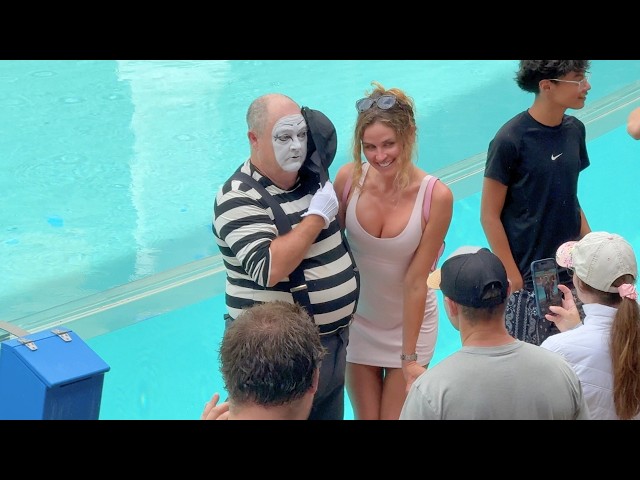
Tom has no budget. Tom has no R&D department. Tom has no Imagineering team in a windowless conference room sketching ride vehicles on whiteboards. Tom has a striped shirt, a pair of suspenders, white gloves, face paint, and a profound, weaponized understanding of human behavior.
Tom wins. Tom always wins.
The Math Doesn’t Math
Consider the absurdity. Across the street from where Tom performs, parks are pouring nine-figure sums into experiences engineered down to the millisecond. Hydraulic systems calibrated by aerospace engineers. Projection mapping synced to orchestral scores recorded in Prague. Ride vehicles with more processing power than the Apollo missions. Animatronic characters whose eye movements were studied for years to achieve emotional realism.
And the loudest, longest, most unhinged laughter in the entire state of Florida is happening over by the sea lion show, where a guy is silently pretending to steal a man’s wallet behind his back.
It is, frankly, embarrassing for the industry. Billions in capital expenditure, and the funniest thing in the entire park is free. The most memorable moment of a family’s thousand-dollar vacation is a man making exaggerated eye contact with their teenager. The TikTok that goes viral isn’t the new coaster. It’s Tom, lurking.
The Genius of Doing Less
Theme parks have spent the last forty years operating under the assumption that more equals better. More screens. More speed. More G-forces. More IP. More licensed characters with copyright disclaimers in microscopic font at the bottom of the ride poster.
Tom proved, definitively, that the opposite is true.
A coaster gives you ninety seconds of adrenaline. Tom gives you a story you’ll tell at dinner parties for fifteen years. A 4D show pummels you with wind, water, and scented mist. Tom raises one eyebrow and the entire crowd loses its mind. A meet-and-greet with a costumed character is a transactional photo op. Being Tommed is an event. People remember exactly where they were standing. They can describe the lighting.
This is the cruel joke at the heart of modern entertainment: the most expensive special effect ever invented is still cheaper than a man with good comic timing and the discipline to commit fully to silence.
The Laughter Economy
Here is what theme parks are actually selling, beneath all the marketing language about magic and memories and family bonding: they are selling laughter. Joy. The involuntary, full-body, eyes-watering kind that you can’t fake and can’t manufacture on demand.
You cannot CGI it. You cannot build it into a ride system. You cannot license it from a movie studio. It either happens or it doesn’t, and when it happens, it is the single most valuable commodity in the entire park.
Tom produces it on tap.
Without speaking. Without props. Without effects. Without a budget line item. Without a marketing campaign. Without a single executive note from a corporate parent demanding a synergistic IP tie-in. Just him, the crowd, and the oldest performance tradition in human history: I am going to do something funny, and you are going to laugh, and neither of us needs to say a word about it.
The most sophisticated entertainment apparatus ever assembled on planet Earth — and the runaway champion is a mime.
What the Executives Won’t Admit
In the quiet rooms where theme park strategy gets made — the ones with the floor-to-ceiling windows and the catered lunches — someone, somewhere, has surely done the math. Cost per laugh. Engagement per dollar. Memorability per square foot of leased real estate.
And somewhere in that spreadsheet, in a cell that nobody wants to highlight, sits the data point that ruins the whole industry’s self-image: one (1) silent man, zero dollars in capex, infinite ROI.
You cannot scale Tom. You cannot franchise Tom. You cannot put Tom in a brand deck and roll him out across six parks globally. Tom is, by definition, unreproducible — because what makes Tom work isn’t the costume or the gimmick or the choice of venue. It’s the guy. The thousands of hours of reps. The instinct, sharpened across decades, for exactly when to look at someone and exactly when to look away.
That’s not a product. That’s a craft. And craft, it turns out, is the one thing no amount of money can manufacture.
A Lesson Etched in Silence
So here is what Tom the Mime has truly changed about theme park entertainment in Florida — and, by extension, everywhere:
He has demonstrated, day after day, year after year, that the central premise of the industry is wrong. You don’t need a billion dollars. You don’t need a licensed character. You don’t need a hydraulic system, a screen the size of a basketball court, or a ride vehicle that costs more than a house.
You need a person. A real, present, observant, committed person. One who has paid attention to other people long enough to know what’s funny about them.
The parks will keep building. The budgets will keep climbing. The next attraction will, somehow, cost more than the last one. That is the nature of the business, and the business is not going to stop.
But somewhere in Orlando, in a pre-show area that smells faintly of fish, a man in white gloves will continue to do what he has always done. He will tilt his head. He will raise an eyebrow. He will steal an invisible hat. He will not say a single word.
And the laughter that follows — that big, helpless, full-throated, real laughter — will be louder than anything the engineers and the executives and the consultants and the shareholders have ever managed to build.
That is Tom’s legacy. That is what he changed.
The quietest man in Florida is also, somehow, the loudest.
About The Author