What Orlando-Area Business Leaders Are Actually Saying About the Economy
Central Florida business leaders entered 2026 with measured optimism, according to the Orlando Economic Partnership’s Q4 2025 Business Conditions Survey, UCF Economist Sean Snaith’s annual forecast, the Florida Council of 100’s Q1 2026 CEO Economic Outlook Index, and the Florida Chamber Foundation’s 2026 Economic Outlook Report. Local business confidence rose in Q4 2025 supported by Central Florida’s projected position as Florida’s employment growth leader at 1.3%.
The sentiment picture emerging from Central Florida business leaders in spring 2026 reflects a distinctive combination — strong confidence in regional fundamentals tempered by recognition of national economic uncertainty, substantial continued capital investment commitments balanced against measured hiring expectations, and the kind of disciplined business thinking that distinguishes Florida’s continued economic outperformance from speculative dynamics that have characterized other markets.
The Orlando Economic Partnership Business Conditions Survey
The most directly relevant current sentiment data for Central Florida business leaders comes from the Orlando Economic Partnership’s quarterly Business Conditions Survey.
Results from the Partnership’s Q4 2025 Orlando MSA Business Conditions Survey indicate local business confidence rose in the final quarter of 2025, as improved performance helped firms look past ongoing national volatility; confidence in the U.S. economy fell for a second consecutive quarter, following the federal government shutdown in late 2025. The rebound mirrors a similar year-end uptick in consumer sentiment in Florida, which rose to 74.9 in December. Both business and consumer sentiment remain below their year-ago levels after a year of uncertainty and significant policy upheaval.
The pattern across the Central Florida sentiment data reveals exactly the dynamic that has characterized sophisticated Florida business thinking in recent years — strong confidence in regional fundamentals combined with appropriate caution about broader national dynamics.
Through October, total sales in the region were up 3.1% from the same period in 2024, broadly in line with inflation as overall demand proved resilient despite ongoing volatility.
The 3.1% sales growth reflects exactly the kind of resilient performance that supports continued business leader confidence while the national volatility considerations explain why the confidence remains measured rather than exuberant.
Brian’s Take: The Central Florida Business Confidence Pattern Reveals Sophisticated Regional Business Thinking.
The most telling aspect of the Q4 2025 Orlando Business Conditions Survey isn’t whether confidence rose — it’s that confidence rose specifically while national economic sentiment fell. Central Florida business leaders demonstrated exactly the kind of independent analytical thinking that distinguishes regions actually maturing into major business markets from regions whose sentiment merely tracks national dynamics. The willingness to recognize improving local fundamentals despite national headwinds reflects business leadership operating with appropriate sophistication rather than either reflexive optimism or unwarranted pessimism. Central Florida business leaders are responding to substantial actual regional performance rather than narrative momentum from external sources.
— Brian
The Florida Council of 100 CEO Outlook
Beyond Central Florida-specific data, the Florida Council of 100’s quarterly CEO Economic Outlook Index — based on responses from CEOs of Florida’s largest employers including substantial Central Florida representation — provides additional context for understanding business leader sentiment affecting the region.
Florida business leaders are signaling strong confidence in the state’s economy, with capital investment expectations reaching a record high, according to a new survey from The Florida Council of 100. The group’s Q1 2026 CEO Economic Outlook Index measured 98, based on responses from 111 executives from the state’s largest employers. That remains well above the national index score of 89 and reflects expectations for sales, capital investment and hiring over the next six months.
The capital investment finding represents particularly significant signal:
The most notable shift came in capital spending. The capital expenditure subindex rose to 91 from 88, the highest level since the council began tracking the data.
The leadership commentary reflects the confidence:
“Florida CEOs are betting on the state’s future through continued investment and expansion,” said George LeMieux, chair of The Florida Council of 100. “That confidence reflects the strength of Florida’s business environment and long-term economic outlook.”
The employment expectations remain strong:
While expectations for sales and employment eased slightly compared with the previous quarter, overall sentiment remained strong. The employment subindex registered at 95, far exceeding the national score of 50, signaling continued hiring confidence among Florida’s largest employers.
“What we’re seeing is alignment among Florida’s leading CEOs around continued investment and growth,” said Mike Simas, president and CEO of The Florida Council of 100. “When that many business leaders are moving in the same direction, it’s a strong signal about where the economy is heading.”
The employment subindex of 95 versus the national score of 50 — nearly double the national score — reflects exactly the dynamic that distinguishes Florida business leader sentiment from broader national sentiment patterns.
The UCF Economic Forecast Foundation
Beyond pure sentiment surveys, UCF Economist Sean Snaith’s annual Florida economic forecast provides substantive economic foundation supporting business leader confidence.
The forecast predicts Florida’s economy will grow 2.4 percent each year through 2028, outperforming the national economy. Florida’s economy is expected to exceed $2.1 trillion by 2028. Personal income average growth will increase three percent each year through 2028. Central Florida is expected to lead Florida’s economy again in the new year.
Central Florida’s expected leadership position within Florida’s broader economic outperformance reflects exactly the kind of substantive positioning that supports continued business leader confidence.
The University of Central Florida forecasts local employment growth of 1.3% in 2026, surpassing both the statewide rate of 0.8% and the national rate of 0.5%.
The substantial employment growth differential — Central Florida’s 1.3% versus the national 0.5% — represents 2.6x the national rate, reflecting exactly the kind of fundamental regional strength supporting business leader confidence.
Florida is currently projected to be among the state’s leaders in employment growth in 2026 at 1.3%.
The Florida Chamber Foundation Perspective
The Florida Chamber Foundation’s 2026 Economic Outlook Report provides additional context affecting Central Florida business leader thinking.
The outlook projects continued growth across all major economic indicators, with Florida’s economy once again expected to outperform the nation. This performance reflects a long-standing trend rather than a short-term surge. Florida continues to rank among the strongest state economies in the country and is recognized by CNBC as the number one state economy in the nation.
“Florida continues to prove that long-term, disciplined and diversified economic strategy works,” said Mark Wilson, President & CEO of the Florida Chamber of Commerce and Foundation. “Florida’s economic growth has outpaced the nation by an average of 2.3 percentage points over the past four years and is expected to exceed national GDP growth again in 2026.”
The longer-term performance context matters substantially:
“Florida is entering 2026 from a position of strength,” said Sheridan Morby, Senior Research Economist of the Florida Chamber Foundation. “The Florida Chamber Foundation’s data show sustained outperformance of the national trends, a resilient labor market, and a period of normalization following several years of rapid growth. Slower growth does not signal concerns. It reflects a stabilizing economy that is built for long-term success.”
The “stabilizing economy built for long-term success” framing reflects exactly the kind of sophisticated business thinking that supports Central Florida business leader confidence — recognizing that moderation reflects healthy normalization rather than emerging weakness.
Brian’s Take: The Multi-Source Sentiment Convergence Substantially Strengthens the Credibility of Central Florida Business Leader Confidence.
Business sentiment data becomes substantially more credible when multiple independent sources reach similar conclusions. The convergence between the Orlando Economic Partnership’s quarterly survey, the Florida Council of 100’s CEO index, UCF’s economic forecast, and the Florida Chamber Foundation’s outlook all pointing toward Central Florida outperformance with measured but real confidence provides substantially stronger signal than any single source could provide alone. The combination of regional survey data, statewide CEO sentiment, academic economic forecasting, and major business association analysis converging on similar conclusions reflects exactly the kind of multi-source validation that should be taken seriously by anyone making business decisions affecting Central Florida positioning.
— Brian
What’s Actually Driving the Confidence: The Underlying Performance
The Central Florida business leader confidence reflects substantial underlying performance providing foundation for sentiment.
Employment Growth Leadership
Central Florida’s projected position as Florida’s employment growth leader at 1.3% represents exactly the kind of substantive performance that supports business leader confidence:
Orlando is projected to remain among the fastest-growing large economies in the nation. The University of Central Florida forecasts local employment growth of 1.3% in 2026, surpassing both the statewide rate of 0.8% and the national rate of 0.5%. Over the next decade, Orlando is expected to add more than [substantial projected employment growth].
Tourism Industry Strength
Central Florida’s substantial tourism industry continues providing economic foundation:
“Leisure travel to Florida continues to drive positive trends. We think that softness from Canada in 2025 will start to wane and visitors will start to return in 2026. Travelers are still going to be looking for deals and special experiences,” industry leaders shared in 2026 Economic Outlook coverage.
Work has begun on a $560-million expansion of the Orange County Convention Center, which is projecting $5 billion in business for 2026, which would be a record. Tourism taxes are paying for the expansion, which is slated to be done by late 2029.
The $5 billion projected 2026 convention business and the $560 million expansion investment reflect exactly the kind of substantial capital commitments that support continued business leader confidence in tourism industry fundamentals.
Major Attraction Development
The continued major attraction activity reinforces regional tourism positioning:
Universal’s Epic Universe, which opened last May, continues to attract visitors to Central Florida, hospitality leaders say.
“Epic Universe will continue to drive traffic in Central Florida as first-time visitors add that to their travel.”
The substantial Epic Universe activity at Universal Orlando Resort, combined with continued Walt Disney World activity, SeaWorld activity, and the broader Central Florida attraction ecosystem supports the substantial tourism foundation that anchors much of the regional economy.
Downtown Orlando Investment
Substantial municipal investment reinforces continued urban core development:
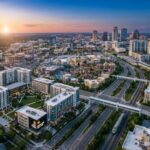
The city of Orlando is kicking off its $750-million Downtown Orlando Action Plan, which is aimed at transforming its urban core. This will eventually mean converting major one-way thoroughfares like Orange and Rosalind avenues to two-way streets to slow down pass-through traffic, while also enhancing green spaces and adding wider sidewalks and pedestrian-friendly amenities to improve walkability and hopefully attract more shops and restaurants.
The $750 million urban core investment represents exactly the kind of substantial public commitment supporting business leader confidence in continued Central Florida development trajectory.
Technology Sector Growth
The continued technology sector development reinforces business leader confidence:
The adoption of artificial intelligence (AI) is set to play a significant role in Orlando’s economy. Over the past two years, the number of local job postings seeking AI skills has doubled, reaching over 1,000 by late 2025. In 2026, AI fluency is expected to become a differentiating skill in the labor market, with businesses leveraging AI to enhance productivity.
The substantial AI activity growth reflects Central Florida’s continued evolution beyond pure tourism dependency into broader technology sector development supporting longer-term economic diversification.
Industry Leadership Sectors
Specific industry leadership areas reinforce confidence:
Economists say our region already has strong simulation, tech and advanced manufacturing sectors. Johnston thinks those areas will create new jobs in 2026 with a strong focus on artificial intelligence.
The substantial simulation industry concentration around Central Florida — anchored by major defense simulation activity, gaming industry activity, and broader simulation technology — represents distinctive regional strength supporting continued business leader confidence.
Real Estate Market Stability
The Central Florida real estate market provides additional foundation:
“The housing market is stabilizing. We still have a pretty strong job market. We’ve got shortages in some job sectors like health care.”
Analysts predict the real estate market in metro Orlando will outperform the Miami and Tampa markets for 2026.
The expected Central Florida real estate outperformance versus other major Florida markets reflects substantial regional fundamentals supporting continued real estate industry confidence.
Commercial Real Estate Improvement
The commercial real estate environment supports business leader sentiment:
In the commercial market, industrial vacancy dropped to 7.2% in the fourth quarter – its lowest level since Q1 2024 – as the market continued to absorb recently completed space; office vacancy ended the year at 17.6% after four quarters of negative net absorption, although delayed occupancy from strong leasing in 2025 should see gains in 2026.
The industrial vacancy improvement and the office market continued absorption represent exactly the kind of substantive commercial real estate performance supporting business leader confidence.
Transit and Transportation Development
The continued transportation development reinforces broader regional confidence:
SunRail ridership increased for the fourth consecutive year in 2025, welcoming 8.8% more passengers than in 2024. Total ridership in 2025 surpassed 1.3 million, aided by the first complete year of the DeLand station being in operation.
The substantial SunRail ridership growth, combined with continued Brightline Orlando service activity, supports continued regional transit development affecting business leader thinking about regional accessibility and continued development.
Aviation Sector Activity
The aviation sector continues providing economic foundation:
With December still to report, passenger volume through Orlando International Airport in 2025 is expected to challenge 2024 levels. Total volume through November was up 0.6%, driven almost entirely by an increase in international passengers (+8.6%).
The substantial international passenger growth (+8.6%) reflects continued Central Florida positioning as a major international destination supporting continued business leader confidence in the broader visitor economy.
Brian’s Take: The Substantial Underlying Performance Provides Genuine Foundation for Central Florida Business Leader Confidence.
The Central Florida business leader confidence isn’t operating in a vacuum or driven by narrative momentum — it reflects actual substantive performance across employment growth, tourism activity, major attraction development, downtown investment, technology sector growth, industry leadership in simulation and advanced manufacturing, real estate stabilization, commercial real estate absorption, transit ridership growth, and aviation activity. The combination of substantial performance across multiple economic dimensions provides exactly the foundation that supports the measured but real confidence Central Florida business leaders demonstrate. This isn’t speculative confidence — it’s confidence built on substantive performance reflecting genuine regional fundamentals.
— Brian
What Business Leaders Are Watching: The Concerns
Beyond the positive performance and confidence indicators, Central Florida business leaders are watching specific concerns that shape current sentiment.
National Economic Uncertainty
National economic uncertainty represents the most consistent concern across Central Florida business leaders:
Growth is expected to rebound to 2.2% in 2026 as easing inflation, tax changes and lower interest rates combine to support consumption. However, the outlook for 2026 remains clouded by ongoing uncertainty over future U.S. government policy.
The continued national policy uncertainty creates exactly the kind of broader economic context that produces measured rather than exuberant business leader sentiment.
Population Growth Moderation
Population growth moderation affects business leader thinking:
A slowdown in population growth and a more restrictive immigration environment are expected to act as key headwinds.
The Florida growth pattern has historically depended substantially on continued migration, with population growth moderation creating implications for continued housing demand, retail activity, and broader regional economic development.
Tourism Industry Variability
Tourism industry concerns affect business leader sentiment:
A moderation of consumer spending, softening labor market, strains on housing market fundamentals, and fewer tourists are weighing on the state’s growth outlook.
The combination of consumer spending moderation and tourist activity concerns affects Central Florida business leaders directly given the substantial regional tourism dependency.
Healthcare Worker Shortages
Specific industry workforce concerns affect business leader thinking:
“We’ve got shortages in some job sectors like health care.”
The healthcare worker shortage affects Central Florida’s substantial healthcare industry including major systems like AdventHealth, Orlando Health, Nemours Children’s Health, and broader healthcare activity.
Housing Affordability
Housing affordability represents continued concern:
Median single-family home listing prices are stabilizing in Florida, and sales are picking up after a period of high prices and slow activity. These shifts also point to an expected market normalization in 2026.
The continued housing affordability dynamics affect business leader thinking about workforce retention, recruitment competitiveness, and broader regional economic sustainability.
Insurance Cost Pressures
Insurance cost pressures affect business leaders:
Seminole County commissioners raised the county’s property tax rate for the first time in 16 years, saying it was necessary to pay for the rising cost of insurance, inflation and law enforcement.
The continued insurance cost pressures affect business leaders directly through commercial property insurance, workers compensation, broader liability insurance, and the broader cost structure affecting regional business operations.
Consumer Spending Patterns
Consumer behavior affects business leader thinking:
Travelers are still going to be looking for deals and special experiences.
The continued consumer value-seeking behavior affects business leaders across retail, hospitality, restaurants, and broader consumer-facing industries that constitute substantial Central Florida economic activity.
Industry-Specific Sentiment Patterns
Within the broader Central Florida business sentiment picture, specific industry sentiment patterns deserve attention.
Tourism and Hospitality
Central Florida’s tourism and hospitality industry sentiment reflects mixed dynamics. Continued strong fundamentals — including Epic Universe activity, continued Walt Disney World activity, the substantial convention center expansion, and broader hospitality activity — support strong sentiment while consumer spending variability and Canadian visitor patterns create concerns.
Technology and Simulation
The continued technology sector growth reflects strong sentiment. The substantial simulation industry concentration, the growing AI activity, and the broader technology sector development support strong industry confidence supporting continued sector growth.
Healthcare
Central Florida’s substantial healthcare industry demonstrates strong sentiment supported by continued patient demand, continued facility expansion activity, and major healthcare system growth — tempered by workforce shortage concerns affecting industry capacity.
Real Estate
Central Florida’s real estate sentiment reflects expected outperformance compared to other major Florida markets, with continued strong fundamentals supporting industry confidence while broader market dynamics create some concerns.
Defense and Aerospace
Central Florida’s substantial defense and aerospace industry — anchored by major operations including the substantial Lockheed Martin Orlando operations, the broader space industry activity, and continued defense industry concentration — supports strong industry sentiment.
Education
Central Florida’s substantial higher education sector — anchored by UCF as one of the nation’s largest universities, plus substantial activity at Rollins College, Stetson University, Full Sail University, Valencia College, Seminole State College, and other institutions — supports continued education industry sentiment.
Professional Services
Professional services including legal, accounting, consulting, and broader professional services demonstrate strong sentiment supported by continued business activity, continued corporate relocations creating professional service demand, and the broader regional business sophistication supporting continued professional service growth.
Brian’s Take: Central Florida’s Industry Diversification Provides Substantial Sentiment Resilience.
Unlike regions whose business sentiment depends heavily on single-industry dynamics, Central Florida’s substantial industry diversification across tourism, technology, healthcare, defense and aerospace, education, professional services, and broader sectors provides substantial sentiment resilience. When specific sectors face challenges, the broader industry diversification supports continued overall business leader confidence. The continued evolution of Central Florida beyond pure tourism dependency — through substantial technology growth, healthcare expansion, defense industry development, and broader sector diversification — represents exactly the kind of long-horizon strategic positioning that supports durable business leader confidence rather than cycle-driven sentiment patterns.
— Brian
What Comes Next: The 2026 Trajectory
Several trends will continue shaping Central Florida business sentiment across 2026.
Continued Economic Outperformance
The continued expected Florida economic outperformance versus national dynamics will continue supporting Central Florida business leader confidence, with the projected employment growth leadership reinforcing continued regional positioning.
Continued Major Investment Activity
The continued substantial investment activity — including the $750 million Downtown Orlando Action Plan, the $560 million Orange County Convention Center expansion, continued attraction development, and broader regional investment — will continue supporting business leader confidence in regional fundamentals.
Continued Technology and AI Development
The continued technology sector development including AI adoption, simulation industry growth, and broader technology activity will continue supporting business leader confidence in regional economic diversification.
Continued Tourism Performance
The continued tourism industry performance — supported by Epic Universe, continued Disney activity, convention center activity, and broader hospitality industry development — will continue providing economic foundation supporting business leader confidence.
Continued Real Estate Evolution
The continued Central Florida real estate market evolution, with expected outperformance compared to other major Florida markets, will continue affecting business leader sentiment across multiple industries.
Continued National Economic Dynamics
The continued national economic dynamics will continue affecting Central Florida business sentiment, with continued national policy uncertainty, continued interest rate evolution, and broader national factors continuing to affect regional business thinking.
Continued Migration Evolution
The continued migration patterns and population growth dynamics will continue affecting business leader thinking about workforce availability, consumer demand, real estate dynamics, and broader regional economic considerations.
Continued Industry Diversification
The continued Central Florida industry diversification across multiple sectors will continue supporting business sentiment resilience and broader regional economic stability.
The Bottom Line
Central Florida business sentiment in spring 2026 reflects measured optimism supported by substantial regional performance, continued strong fundamentals, expected Florida economic outperformance versus national dynamics, ongoing substantial investment activity, continued technology sector growth, and the broader regional momentum that has distinguished Central Florida’s continued economic development.
The pattern across the data — strong company-specific performance combined with measured national sentiment, continued institutional capital interest, ongoing major investment commitments, continued workforce development activity, and the broader sophisticated business thinking — reflects exactly the kind of business community maturation that produces durable economic development rather than cycle-driven dynamics.
For business leaders considering Central Florida engagement, the sentiment data and underlying performance support continued substantial regional opportunity with appropriate consideration of broader national economic dynamics, workforce challenges, affordability constraints, and the continued evolution affecting how the region develops across the years ahead.
For Central Florida business leaders, the current sentiment reflects substantial regional positioning built through continued long-horizon investment, continued institutional development, continued industry diversification, and continued strategic thinking that distinguishes Central Florida’s current business environment from speculative dynamics characterizing other markets in recent years.
For broader business observers paying attention to Florida’s continued economic evolution, the Central Florida sentiment picture provides important context for understanding one of the most consequential American regional business stories of the current era — with Central Florida’s continued expected employment growth leadership, substantial industry diversification, continued tourism industry foundation, growing technology sector, and broader regional dynamics all supporting continued substantial regional development.
The companies continue investing. The major projects continue progressing. The tourism continues developing. The technology continues advancing. The major attractions continue drawing visitors. The downtown investment continues transforming the urban core. The convention center expansion continues progressing. The business leader confidence continues — measured, sophisticated, grounded in substance rather than narrative momentum.
That’s the Central Florida business sentiment reality in 2026. That’s a regional business story worth understanding seriously — and one that will continue producing substantial implications for Florida’s continued economic transformation across the years ahead.
Disclaimers and Methodology
Article Purpose and Methodology. This article provides analysis of Central Florida business sentiment based on publicly available data from the Orlando Economic Partnership’s Q4 2025 Business Conditions Survey, the Florida Council of 100’s Q1 2026 CEO Economic Outlook Index released in April 2026, UCF Economist Sean Snaith’s annual Florida economic forecast, the Florida Chamber Foundation’s 2026 Economic Outlook Report, Florida Trend’s 2026 Economic Outlook coverage, and additional sources cited throughout. The information reflects sentiment data, performance metrics, and business leader statements available as of time of writing. Specific business sentiment continues evolving; current information may differ from the information presented as continued market developments occur.
Important Limitations. This article is not professional business, investment, financial, or planning advice and should not be relied upon for any specific business decision, investment, or other consequential situation. Business sentiment data and broader business analysis involve complex considerations that vary substantially based on specific business circumstances. Specific business decisions require qualified professionals with relevant experience including business advisors, financial advisors, investment professionals, and other qualified advisors — not reliance on general informational articles. Sentiment data reflects survey responses and reported leader statements at specific time periods and may not predict future conditions. Always consult qualified professionals for advice specific to your circumstances. The author and publisher disclaim any liability for outcomes resulting from the use, application, or interpretation of information in this article.
Resources & Further Reading
- Orlando Economic Partnership — Regional economic development organization with quarterly Orlando MSA Business Conditions Survey and substantial regional economic research.
- Florida Council of 100 — Major Florida business organization producing quarterly CEO Economic Outlook Index based on responses from CEOs of Florida’s largest employers.
- Florida Chamber Foundation — Major Florida business organization producing annual Florida Economic Outlook Report and broader research affecting business leader sentiment.
- University of Central Florida College of Business — UCF business school producing substantial regional economic research including UCF Economist Sean Snaith’s annual Florida economic forecast.
- Florida Trend Magazine — Major Florida business publication with comprehensive coverage of Central Florida and broader Florida economic activity.
- Visit Orlando — Regional tourism organization with substantial visitor economy data affecting hospitality industry sentiment.
- Orange County Convention Center — Major convention facility with significant impact on Central Florida business activity through the $560 million expansion currently underway.
- Greater Orlando Aviation Authority — Operator of Orlando International Airport with substantial data on aviation activity affecting regional business and visitor activity.
About The Author