Photo: Ameer Basheer via Unsplash, Unsplash License
Quick Answer: Lake County added about 61,900 residents between 2020 and 2025, reaching 445,881, and its preliminary 2026 county taxable value rose to $48.7 billion, about 8.6% above the 2025 final roll. Jobs based in the county have not kept up. Federal wage data show 118,275 jobs in March 2026, down 0.7% from a year earlier, with average weekly pay of $1,039, well below the state average.
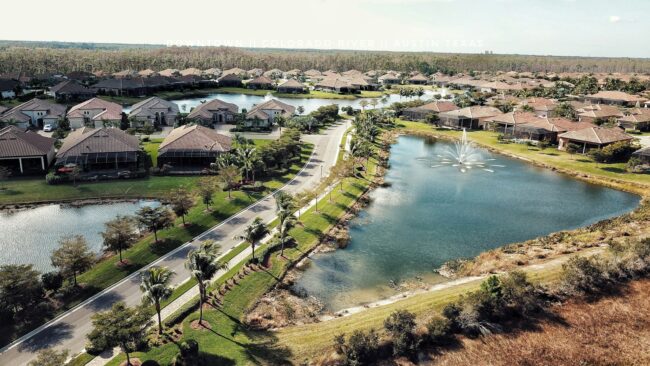
Lake County’s growth is easy to see from U.S. 27 or State Road 50. Subdivisions keep spreading across former citrus groves and pasture between Clermont, Minneola, Groveland and Leesburg. The official numbers show two things happening together. Residents and property value are rising quickly. Employment and wages inside the county are close to flat. The gap between those trends explains why county planners have spent a decade pushing an employment-focused master plan in Wellness Way, and why the newest large approval there requires more than 1 million square feet of nonresidential space.
How fast is Lake County’s population growing?
BEBR estimated Lake County’s population at 445,881 as of April 1, 2025, up from 383,956 in the April 2020 Census. That is an increase of 61,925 people, or 16.1%, in five years.
The fastest growth has been in the south and central cities. Minneola grew from 13,843 residents to 21,201, a gain of 53.2%. Mascotte grew 49.7%, from 6,609 to 9,894. Leesburg added 10,541 residents, rising 39.0% to 37,541, which is the largest numeric gain of any Lake city. Groveland grew 28.8% to 23,827. Clermont is still the county’s largest city at 51,042, up 18.6%. Older cities in the northeast grew more slowly. Eustis rose 5.6% to 24,477, and Mount Dora and Tavares each grew about 15%.
What do the projections say about 2030 and beyond?
The state’s official projections, published by BEBR in February 2026 with the Florida Demographic Estimating Conference, put Lake County at 499,078 residents in 2030, 575,312 in 2040 and 626,012 in 2050. That means about 53,200 more people by 2030, and a 2050 population roughly 40% larger than the 2025 estimate. Over the same period Florida as a whole is projected to grow from 23.4 million to 28.25 million, about 21%. Lake is projected to grow nearly twice as fast as the state.
| Place | 2020 Census | 2025 BEBR estimate | Change | % change |
|---|---|---|---|---|
| Lake County total | 383,956 | 445,881 | +61,925 | 16.1% |
| Clermont | 43,021 | 51,042 | +8,021 | 18.6% |
| Leesburg | 27,000 | 37,541 | +10,541 | 39.0% |
| Groveland | 18,505 | 23,827 | +5,322 | 28.8% |
| Minneola | 13,843 | 21,201 | +7,358 | 53.2% |
| Mascotte | 6,609 | 9,894 | +3,285 | 49.7% |
| Unincorporated | 183,278 | 200,867 | +17,589 | 9.6% |
Source: BEBR, Florida Estimates of Population 2025. Percentages calculated from BEBR figures.
How much did Lake County’s tax roll grow in 2026?
The Lake County Property Appraiser’s preliminary 2026 roll, dated June 30, 2026, lists total just value of $73.67 billion and county general fund taxable value of $48.71 billion. The 2025 final roll, certified in October 2025, had county taxable value of $44.85 billion. On that basis, countywide taxable value rose about $3.86 billion, or 8.6%. That is slower than the 11.36% gain from 2024 to 2025, but still a large increase.
New construction accounts for a big share of that increase. The preliminary filing lists $1.70 billion of net new taxable value from new construction, about 44% of the year’s increase in taxable value. The rest comes mostly from higher assessments on existing property. Florida’s homestead assessment caps limit how much of that second part can reach existing homesteaded owners.
Which Lake County cities saw the biggest taxable value gains?
Taxable value growth tracked population growth closely. Minneola’s taxable value rose about 14.0%, from $2.07 billion to $2.36 billion with $156 million of net new taxable value. Clermont, the largest municipal tax base, gained about 10.6%, to $6.99 billion. Mount Dora rose about 10.5%, Groveland about 8.4%, Tavares about 7.9%, Leesburg about 7.7% and Eustis about 6.8%. Mascotte, much smaller, reported $97 million of net new taxable value on a $721 million base, a sign of how much of its roll is new homes.
| Taxing authority | 2025 final taxable value | 2026 preliminary taxable value | Approx. change | 2026 proposed millage (rolled-back) |
|---|---|---|---|---|
| Lake County general fund | $44.85B | $48.71B | +8.6% | 5.0254 (4.8235) |
| Clermont | $6.32B | $6.99B | +10.6% | 4.2900 (4.3665) |
| Leesburg | $3.87B | $4.17B | +7.7% | 3.4752 (3.3783) |
| Groveland | $2.64B | $2.86B | +8.4% | 5.7000 (5.6040) |
| Mount Dora | $2.17B | $2.39B | +10.5% | 6.3000 (5.9985) |
| Minneola | $2.07B | $2.36B | +14.0% | 5.4000 |
| Tavares (general fund) | $1.90B | $2.05B | +7.9% | 7.2000 (6.4412) |
| Eustis | $1.83B | $1.96B | +6.8% | 7.3898 (7.1106) |
Sources: Lake County Property Appraiser 2025 Final Millage Rates and Values Comparison Sheet (Oct. 8, 2025), 2026 Preliminary DR-489V filing (June 30, 2026) and 2026 Proposed Millage Rate Comparison (Aug. 12, 2026). Changes calculated from the filings. Final 2026 values and adopted rates can differ from preliminary and proposed figures.
What does the tax roll mean for the county’s FY2027 budget?
The 2026 tax roll funds Lake County’s fiscal 2027 budget, which runs from October 1, 2026, through September 30, 2027. The Property Appraiser’s August 12, 2026 comparison of proposed millage shows the county commission proposing to keep its countywide general fund rate at 5.0254 mills, the same as the 2025 adopted rate. The rolled-back rate, which would raise the same property tax revenue from existing property as the prior year, was 4.8235 mills. Keeping the rate flat while values rise counts as a tax increase under Florida’s truth-in-millage law, though most of the extra revenue comes from new construction, not higher rates.
For scale, 5.0254 mills on the $48.71 billion preliminary base would produce about $244.8 million in gross general fund levy. The same rate on the 2025 final base produces about $225.4 million. Actual collections run lower because of discounts and adjustments.
Several cities also proposed rates above rollback. Tavares proposed raising its general fund rate from 6.6850 to 7.2000 mills. Clermont proposed cutting its rate from 4.5900 to 4.2900 mills, below its rolled-back rate, and Minneola proposed trimming its rate from 5.5000 to 5.4000. This article does not report the final adopted city or county rates for 2026.
How big is Lake County’s budget?
The most recent full budget book available, for fiscal 2026, gives a sense of scale. At its final hearing in Tavares on September 23, 2025, the county commission adopted a total budget of $1.052 billion, up $15.1 million from the tentative budget. That included $383.2 million in countywide funds and a total operating budget of $889.6 million after transfers. The adopted plan funded 2,393 full-time positions across the commission and the constitutional officers. Board of County Commissioners positions rose to 1,191 from 1,129 the year before.
That budget also cut the Wellness Way MSTU rate from 0.9170 to 0.4585 mills and set an aggregate countywide rate of 6.2371 mills, 5.05% above the aggregate rolled-back rate. Capital items included a $5.59 million match for an FDOT grant tied to Hartwood Marsh Road.
Are jobs in Lake County keeping up with population?
Not by the most recent federal count. The BLS Quarterly Census of Employment and Wages, released September 2, 2026, counted 118,275 jobs at establishments in Lake County in March 2026. That was down 0.7% from March 2025. Statewide employment was flat at 0.0%. Neighboring counties grew. Orange rose 1.2%, Osceola 0.9%, Marion 0.6% and Polk 0.5%.
Pay is the larger concern. Lake County’s average weekly wage in the first quarter of 2026 was $1,039, up 0.7% from a year earlier. Florida averaged $1,518, up 4.3%, and the nation averaged $1,654. Lake’s average was below Orange ($1,432), Polk ($1,142), Osceola ($1,087) and Marion ($1,055).
The ratio of local jobs to residents shows the structural issue. With about 118,000 jobs and about 446,000 residents, Lake has roughly 0.27 jobs per person. The county functions largely as a residential base for a wider regional labor market, which supports rooftops and retail but loads commuter roads.
What is Lake County’s unemployment rate?
BLS local area data, which counts residents by where they live rather than where they work, put Lake County’s not-seasonally-adjusted unemployment rate at 4.6% in September 2026. That was down from 4.9% in August and 5.0% in July, but slightly above the 4.5% recorded in September 2025. The rate peaked at 5.4% in January 2026. No October 2025 figure was published.
| Lake County snapshot | Figure | Period / source |
|---|---|---|
| Population | 445,881 | April 1, 2025 (BEBR) |
| Jobs located in county | 118,275 (-0.7% y/y) | March 2026 (BLS QCEW) |
| Average weekly wage | $1,039 (+0.7% y/y) | Q1 2026 (BLS QCEW) |
| Unemployment rate | 4.6% | Sept. 2026, not seasonally adjusted (BLS) |
| County taxable value | $48.71 billion | 2026 preliminary roll |
| Housing units permitted | 5,342 | 2025 (Census, via FRED) |
| County total budget | $1.052 billion | FY2026 adopted |
How many homes is Lake County permitting?
Census Bureau building permit data, published through the Federal Reserve Bank of St. Louis, show 5,342 new private housing units authorized in Lake County in 2025. That was up from 4,990 in 2024 but below the 2023 peak of 6,316. Permitting has roughly doubled over the past decade, from 2,778 units in 2015.
In practice, Lake has been permitting more than 5,000 homes a year in most recent years, and many of them have become the new-construction value now showing up on the tax roll.
What is Wellness Way and why does it matter?
Wellness Way is Lake County’s largest planned growth area. It covers about 15,000 acres in southeast Lake County between U.S. 27 and State Road 429, inside the Clermont Joint Planning Area. The county adopted the Wellness Way Area Plan in January 2016, and amended it with commission approval on May 3, 2022. County planning documents describe the area as an emerging employment center meant to diversify the regional economy, with open space requirements of at least 30% in most land use categories and 50% in conservation subdivisions.
The 2022 amendment materials show how the plan’s balance shifted. Maximum residential capacity rose from about 15,066 units to 19,377. Minimum nonresidential space fell from about 11.1 million square feet to 8.8 million. The required jobs-to-housing ratio was lowered, which the staff report describes as a reduction from 1.5 to 1.25.
What did Lake County approve at Panther Run?
On September 1, 2026, the Board of County Commissioners approved the Panther Run planned unit development, according to the county’s hearing schedule and WKMG coverage published September 3. Owner GT Homes Wellness Way II LP requested to rezone about 2,241 gross acres, about 1,070 net acres, from agriculture. The site lies north of Sawgrass Bay Boulevard and south of Schofield Road in the unincorporated Clermont area.
The staff report allows up to 2,624 dwelling units. That figure is a base density of 2,559 units plus a 65-unit bonus for dedicating about 32.5 acres of road right-of-way. The project must include at least 1,074,804 square feet of nonresidential space on at least 82.2 acres in its center, with planned uses including a grocery store, retail, an employment center, a possible high school and a resort area. About 1,248 acres of the property are wetlands and surface waters. The plan requires at least 441 acres of open space.
Transportation conditions are significant. County Road 455 must be built as a four-lane divided collector from the SR 516 terminus to Sawgrass Bay Boulevard. Traffic signals are required at new intersections on U.S. 27 and the CR 455 extension, and a roadway improvement or proportionate-share agreement must be in place before vertical construction or platting. Staff noted the traffic study needed revision, and school concurrency review is still to come. WKMG reported the developer said construction could begin as early as 2027, and that residents raised concerns about traffic and wildlife.
Frequently Asked Questions
What is Lake County, Florida’s population in 2025?
BEBR estimated 445,881 residents as of April 1, 2025, up 16.1% from the 2020 Census count of 383,956.
Which Lake County city is growing fastest?
Minneola, by percentage. Its population rose 53.2% from 2020 to 2025, to 21,201. Leesburg added the most people, 10,541.
How much is Lake County’s 2026 taxable value?
The preliminary 2026 roll shows $48.71 billion in county general fund taxable value, about 8.6% above the 2025 final roll, including $1.70 billion from new construction.
What is Lake County’s unemployment rate?
The rate was 4.6% in September 2026, not seasonally adjusted, compared with 4.5% a year earlier.
How many homes can Panther Run include?
Up to 2,624 dwelling units, plus at least 1,074,804 square feet of nonresidential space, on about 2,241 gross acres.
Sources and Further Reading
- Florida Estimates of Population 2025 — University of Florida Bureau of Economic and Business Research
- Projections of Florida Population by County, 2030-2050, with Estimates for 2025 — Florida Office of Economic and Demographic Research / BEBR
- 2026 Preliminary Tax Roll, Form DR-489V — Lake County Property Appraiser
- 2025 Final Millage Rates and Values Comparison Sheet — Lake County Property Appraiser
- 2026 Proposed Millage Rate Comparison — Lake County Property Appraiser
- FY2026 Final Budget Hearing Book — Lake County Board of County Commissioners
- County Employment and Wages in Florida, First Quarter 2026 — U.S. Bureau of Labor Statistics
- Unemployment Rate in Lake County, FL — U.S. Bureau of Labor Statistics, via FRED, Federal Reserve Bank of St. Louis
- New Private Housing Structures Authorized by Building Permits for Lake County, FL — U.S. Census Bureau, via FRED, Federal Reserve Bank of St. Louis
- Wellness Way Area Plan Comprehensive Plan Amendment materials — Lake County
- Panther Run PUD Rezoning Staff Report and Ordinance — Lake County Planning and Zoning
- Lake County approves massive Panther Run development near Clermont — WKMG News 6
About The Author