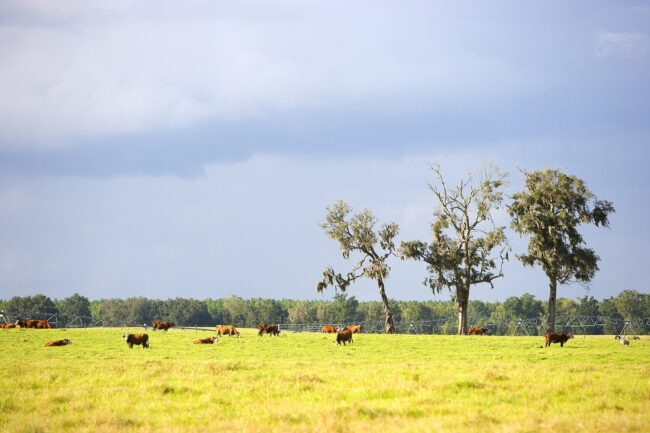
Photo: Scott Bauer, USDA Natural Resources Conservation Service / Public domain
Quick Answer: Polk, Osceola, Highlands, Hardee and DeSoto counties held about 419,000 head of cattle on January 1, 2024, roughly 27% of Florida’s herd, according to USDA. In November 2026, Heartland calf prices are running above a year ago while cull cow prices are lower, screwworm rules have tightened animal imports, and $7,650-an-acre pasture is driving state conservation easements.
Citrus gets the headlines in the Heartland, but cattle hold the land: nearly half of Florida’s agricultural acreage is in cattle production. Here is where Central Florida’s cattle economy stands in late 2026, based on USDA counts, auction reports and state land records.
How Many Cattle Are in Central Florida’s Heartland Counties?
The most recent county-level estimates from the USDA National Agricultural Statistics Service (NASS), published in May 2024 with the Florida Department of Agriculture and Consumer Services, count cattle as of January 1, 2024. Polk ranks second in the state with 110,000 head, behind Okeechobee County, followed by Osceola, Highlands, Hardee and DeSoto.
Together those five counties held about 419,000 head, roughly 27% of Florida’s 1.56 million cattle and calves. Adding the other eight counties this site covers (Alachua, Marion, Sumter, Lake, Brevard, Orange, Volusia and Seminole) brings the total to about 614,500 head, or 39% of the state herd.
| County | All cattle, Jan. 1, 2023 | All cattle, Jan. 1, 2024 | Beef cows, 2024 |
|---|---|---|---|
| Polk | 110,000 | 110,000 | 57,000 |
| Osceola | 100,000 | 99,000 | 63,000 |
| Highlands | 76,000 | 74,000 | Withheld |
| Hardee | 74,000 | 71,000 | 40,000 |
| DeSoto | 67,000 | 65,000 | 38,500 |
| Alachua | 46,000 | 44,500 | 27,500 |
| Marion | 42,000 | 40,000 | 25,000 |
| Sumter | 34,000 | 32,500 | Withheld |
| Lake | 26,000 | 25,500 | 15,900 |
| Brevard | 24,000 | 23,000 | 15,500 |
| Orange | 16,800 | 16,200 | 12,200 |
| Volusia | 10,200 | 9,900 | 6,400 |
| Seminole | 4,100 | 3,900 | 2,200 |
| Florida total | 1,610,000 | 1,560,000 | 862,000 |
Source: USDA NASS, Florida County Estimates, Cattle 2023-2024 (May 2024). “Withheld” means NASS did not publish the figure to avoid disclosing individual operations.
Every county lost head or held flat from 2023 to 2024. NASS has not published newer county estimates; statewide, Florida had 1.56 million head on January 1, 2025, and 1.58 million on January 1, 2026, up 1.3%.
Is Florida’s herd growing again?
Slowly. The USDA Cattle report released January 30, 2026, put Florida’s beef cows at 872,000, up 7,000 head (0.8%) from 2025, while beef replacement heifers stayed at 115,000. Florida’s 2025 calf crop was 780,000 head, up from 770,000. Hannah Baker, the UF/IFAS extension agent for beef and forage economics at the Range Cattle Research and Education Center in Ona, in Hardee County, wrote in February 2026 that the state’s beef herd is still 47,000 head below its 2021 peak, and that Florida “appears to be stabilizing” and thinking more seriously about expansion.
Nationally, U.S. cattle totaled 86.2 million head on January 1, 2026, the smallest count since 1951, and the beef cow herd of 27.6 million was the smallest since 1961, according to the UF/IFAS annual market update. That scarcity is why Heartland calves bring strong prices.
How Much Money Do Cattle Bring Into Heartland Counties?
The 2022 Census of Agriculture, the most recent full census, gives county sales figures. Osceola County ranked first in Florida for cattle and calf sales at $58.8 million. Polk ranked third at $30.5 million, Hardee fourth at $30.2 million, Highlands fifth at $26.0 million and DeSoto sixth at $25.8 million. Those five counties sold about $171 million in cattle and calves in 2022, before the 2024-2026 price surge.
| County (2022 Census) | Farms | Land in farms (acres) | Avg. farm size | Cattle and calf sales | State rank |
|---|---|---|---|---|---|
| Osceola | 353 | 584,279 | 1,655 | $58.8M | 1 |
| Polk | 2,197 | 559,699 | 255 | $30.5M | 3 |
| Hardee | 920 | 290,694 | 316 | $30.2M | 4 |
| Highlands | 836 | 389,622 | 466 | $26.0M | 5 |
| DeSoto | 689 | 293,944 | 427 | $25.8M | 6 |
Source: USDA NASS, 2022 Census of Agriculture county profiles. Sizes are average acres per farm.
In Osceola, livestock made up 61% of farm sales; in the other four counties crops made up 73% to 83%, though ranches hold much of the land. From 2017 to 2022, Hardee lost 23% of its land in farms and DeSoto lost 12%, while Polk added 15%.
Statewide, NASS counts $775 million in 2023 cattle and calf cash receipts, out of $9.47 billion in total farm receipts, before most of the price rally.
What Are Calves Selling for at Heartland Auctions in November 2026?
USDA Market News, working with the Florida Department of Agriculture, reports weighted average prices from Florida auctions. At the Arcadia sale on November 11, 2026, in DeSoto County, 1,008 head sold, 79% of them feeder cattle. Medium and Large No. 1 steers averaging 515 pounds brought an average of $412.26 per hundredweight, or about $2,123 a head. Lighter steers averaging 324 pounds averaged $589.69 per hundredweight.
At the Cattlemen’s Livestock Auction in Lakeland, in Polk County, the November 10, 2026, sale moved 436 head, compared with 471 a year earlier. No. 1 steers weighing 210 to 225 pounds averaged $560.34 per hundredweight, and steers weighing 600 to 630 pounds averaged $324.92.
How do 2026 prices compare with a year ago?
The year-ago comparison is not exact. USDA’s November 11, 2025, Florida summary combined the Lakeland, Madison and Okeechobee markets, while the November 2026 report covers Arcadia only. Even so, the direction is clear.
| Class (Medium and Large No. 1) | Nov. 11, 2025 (FL summary) | Nov. 11, 2026 (Arcadia) | Change |
|---|---|---|---|
| Steers, about 515 lb ($/cwt) | $364.16 | $412.26 | +13% |
| Steers, about 325-330 lb ($/cwt) | $528.09 | $589.69 | +12% |
| Heifers, about 320-326 lb ($/cwt) | $421.95 | $485.47 | +15% |
| Boner slaughter cows, average dressing ($/cwt) | $146.72 | $117.45 | -20% |
Source: USDA AMS Florida Daily Livestock Auction Summary reports. Percentages calculated from the published weighted averages.
Feeder calves are bringing more than a year ago. Cull cows are not: Arcadia’s boner cow average of $117.45 and Lakeland’s $123.41 are well below November 2025’s $146.72. Selling calves pays more, while culling older cows pays less.
Earlier in the cycle, the jump was much larger. UF/IFAS reported that on January 30, 2026, Florida 500 to 545 pound steers were 54% above January 2025 and 78% above January 2024. The same update estimated cow-calf returns at $882 per cow, against Florida and Southeast cash costs plus land rent of roughly $600 to $900 per cow.
How Has New World Screwworm Affected Florida Cattle?
New World screwworm is a fly whose larvae infest open wounds. Mexican cattle imports have been largely halted since late 2024 to keep it out. UF/IFAS noted that about 1 million head a year, roughly 5% of U.S. feedlot placements, normally come from Mexico; only 228,000 crossed in 2025. Fewer feeder cattle nationally made Florida calves more valuable.
The pest itself arrived in the U.S. in 2026. After USDA confirmed screwworm in Texas, Agriculture Commissioner Wilton Simpson issued Emergency Rule 5CER26-6 on June 5, 2026, and strengthened it with 5CER26-7 on June 10. Under the rule, warm-blooded animals entering Florida from high-risk areas need an official certificate of veterinary inspection, valid for five days, stating they are free of screwworm larvae. Animals from counties with confirmed detections, and from the counties around them, need a state movement certificate with prior permission at least two days before arrival, plus proof of treatment with an effective screwworm product. As of the June rule, Florida had no detections.
By October 20, 2026, USDA had confirmed 56 U.S. cases since June, five of them active, according to Reuters, and USDA confirmed a detection in Arizona on October 28. USDA is also reopening the border in phases: Douglas, Arizona, in August, Santa Teresa, New Mexico, in September, Columbus, New Mexico, on October 26, and Nogales, Arizona, planned for November 30, 2026.
Why Are Heartland Ranchers Selling Conservation Easements?
Land prices help explain it. USDA’s Land Values 2026 Summary, released July 31, 2026, put Florida pasture at $7,650 an acre, up 3.4% from 2025. That is nearly four times the U.S. pasture average of $2,000. At those prices, development offers are hard to ignore.
The state’s Rural and Family Lands Protection Program pays landowners to permanently give up development rights while they keep ranching. Recent approvals in this site’s coverage counties include:
- February 2026: Square One Ranch in Highlands County, about 1,500 acres, for $6.1 million, including $2 million from the U.S. Air Force’s REPI program; and Buckhorn Ranch in Hardee County, 1,326 acres, for $5.3 million.
- August 2026: The Ludwig property (639 acres) and two C&G Cattle tracts (672 and 779 acres) in Hardee County, plus Dale Wright Farms (589 acres) in Marion County. The four easements totaled more than $16 million.
- October 30, 2026: D.T. Davis Ranch in Hardee County, a cattle operation of about 522 acres, for $2.95 million.
Those prices work out to roughly $4,000 an acre for Square One and Buckhorn and about $5,650 an acre for D.T. Davis. The October release said the program has protected more than 257,000 acres since its creation, including more than 191,000 under Simpson, with more than $1.1 billion in state funding since 2022 and $425 million in the 2026-27 budget.
| Key fact | Figure |
|---|---|
| Florida cattle and calves, Jan. 1, 2026 | 1.58 million head (+1.3%) |
| Florida beef cows, Jan. 1, 2026 | 872,000 (ninth in U.S.) |
| Five Heartland counties’ share of state herd (2024) | About 27% |
| Florida cattle cash receipts (2023) | $775 million |
| Florida pasture value (2026) | $7,650 per acre (+3.4%) |
| Rural and Family Lands acres protected | More than 257,000 |
Brian’s Take
I look at the Heartland cattle numbers and see a business sitting on two very different assets. The cattle are earning better money than they have in years, but the land under them is worth far more. A 515-pound steer at Arcadia brought about $2,123 last week. An acre of average Florida pasture is valued at $7,650. Over time, that gap decides what happens to a ranch more than any single calf check does.
That is why I pay attention to the easement program. Hardee County alone had five farm and ranch easements approved between February and October 2026, and the state budgeted $425 million for the program this year. For a ranch family, selling development rights turns part of the land’s value into cash without selling the land. For the rest of Central Florida’s business community, it keeps open land and a working agricultural economy south of the I-4 growth corridor.
I would also watch the cull cow price closely. It is down about 20% from a year ago while calves are still up, and the Mexican border is reopening one port at a time. Ranchers who planned around 2025 conditions should run their numbers again with 2026 prices.
Frequently Asked Questions
Which Central Florida county has the most cattle?
Polk County, with 110,000 head on January 1, 2024, according to USDA NASS. It ranks second statewide behind Okeechobee County. Osceola is third with 99,000 head and ranks first in the state for cattle and calf sales in the 2022 Census of Agriculture.
Are Florida cattle prices at record highs in 2026?
Feeder calf prices are still very high. Arcadia No. 1 steers near 515 pounds averaged $412.26 per hundredweight on November 11, 2026, about 13% above a comparable Florida average a year earlier. Cull cow prices are down roughly 20% from a year ago.
Has New World screwworm been found in Florida?
Not as of the state’s June 2026 emergency rules, which said Florida had no detections. U.S. cases have been confirmed in Texas, New Mexico and Arizona, and Florida requires inspection certificates and, from affected counties, treatment proof and prior permission before animals enter.
What is the Rural and Family Lands Protection Program?
It is a Florida Department of Agriculture and Consumer Services program that buys permanent conservation easements on working farms and ranches. Landowners keep ownership and keep farming, but give up development rights. It has protected more than 257,000 acres since 2001.
Sources and Further Reading
- Florida County Estimates, Cattle 2023-2024 — USDA National Agricultural Statistics Service and Florida Department of Agriculture and Consumer Services
- Cattle (January 30, 2026 release) — USDA National Agricultural Statistics Service
- 2022 Census of Agriculture County Profiles: Polk, Osceola, Highlands, Hardee and DeSoto — USDA National Agricultural Statistics Service
- Florida Agricultural Facts 2024 — USDA National Agricultural Statistics Service
- Land Values 2026 Summary — USDA National Agricultural Statistics Service
- Florida Daily Livestock Auction Summary, November 12, 2025 and November 12, 2026 — USDA Agricultural Marketing Service Market News
- Livestock Weighted Average Report, Lakeland, November 10, 2026 — USDA Agricultural Marketing Service Market News
- Annual Cattle Market Update: January 2026 — UF/IFAS Range Cattle Research and Education Center
- Stabilizing and Growing the Herd: What We Know and Don’t Know — UF/IFAS Range Cattle Research and Education Center
- Commissioner Simpson Strengthens and Extends Emergency Protections Against New World Screwworm — Florida Department of Agriculture and Consumer Services
- USDA Plans to Resume Imports of Mexican Cattle at More Ports of Entry — Reuters
- Screwworm Current Status — USDA Animal and Plant Health Inspection Service
- Commissioner Simpson Announces Permanent Protection of Over 3,200 Acres of Agricultural Land — Florida Department of Agriculture and Consumer Services
- Ag Commissioner Simpson Announces State Approval to Protect Over 2,800 Acres of Working Agricultural Land — Central Florida Ag News
- Four Florida Farms, Ranches Protected Through State Conservation Program — The Capitolist
- From Pastures to Production: Livestock Holds Its Ground in Florida Agriculture — Central Florida Ag News
About The Author