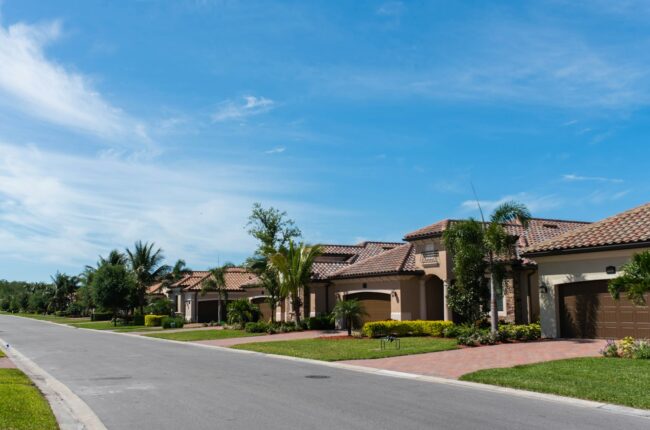
Photo: FilterGrade via Unsplash (Unsplash License)
Quick Answer: University of Florida BEBR estimates show Sumter (+25.2%) and Osceola (+24.8%) as the fastest-growing Central Florida counties since the 2020 Census, while Polk added the most people, nearly 122,000. Lake and Marion also grew more than 15%. BEBR’s medium projections add about 1.38 million more residents across the 15 counties reviewed here by 2050, most of them along the I-4 and I-75 corridors.
Central Florida’s population boom is not spread evenly. Population estimates from the University of Florida’s Bureau of Economic and Business Research (BEBR), the official source the Florida Legislature uses for revenue sharing, show a handful of counties absorbing most of the region’s growth. Others, especially in the rural Heartland, have barely moved. For employers, developers, lenders and local governments, the difference between a county growing 25% in five years and one growing 2% changes almost every planning decision.
This analysis uses BEBR’s Florida Estimates of Population 2025 (population as of April 1, 2025), the state’s adjusted 2024-to-2025 comparison, and BEBR’s Projections of Florida Population by County, 2030–2050, published February 3, 2026. BEBR posted a spreadsheet labeled “Florida Estimates of Population 2026, Table 1” on November 12, 2026. We could not open that file for this report, so the county detail below comes from the most recent complete set of estimates and projections we were able to verify.
Which Central Florida counties are growing fastest?
We looked at 15 counties that make up Central Florida and the Heartland, from Alachua and Levy in the north to DeSoto and Okeechobee in the south and Brevard and Volusia on the Atlantic coast. Orange County sits at the center of the region, but it is covered separately here as a benchmark.
Together these 15 counties had an estimated 4,863,023 permanent residents on April 1, 2025. That is up 553,286, or 12.8%, from the 4,309,737 counted in the 2020 Census. The statewide figure was 8.5% over the same period: BEBR estimates Florida’s population at 23,379,261, up 1,841,074 since 2020. In other words, this part of the state is growing about half again as fast as Florida overall.
How do the counties rank since the 2020 Census?
| County | 2020 Census | April 1, 2025 estimate | Gain | % change |
|---|---|---|---|---|
| Sumter | 129,752 | 162,493 | 32,741 | 25.2% |
| Osceola | 388,656 | 484,915 | 96,259 | 24.8% |
| Polk | 725,046 | 846,896 | 121,850 | 16.8% |
| Lake | 383,956 | 445,881 | 61,925 | 16.1% |
| Marion | 375,908 | 433,765 | 57,857 | 15.4% |
| Brevard | 606,612 | 667,900 | 61,288 | 10.1% |
| Volusia | 553,543 | 604,533 | 50,990 | 9.2% |
| Citrus | 153,843 | 166,500 | 12,657 | 8.2% |
| Levy | 42,915 | 46,270 | 3,355 | 7.8% |
| Alachua | 278,468 | 298,485 | 20,017 | 7.2% |
| Highlands | 101,235 | 107,976 | 6,741 | 6.7% |
| DeSoto | 33,976 | 35,947 | 1,971 | 5.8% |
| Seminole | 470,856 | 495,106 | 24,250 | 5.2% |
| Hardee | 25,327 | 26,042 | 715 | 2.8% |
| Okeechobee | 39,644 | 40,314 | 670 | 1.7% |
| Florida | 21,538,187 | 23,379,261 | 1,841,074 | 8.5% |
Source: UF BEBR, Florida Estimates of Population 2025 (Tables 1 and 3). Estimates cover permanent residents only.
Five counties stand out: Sumter, Osceola, Polk, Lake and Marion. Each grew more than 15% in five years. Together they added 370,632 residents, about two-thirds of all the growth among the 15 counties. Each of the five sits on or near one of two interstates: I-4 running through Osceola and Polk, and I-75 and Florida’s Turnpike running through Marion, Sumter and Lake.
Who added the most people in raw numbers?
Polk leads by a wide margin. It added 121,850 residents since 2020, more than Orange County’s 106,137 even though Orange has nearly twice as many people (1,536,045 in 2025). Osceola was second with 96,259. Lake (61,925), Brevard (61,288) and Marion (57,857) were close together in the next tier.
Percentage growth and raw growth tell different stories. Sumter has the highest rate in the region, but with about 162,500 residents it added roughly a quarter as many people as Polk. Brevard’s 10.1% rate looks moderate, but its large base turned that rate into more than 61,000 new residents, about the same as Lake.
Is growth speeding up or slowing down?
The state’s Office of Economic and Demographic Research (EDR) publishes adjusted estimates, built from BEBR data, that it uses for state revenue-sharing calculations. They show how the most recent year compares with the five-year trend. Statewide, the adjusted population rose 362,003, or 1.6%, between April 1, 2024 and April 1, 2025.
What did the latest one-year numbers show?
| County | Gain, 2024–2025 | % change |
|---|---|---|
| Osceola | 33,608 | 7.5% |
| Sumter | 5,774 | 3.9% |
| Marion | 14,159 | 3.4% |
| Lake | 12,528 | 2.9% |
| Polk | 20,896 | 2.5% |
| Brevard | 14,196 | 2.2% |
| Highlands | 1,869 | 1.8% |
| Volusia | 9,934 | 1.7% |
| Alachua | 2,063 | 0.7% |
| Seminole | 1,771 | 0.4% |
| Citrus | 338 | 0.2% |
Source: Florida Office of Economic and Demographic Research, Comparison of 2024 and 2025 Adjusted Population Estimates (prepared from BEBR data). Adjusted figures differ from BEBR’s total estimates and are used for revenue-sharing calculations.
Osceola’s 7.5% one-year gain was the highest of any of Florida’s 67 counties in the EDR comparison. Its 33,608 new residents trailed only Miami-Dade’s 38,826 statewide. Polk added 20,896 and Orange 24,553. Sumter grew 3.9% and Marion 3.4%. Growth near the coast and in established suburbs was much slower. Seminole grew 0.4% and Citrus 0.2%, and Okeechobee (121 people) and Hardee (154) were close to flat.
Why are mid-sized counties gaining while big metros slow?
Migration is the main driver. In its 2025 estimates report, BEBR attributes all of Florida’s growth since 2020 to net migration: about 1.94 million people. Natural change was slightly negative, with 1,096,073 births against 1,197,162 deaths. In a July 2026 University of Florida News report on migration, UF said Florida’s net migration slowed sharply in 2025 to about 201,000 people, roughly 551 a day, down from a 2022 peak of about 599,000.
That report also found that large metro counties lost domestic movers. Orange posted domestic outmigration that was offset by international arrivals. Mid-sized counties kept growing. UF reported that Polk has ranked among the nation’s top five counties for domestic migration for five straight years, adding 22,000 to 34,000 U.S. movers a year since 2021, though its pace has eased since a 2022–23 peak. Marion has steadily attracted residents for three years. IRS data cited by UF show that about 59% of domestic newcomers to Polk and Pasco during 2021–23 came from other Florida counties.
Anne Ray, manager of the Florida Housing Data Clearinghouse at UF’s Shimberg Center for Housing Studies, explained the pattern in the UF report: “As housing costs have risen, many movers appear to be looking beyond the state’s largest urban counties.”
How big will Central Florida counties be by 2030 and 2050?
BEBR publishes low, medium and high projections and says it recommends “using the medium series for most purposes.” Under the medium series, Florida reaches 24,909,000 residents in 2030 and 28,250,100 in 2050, up 20.8% from 2025.
Which counties are projected to add the most residents?
| County | 2025 est. | 2030 medium | 2050 medium | Gain 2025–2050 | % |
|---|---|---|---|---|---|
| Polk | 846,896 | 936,600 | 1,138,900 | 292,004 | 34.5% |
| Osceola | 484,915 | 562,900 | 754,900 | 269,985 | 55.7% |
| Lake | 445,881 | 499,100 | 626,000 | 180,119 | 40.4% |
| Brevard | 667,900 | 711,700 | 806,700 | 138,800 | 20.8% |
| Marion | 433,765 | 471,100 | 566,200 | 132,435 | 30.5% |
| Volusia | 604,533 | 643,200 | 721,400 | 116,867 | 19.3% |
| Sumter | 162,493 | 187,000 | 249,100 | 86,607 | 53.3% |
| Seminole | 495,106 | 517,500 | 562,700 | 67,594 | 13.7% |
| Alachua | 298,485 | 314,600 | 345,200 | 46,715 | 15.7% |
| Citrus | 166,500 | 175,700 | 194,700 | 28,200 | 16.9% |
| Highlands | 107,976 | 111,800 | 120,600 | 12,624 | 11.7% |
Source: UF BEBR, Projections of Florida Population by County, 2030–2050, with Estimates for 2025 (medium series). Projections are rounded to the nearest hundred.
Across all 15 counties, the medium series reaches 6,246,900 residents in 2050, about 1.38 million more than in 2025 and a 28.5% increase. The state as a whole is projected to grow 20.8%. Polk is projected to pass 1.1 million residents. Osceola and Sumter are each projected to grow by more than half. Lake is projected to add about 180,000 residents, more than the entire 2025 population of Citrus County.
The projections come with a wide range of outcomes. Under BEBR’s high series, Polk reaches 1,387,000 by 2050. Under the low series it reaches only 890,800. For Osceola, the range runs from 590,500 to 919,300. Planners who rely on a single number are underestimating that uncertainty.
What about the Heartland and North Central Florida?
Highlands, Hardee, DeSoto and Okeechobee together had 210,279 residents in 2025, up about 5% from 200,182 in 2020. That is well below the state rate. BEBR’s medium series has Hardee essentially flat, at 26,400 in 2050. Okeechobee is projected to reach 42,100. Highlands is the Heartland county most likely to grow, reaching 120,600. In the north, Alachua grew 7.2% since 2020, and Levy grew 7.8% to 46,270.
What does this growth mean for business, housing, workforce and infrastructure?
Where will housing demand be strongest?
BEBR estimates population with the housing unit method, which builds estimates from changes in occupied homes. So the counties with the fastest population growth are also, by construction, the counties where the most homes are being occupied. Osceola’s one-year gain of more than 33,000 residents and Polk’s nearly 21,000 represent demand for thousands of new homes a year, along with apartments and build-to-rent communities. Ray’s remark in the UF report that movers are looking beyond the largest urban counties points to Polk, Lake, Marion and Osceola as the places where that demand ends up.
What does it mean for employers and the workforce?
Fast-growing counties add workers and customers at the same time. Retail, health care, construction, logistics and personal services follow rooftops. Employers in Polk and Osceola are drawing on a labor pool that has grown by six figures since 2020. UF’s data show many of the newcomers to Polk are moving from elsewhere in Florida. In slower counties such as Seminole and Alachua, where growth was 0.4% and 0.7% last year, employers may have to compete harder for workers instead of waiting for population growth to add them.
For Sumter, the short version is data only: 32,741 more residents since 2020 and a medium-series projection of 249,100 by 2050.
What does it mean for roads, water and schools?
Growth along the corridors falls hardest on transportation and utilities. Polk, Osceola and Lake are projected to add a combined 742,108 residents by 2050 under the medium series, roughly the population of another Polk County in 2020. Local governments will be planning road widenings, water supply, wastewater capacity and school construction around those numbers. The EDR adjusted estimates also drive state revenue sharing. So population gains raise local revenue, though typically only after the demand for new services has already arrived.
Brian’s Take
I read these numbers as a map of where Central Florida’s money will flow over the next decade. Polk added nearly 122,000 people in five years, more than Orange did. Osceola grew 7.5% in a single year, a rate no other Florida county matched. That kind of growth isn’t happening on a margin. It’s a structural shift in where people live, and businesses that choose locations based on where the region was ten years ago are working from an old map.
I’d also caution against assuming the boom is uniform or permanent. UF reports statewide migration fell to about 201,000 in 2025 from roughly 599,000 at the 2022 peak. Seminole, Citrus and much of the Heartland grew less than 1% last year. BEBR’s own range for Polk in 2050 spans nearly half a million people between the low and high series. Smart operators will plan for the medium case and stress-test the low one.
The practical point is that roads, water and schools don’t build themselves as fast as rooftops go up. Businesses in Osceola, Polk, Lake and Marion should expect continued pressure on labor, land and infrastructure. Businesses in the slower counties should expect to work harder for growth that the corridor counties get almost by default.
Frequently Asked Questions
What is the fastest-growing county in Central Florida?
Since the 2020 Census, Sumter grew fastest at 25.2%, with Osceola close behind at 24.8%, according to BEBR’s April 1, 2025 estimates. In the most recent single year (2024 to 2025), Osceola led the entire state with 7.5% growth in the EDR adjusted estimates.
Which Central Florida county added the most people?
Polk County added 121,850 residents between 2020 and 2025, reaching an estimated 846,896. That is the largest numeric gain in the region, ahead of Orange County’s 106,137.
Where do BEBR population estimates come from?
BEBR, part of the University of Florida, prepares annual April 1 estimates under contract with the Florida Legislature using the housing unit method. The estimates count permanent residents only, not seasonal visitors.
How many people will Polk County have in 2050?
BEBR’s medium projection puts Polk at 1,138,900 in 2050. Its low and high series range from 890,800 to 1,387,000.
Is Florida’s population growth slowing?
Migration has slowed. UF reported net migration of about 201,000 in 2025, compared with about 599,000 in 2022. Mid-sized Central Florida counties such as Polk and Marion have continued to attract new residents.
Has BEBR released 2026 population estimates?
BEBR posted a table labeled “Florida Estimates of Population 2026” on November 12, 2026. This article relies on the complete 2025 estimates report and the February 2026 projections, which we were able to verify county by county.
Sources and Further Reading
- Florida Estimates of Population 2025 — Bureau of Economic and Business Research, University of Florida
- Projections of Florida Population by County, 2030–2050, with Estimates for 2025 — Bureau of Economic and Business Research, University of Florida
- Comparison of 2024 and 2025 Adjusted Population Estimates — Florida Office of Economic and Demographic Research
- Florida migration slowed sharply in 2025, with mid-sized counties continuing to grow — University of Florida News
- Florida Estimates of Population 2026, Table 1 — Bureau of Economic and Business Research, University of Florida
About The Author