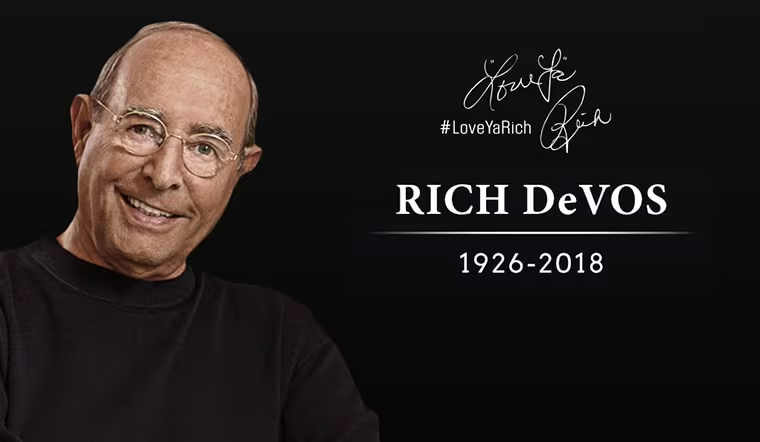
Rich DeVos: The Grand Rapids Co-Founder of Amway Who Bought the Orlando Magic and Anchored a City
When Rich DeVos and his high school friend Jay Van Andel started Amway from the basements of their homes in Ada, Michigan in 1959, neither man could have predicted that one of them would eventually become the long-tenured owner of an NBA franchise in a city more than a thousand miles away. But that is exactly what happened.
DeVos, who built Amway into the largest direct-selling company in the world while becoming one of the wealthiest Americans of his generation, purchased the Orlando Magic in September 1991 for $85 million — and over the next 27 years, until his death in 2018, he transformed both the franchise and the city of Orlando through ownership rooted in faith, civic stewardship, and a Midwesterner’s belief that businesses exist to serve communities. By the time he died at age 92, the Magic had become an institution central to Orlando’s identity, the Amway Center had reshaped downtown, and the DeVos family had committed more than $1.2 billion in lifetime philanthropy. This is the story of how a Dutch-American kid from Grand Rapids who paid Jay Van Andel 25 cents a week for a ride to school in a 1931 Model A Ford built one of the most consequential American business and sports legacies of the 20th and 21st centuries.
Early Life, Education, and Military Service
Richard Marvin DeVos Sr. was born on March 4, 1926, in Grand Rapids, Michigan, the son of Ethel Ruth (Dekker) and Simon Cornelius DeVos — Dutch-American parents who worked in the electrical business [1]. The DeVos household was deeply Christian, frugal, and disciplined. Rich grew up during the Great Depression, an experience that hardened both his work ethic and his lifelong conviction that ordinary people could build extraordinary lives through entrepreneurship [4].
DeVos was educated at Grand Rapids Christian School, where he met Jay Van Andel — the man who would become his lifelong business partner. Their friendship began as a business arrangement: DeVos paid Van Andel 25 cents a week for a ride to and from school in a 1931 Model A Ford [6]. He went on to attend Calvin College in Grand Rapids and was a member of the Sigma Phi Epsilon fraternity [1].
When World War II broke out, DeVos served in the United States Army Air Corps [1, 4]. After both men returned from the service, they began testing the entrepreneurial waters together — running a flight school and one of Michigan’s first drive-in restaurants [4]. In 1948, they sold both interests to buy a sailboat in Connecticut with intentions to sail to the Caribbean — even though neither had any sailing experience. Their old wooden schooner sank off the coast of Cuba. A passing freighter rescued them, and they continued their adventure through South America [6].
It is, frankly, one of the most American origin stories in modern business history.
“Brian’s Take”
“What separates Rich DeVos from almost every other major American billionaire of his generation is that he never stopped being a Grand Rapids guy. Most men who build $5 billion fortunes either move to Manhattan, buy estates in the Hamptons, or fly so far from their roots that they become functionally unrecognizable to the people they grew up with. DeVos did the opposite — he stayed in Grand Rapids his entire life, lived modestly compared to his peers, kept Amway headquartered in Ada, Michigan, and treated his fortune as something to be deployed back into Grand Rapids and Orlando rather than something to be enjoyed in private. The reason Grand Rapids has the buildings, hospitals, and arts venues it has today is the same reason the Orlando Magic has the legacy it has. The man cared about communities.”
Founding Amway
In 1949, DeVos and Van Andel invested $49 to become independent distributors for Nutrilite, a California manufacturer of vitamins that used a person-to-person direct-selling approach [2, 5]. The model worked. The two friends refined it, learned what worked and what didn’t, and ten years later — in 1959 — they founded Amway Corporation from the basements of their homes in Ada, Michigan, just outside of Grand Rapids [2].
The original product was a single all-purpose cleaner called L.O.C. [5]. The name “Amway” was a shorthand for “American Way” — a phrase that captured DeVos’s lifelong philosophy that business ownership combined with the U.S. free-enterprise system was the most powerful engine for human flourishing ever invented [5].
The growth was extraordinary. Amway went from one product and $500,000 in sales in its first full year (1960) to:
- Over 700 products and services
- More than $9 billion in estimated annual sales (2015)
- Over 4 million independent distributors in more than 100 countries and territories worldwide
- Approximately 80% of sales generated outside of the United States
- More than 19,000 employees in Michigan and around the world [4, 5]
Top-selling Amway brands include Nutrilite vitamins and dietary supplements (the company purchased Nutrilite outright in 1972), Artistry skincare and color cosmetics, eSpring water treatment systems, and XS energy drinks [2]. Amway is routinely ranked the number one direct selling business in the world based on global sales, according to the Direct Selling News Global 100 [2].
DeVos served as president of Amway from its 1959 founding until his retirement in 1993 [2]. The company was restructured as Alticor Inc. in 2000 [1]. DeVos’s son Dick succeeded him as president in 1993, and his son Doug DeVos has served as Amway president since 2002 [3]. The DeVos family still co-owns Amway with the family of co-founder Jay Van Andel [3].
In 2018, when DeVos passed away, his combined family fortune was worth approximately $5.5 billion, ranking him among the wealthiest Americans of his era [3]. At the time of his death, his personal net worth was estimated at $5.4 billion by Forbes [9].
The Move into Sports Ownership
DeVos was a passionate sports fan throughout his life — particularly of basketball and hockey [10]. In September 1991, he purchased the Orlando Magic for $85 million, buying the franchise from a local ownership group before the team’s third NBA season [7, 11].
The Magic were a young, struggling expansion franchise without firm financial backing when DeVos stepped in. He gave them stability. He gave them legitimacy. And, critically, he gave them an owner who — despite being Michigan-based — committed publicly from the beginning to be a steward for the team and a pillar in the central Florida community [9].
He didn’t stop at the Magic. DeVos’s ownership in professional sports also included:
- Orlando Solar Bears (International Hockey League) — Through 2001, when the IHL folded [1]
- Grand Rapids Griffins (originally IHL, now AHL) — Currently under the ownership of his son Dan DeVos [1]
- Kansas City Blades (IHL) — Closed when the league folded [1]
- Orlando Miracle (WNBA) — Owned from 1998 to 2002 as the Magic’s sister team; the franchise relocated after 2002 to Uncasville, Connecticut, where they became the Connecticut Sun, becoming the first professional sports team owned by a Native American tribe [10]
The corporate vehicle DeVos created to own the Magic was RDV Sports, Inc. — founded in 1991 and named for “Rich DeVos.” It remains the team’s owner of record to this day [10].
Anchoring Orlando
In the early 2000s, DeVos faced one of the most consequential decisions of his ownership tenure. The Magic’s home venue, the aging TD Waterhouse Centre (originally the Orlando Arena), was no longer competitive with newer NBA arenas. A nasty political fight erupted over public funding for a replacement. With DeVos having recently undergone a heart transplant — and uncertain whether he could continue managing the team — he put the Magic up for sale [11].
Business was bad. Attendance was creeping down. The team was middling through the Eastern Conference with only Tracy McGrady as a star attraction. The Magic were close to relocating, and the Orlando NBA dream looked over [11].
Then DeVos changed his mind.
He took the team off the market, told the city he was committed to making Orlando work, and re-engaged. The decision proved spectacularly shrewd. The franchise drafted Dwight Howard, the city of Orlando entered a sustained growth phase, and the Magic secured the public-private partnership that produced the Amway Center — which opened in 2010 and is now known as the Kia Center [1, 9].
DeVos asked Orange County, Florida to help fund the new arena using public money — a move that was politically controversial at the time. Amway eventually paid for the naming rights to the Amway Center [1]. The arena became the catalyst for sustained downtown Orlando development and gave the city legitimate big-league sports infrastructure for the first time.
By the time DeVos died in 2018, Forbes valued the Magic at $1.225 billion — a more than 14x increase from his $85 million purchase 27 years earlier [9].
“Brian’s Take”
“The single most important decision Rich DeVos made as Magic owner wasn’t drafting Shaq or Dwight Howard or hiring any particular GM — it was the moment in the early 2000s when he had every reason in the world to sell the team and walk away. He’d just had a heart transplant. He was 75-plus years old. The arena situation was a political mess. The team was middling. The path of least resistance was to take the bag and let someone else move the franchise. He didn’t. He recommitted to Orlando, fought through the arena politics, secured public-private financing, and gave the city Dwight Howard, the Amway Center, and another 17 years of NBA stability. Most owners would have cashed out. DeVos doubled down. That’s the difference between an owner and a steward.”
The 1997 Heart Transplant: A Story of Faith and Persistence
In 1997, at age 71, DeVos faced what doctors expected to be a terminal diagnosis. He needed a heart transplant. Two prior heart-bypass operations — one in 1983, another in 1992 — had not solved the underlying problem. He was turned down for a transplant in the United States because of his age and diabetes [1].
DeVos refused to accept the verdict. He pursued treatment in the United Kingdom, where he successfully underwent the transplant operation that would extend his life by 21 more years [1, 10].
The experience transformed him. He became a national advocate for organ donation and in 2002 became chairman of the national speakers bureau of the United Network for Organ Sharing, promoting the need for increased organ donations [2]. The transplant also inspired one of his most important books, “Hope From My Heart: Ten Lessons for Life,” in which he distilled his post-transplant reflections on persistence, confidence, optimism, respect, and faith [2].
He lived 21 more years after the transplant — years during which he wrote books, took the Magic off the market and recommitted to Orlando, oversaw Amway’s expansion into more than 100 countries, and continued the philanthropic work that defined his life.
Author and Speaker
DeVos was the author of five books that combined business philosophy with personal reflection on faith, family, and free enterprise [2]:
- Believe! (1975, co-authored with Charles Paul Conn) — His foundational book on success philosophy
- Compassionate Capitalism (1993) — A treatise on how the wise use of financial resources can help others help themselves
- Hope From My Heart: Ten Lessons for Life — Inspired by his 1997 heart transplant
- Ten Powerful Phrases for Positive People
- Simply Rich: Life and Lessons from the Cofounder of Amway (2014) — His memoir reflecting on work, faith, family, and core values from his humble Christian upbringing through his rise as Amway co-founder [2]
He was also one of the most sought-after motivational and inspirational speakers in American business — a role he played for decades, drawing audiences across the country and the world.
Philanthropy: $1.2 Billion in Lifetime Giving
The DeVos family’s philanthropy is among the most significant in American history. As of October 2015, the DeVos family had donated a lifetime total of $1.2 billion to philanthropic causes [8].
In 1970, Rich and Helen DeVos co-founded the Richard and Helen DeVos Foundation in Grand Rapids, Michigan — a grant-making foundation that has supported education, health care, the arts, conservative think tanks, and Christian causes for more than five decades [1].
Major DeVos philanthropic projects include:
Grand Rapids and Michigan
- DeVos Performance Hall — Major DeVos contributions in 1977–1978 funded a renovation of the symphony’s performance space, which was renamed in their honor; followed by a $5 million donation to the symphony foundation in 2002 [7]
- Helen DeVos Children’s Hospital — Major medical institution
- Amway Grand Plaza Hotel — Restoration of the historic Pantlind Hotel (purchased by Amway), now a 682-room property with an added 29-story tower [2]
- JW Marriott Grand Rapids — On the banks of the Grand River, spearheaded by DeVos and Van Andel [2]
- DeVos Place Convention Center and Concert Hall [3]
- DeVos Communications Center at Calvin College [3]
- DeVos Campus of Grand Valley State University [3]
- Richard M. and Helen DeVos Center for Entrepreneurship & Innovation at Grand Valley State University [1]
- Richard and Helen DeVos Fieldhouse at Hope College [1]
- Richard and Helen DeVos Center for Arts and Worship at Grand Rapids Christian Schools [1]
Florida and Orlando
- Orlando Magic Youth Foundation — Established to benefit youth programs across central Florida [11]
- Sport Business Management Program at the University of Central Florida — Funded in part by the Richard and Helen DeVos Foundation; later named the DeVos Sport Business Management Program [1, 2]
- Amway Center — Anchor of downtown Orlando redevelopment [9]
National
- Mount Vernon — Major historical preservation contributions [1]
- The Heritage Foundation and American Enterprise Institute — Major contributions to conservative think tanks [1]
- National Constitution Center in Philadelphia — Where DeVos served as a board trustee [1]
- Hundreds of Christian churches and ministries — With a special emphasis on Christian education [2]
DeVos was a winner of the William E. Simon Prize for Philanthropic Leadership with his wife Helen [12]. His honors and awards spanned decades and included the Horatio Alger Award (1996), the Lifetime Achievement Award from the Direct Selling Association (2012), the Norman Vincent Peale Award for Positive Thinking (2007), the Napoleon Hill Gold Medal Award for Free Enterprise Achievement (1989), and induction into the National Business Hall of Fame by Junior Achievement (1989) [2].
Politics and Controversy
DeVos was one of the most prominent Republican Party donors of his generation and a major funder of conservative causes [1]. He served as finance chairman for the Republican National Committee and was, for a period, president of the Council for National Policy [1].
In 1987, President Ronald Reagan appointed DeVos to the President’s Commission on the HIV Epidemic, where he was criticized for characterizing people with AIDS as wanting “special treatment” [1]. He was a dedicated opponent of same-sex marriage [1], a position that drew significant criticism throughout his later years.
His son Dick DeVos ran for governor of Michigan as a Republican in 2006 and is married to Betsy DeVos, who served as U.S. Secretary of Education under President Donald Trump from 2017 to 2021 [1, 3].
DeVos was also a long-time close friend of Gerald and Betty Ford, served as an honorary pallbearer at Gerald Ford’s state funeral, and was an honorary trustee of the Gerald R. Ford Presidential Foundation [1].
The political dimension of DeVos’s legacy remains genuinely contested. His impact on Republican politics, conservative think tanks, and the broader American political ecosystem was substantial — and the controversy his political stances generated, particularly on LGBTQ rights, is part of the public record alongside his business and philanthropic achievements.
“Brian’s Take”
“You can’t write a complete profile of Rich DeVos without holding two things at once. On the business and civic side, the man’s record is genuinely extraordinary — co-founder of the largest direct-selling company in the world, $1.2 billion in family philanthropy, the institution-builder behind Grand Rapids and a meaningful piece of Orlando’s identity. On the political side, his positions — particularly on LGBTQ rights and HIV/AIDS — drew sustained and legitimate criticism throughout his life and continue to shape how some communities remember him. A serious profile has to acknowledge both. He was simultaneously one of the most generous philanthropists in American history and a divisive political figure whose family continues to influence American conservative politics through Betsy DeVos and others. Both things are real. Both things are part of the legacy.”
Family and Succession
Rich and Helen DeVos had four children, each of whom has taken on significant family business and civic roles:
- Dick DeVos (Richard Jr.) — Former president of Amway (1993–2002); 2006 Republican gubernatorial candidate in Michigan; husband of former Education Secretary Betsy DeVos [1]
- Dan DeVos — Owner of the Grand Rapids Griffins hockey team; CEO of DP Fox; chairman of the Orlando Magic since 2011; chairman of the Orlando Magic Youth Foundation [1, 10]
- Cheri DeVos (Suzanne) — Former Amway vice president of corporate affairs; chairman of the Orlando Magic Youth Foundation; executive vice chair of RDV Sports and the governing board of the Orlando Magic; director of Alticor Inc. [4]
- Doug DeVos — President of Amway since 2002; Co-Chair of the Amway Board of Directors [3, 5]
Dan DeVos assumed the role of Orlando Magic chairman in 2011, ensuring that the franchise would remain in DeVos family hands well beyond his father’s lifetime [10]. The Magic continue to be owned by RDV Sports, Inc. under DeVos family control to this day [10].
Helen DeVos, Rich’s wife of 65 years, passed away in 2017 — one year before Rich. Their partnership underpinned essentially every major chapter of his career, his philanthropy, and his family’s institutional impact.
Death and Legacy
Rich DeVos died peacefully at his home in Michigan on September 6, 2018, at age 92, surrounded by family. The cause of death was listed as a complication from an infection [9].
In a statement following his death, Magic CEO Alex Martins said: “DeVos’ boundless generosity, inspirational leadership and infectious enthusiasm will always be remembered. Simply, he was the team’s No. 1 cheerleader and the best owner that a Magic fan could ever want for their team. When the DeVos family purchased the Magic, his vision was that the team and organization would serve as a platform to improve the central Florida community” [9].
By any reasonable measurement, that vision was realized.
DeVos’s legacy across two cities and one global business is genuinely difficult to overstate:
- Co-founder of Amway — The largest direct-selling company in the world, with more than $9 billion in estimated annual sales, 4+ million independent distributors, and operations in 100+ countries
- Owner of the Orlando Magic for 27 years — From 1991 to 2018, growing the franchise’s value from $85 million to over $1.225 billion (Forbes 2018), with 14x return on investment
- Anchor of Grand Rapids — DeVos Performance Hall, Helen DeVos Children’s Hospital, DeVos Place, the DeVos Campus of Grand Valley State, the Amway Grand Plaza Hotel, the JW Marriott on the Grand River
- Anchor of Orlando — The Amway Center (now Kia Center), the Orlando Magic Youth Foundation, the DeVos Sport Business Management Program at UCF
- $1.2+ billion in lifetime DeVos family philanthropy — Across education, healthcare, the arts, religious institutions, and civic infrastructure
- Author of five books — Including the bestselling Compassionate Capitalism and Simply Rich
- Heart transplant survivor and organ donation advocate — Living 21 years beyond the surgery he was nearly denied
- Grandfather of a political and business dynasty — That continues to shape American conservative politics, education policy, and direct selling
Rich DeVos was, in the most literal sense, the kind of American businessman who built things that outlast him. The Magic still play in the arena he made possible. Amway still operates from the basements he and Jay Van Andel started in. Grand Rapids still has the buildings, hospitals, and arts institutions his family funded. The DeVos Sport Business Management Program at UCF is still training the next generation of sports executives.
He never stopped being a Grand Rapids guy. He never stopped believing the American Way was about ordinary people building extraordinary lives. And every time the Orlando Magic take the court at the Kia Center — the building that exists because he changed his mind in the early 2000s and decided not to sell the team — they are walking onto a floor he made possible.
That’s not a basketball career. That’s an American legacy.
Sources
- Wikipedia — Richard DeVos — Comprehensive biographical reference covering DeVos’s life, Amway co-founding, Orlando Magic ownership, philanthropy, political activities, family, and death.
https://en.wikipedia.org/wiki/Richard_DeVos - RichDeVos.com — Biography — Official biographical resource covering DeVos’s career, books, philanthropy, awards, and family.
https://richdevos.com/resources/biography - Amway Global — Our Story: Founders — Official Amway corporate history covering DeVos, Van Andel, and the founding of Amway.
https://www.amwayglobal.com/our-story/founders/ - Northwood University — “The Fruit Didn’t Fall Far From the Tree: The DeVos Family Story” — University publication on the DeVos family’s business and educational legacy.
https://www.northwood.edu/news/the-fruit-didnt-fall-far-from-the-tree-the-devos-family-story/ - CNN Business — “Amway co-founder Richard DeVos dies at 92” (September 6, 2018) — Coverage of DeVos’s death and Amway’s founding history.
https://money.cnn.com/2018/09/06/news/amway-richard-devos/index.html - Horatio Alger Association — Richard M. DeVos — Membership profile covering his early life, the school-ride friendship with Van Andel, and the Amway founding story.
https://horatioalger.org/members/detail/richard-m-devos/ - Ballotpedia — Richard DeVos Sr. — Encyclopedic political reference covering DeVos’s net worth, philanthropy, and influence.
https://ballotpedia.org/Richard_DeVos_Sr. - MLive Media Group — “$1.2B in donations puts DeVos family on Forbes top philanthropy list” (October 1, 2015) — Coverage of the DeVos family’s $1.2 billion in lifetime philanthropic giving. (Cited via Ballotpedia.)
- ESPN — “Amway founder, philanthropist Richard DeVos dies at age 92” (September 6, 2018) — Coverage of DeVos’s death, including the Forbes valuation of the Orlando Magic at $1.225 billion and his personal net worth of $5.4 billion.
https://www.espn.com/nba/story/_/id/24595585/orlando-magic-owner-richard-devos-dies-age-92 - MoneyInc — “10 Things You Didn’t Know About the Orlando Magic Owner Richard DeVos” — Background on RDV Sports, the Orlando Solar Bears, the Orlando Miracle WNBA franchise, and DeVos family ownership succession.
https://moneyinc.com/orlando-magic-owner-richard-devos/ - Orlando Magic Daily — “Orlando Magic owner Rich DeVos dies at 92” (September 6, 2018) — Coverage of DeVos’s near-sale of the Magic in the early 2000s, the heart transplant context, and his commitment to Orlando.
https://orlandomagicdaily.com/2018/09/06/orlando-magic-owner-rich-devos-dies-92/ - Fox Business — “Richard DeVos, Amway co-founder and Orlando Magic owner, dead at 92” (September 6, 2018) — Coverage of DeVos’s life, military service, and post-WWII business ventures with Van Andel.
https://www.foxbusiness.com/business-leaders/richard-devos-amway-co-founder-and-orlando-magic-owner-dead-at-92 - Mabumbe — “Richard DeVos: Age, Net Worth, Family, and Career Highlights” — Biographical reference covering DeVos’s net worth, sports ownership, books, and family.
https://mabumbe.com/people/richard-devos-age-net-worth-family-and-career-highlights/
This profile was researched and compiled using publicly available reporting, official Amway and Orlando Magic communications, university source material, philanthropic foundation records, and obituary coverage from major news outlets. Where dollar figures or dates differ across sources, the most recent or most authoritative source has been cited. All financial figures cited are subject to ongoing market change. Rich DeVos’s political activities and the controversies attached to certain of his political positions are part of the public record and have been reported by multiple sources cited above.
About The Author