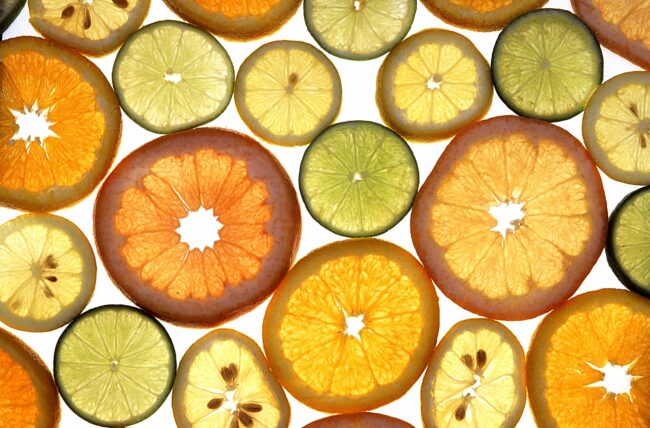
Citrus fruits including oranges, grapefruit, lemons and limes. Source: Scott Bauer, U.S. Department of Agriculture, via Wikimedia Commons. License: Public domain.
Quick Answer: USDA’s first forecast for the 2026-27 season, released October 9, 2026, puts Florida’s orange crop at 10.0 million boxes. That is 23% below last season’s final 12.95 million boxes. The decline is blamed mainly on the winter freezes of 2025-26, and it lands on a Central Florida citrus belt where Polk, Highlands, Hardee and DeSoto counties grew close to two-thirds of the state’s fruit last season and lost more than 28,000 acres of groves in a single year.
The U.S. Department of Agriculture’s National Agricultural Statistics Service (NASS) has issued its first look at Florida’s 2026-27 citrus crop, and the numbers show a smaller harvest than the one just finished. The October 9 forecast calls for 10.0 million 90-pound boxes of oranges, down 23% from the 2025-26 final of 12.95 million boxes. Grapefruit is forecast at 1.30 million boxes, down 4%. Tangerines and tangelos are forecast at 450,000 boxes, down 10,000 boxes from last season.
The forecast follows a season of modest recovery. In its August 2026 Citrus Summary, NASS reported that 2025-26 all-citrus production reached about 15.7 million boxes, up 7% from the year before. That gain now looks likely to be reversed. Industry leaders say the main reason is damage from the two winter storms that crossed the state between late December 2025 and early February 2026.
What did USDA forecast for Florida’s 2026-27 citrus crop?
The October forecast covers all major Florida varieties. Early, midseason and Navel oranges, grouped by NASS as non-Valencia, are forecast at 3.00 million boxes. That is 37% below last season’s 4.77 million. Valencia oranges, the late-season juice variety, are forecast at 7.00 million boxes, down 14% from 8.18 million. Red grapefruit is forecast at 1.20 million boxes and white grapefruit at 100,000 boxes. Lemons, a small but growing category, are forecast at 950,000 boxes, up 6%.
| Variety | 2024-25 final (boxes) | 2025-26 final (boxes) | 2026-27 Oct. forecast (boxes) | Change vs. 2025-26 |
|---|---|---|---|---|
| Non-Valencia oranges | 4,600,000 | 4,770,000 | 3,000,000 | -37% |
| Valencia oranges | 7,680,000 | 8,180,000 | 7,000,000 | -14% |
| All oranges | 12,280,000 | 12,950,000 | 10,000,000 | -23% |
| All grapefruit | 1,300,000 | 1,350,000 | 1,300,000 | -4% |
| Tangerines and tangelos | 400,000 | 460,000 | 450,000 | -2% |
| Lemons | 670,000 | 900,000 | 950,000 | +6% |
| All citrus | 14,650,000 | 15,660,000 | 12,700,000* | -19%* |
Source: USDA NASS Citrus Summary (August 2026) and USDA’s October 9, 2026 forecast as reported by the Florida Department of Citrus and trade press. *All-citrus forecast is the sum of the variety forecasts, calculated for this article.
Nationally, the picture is less severe. Spectrum News 13 reported that U.S. orange production is projected to fall 3% to 61.7 million boxes, with Florida’s decline outweighing gains in California and Texas.
How reliable is a first forecast?
USDA’s Florida forecasts are built from an objective count model with four inputs: the number of bearing-age trees from the latest Commercial Citrus Inventory, fruit per tree from a limb-count survey, fruit size, and the share of fruit expected to drop before harvest. Early numbers can change a great deal. Last season’s first Florida forecast, issued January 12, 2026, called for 12.0 million boxes of oranges. The final count came in at 12.95 million, almost 8% higher. Shannon Shepp, executive director of the Florida Department of Citrus, told The Packer that the state ended up producing more oranges and grapefruit than the early USDA forecast had predicted. Spectrum News 13 reported that the next forecast is due in mid-January, with updates in April and July.
How much did the winter freezes cost Florida citrus?
Two winter storms caused the damage. The Florida Department of Agriculture and Consumer Services (FDACS) identified them as Winter Storm Ezra, from December 30, 2025 to January 1, 2026, and Winter Storm Gianna, from January 26 to February 4, 2026. The FDACS freeze report estimated total agricultural losses at about $3.17 billion, with 66 of Florida’s 67 counties seeing freezing temperatures for multiple hours.
Citrus accounted for an estimated $674.66 million of the total. That includes $85.2 million in lost fruit, $327.39 million in tree losses, $41.48 million in damage to individual tree protective infrastructure, and $220.56 million in future production losses. Producers estimated 15% tree loss across the affected areas. The report said about 80% of Florida’s citrus acres were significantly affected and projected a multi-year average productivity loss of 27% per year.
Why are early and midseason oranges hit hardest?
The October forecast does not explain the difference between varieties. Growers and extension agents, however, have described damage that cuts into the next crop. Matt Smith, a commercial crop production extension agent with UF/IFAS Extension, told Spectrum News 13 that the freeze killed some trees and stripped canopy, leaving trees with less energy to develop fruit. The forecast drop is steepest for non-Valencia oranges, at 37%, compared with 14% for Valencias.
In Lake County, the Clermont agritourism grove The Showcase of Citrus expects a crop running a few months late. Manager Tara Boshell told Spectrum News 13, “We will have a small crop, not a great crop.” She said the business is shifting toward tours and seasonal events to make up for lost fruit sales.
Which Central Florida counties grow the most citrus?
Central Florida’s Ridge and Heartland remain the core of the industry. According to NASS’s August 2026 Citrus Summary, Polk County led the state in 2025-26 with 3.27 million boxes (excluding lemons), followed by Highlands with 3.07 million. DeSoto ranked third, St. Lucie fourth and Hardee fifth. Those five counties produced 73% of the state’s crop. Polk, Highlands, Hardee and DeSoto alone produced about 9.3 million boxes, or roughly 63% of the 14.76 million boxes NASS assigned to counties.
| County | 2025-26 production (1,000 boxes) | Citrus acres 2025 | Citrus acres 2026 | Acreage change |
|---|---|---|---|---|
| Polk | 3,265 | 48,473 | 37,529 | -22.6% |
| Highlands | 3,065 | 37,561 | 34,671 | -7.7% |
| DeSoto | 1,658 | 32,892 | 26,478 | -19.5% |
| Hardee | 1,312 | 26,840 | 18,484 | -31.1% |
| Osceola | 264 | 2,430 | 2,106 | -13.3% |
| Lake | 153 | 3,404 | 3,152 | -7.4% |
| Marion | Not listed | 190 | 139 | -26.8% |
| Florida total | 14,760 | 208,186 | 165,359 | -20.6% |
Source: USDA NASS Citrus Summary (August 2026) and Preliminary Commercial Citrus Inventory (August 2026). County production excludes lemons; Marion is not shown separately in the production table.
Each county grows a different mix of fruit. Polk’s 2025-26 crop included 1.83 million boxes of Valencias and 1.30 million boxes of non-Valencia oranges. Highlands produced 2.18 million boxes of Valencias and 842,000 boxes of non-Valencias. Hardee leaned toward early and midseason fruit, with 672,000 non-Valencia boxes and 617,000 Valencia boxes. That mix matters, because the forecast’s deepest cut is in non-Valencia oranges. NASS does not publish county-level forecasts, so how the 2026-27 decline is spread across counties will not be known until the season-end summary.
How fast is Florida losing citrus acreage?
NASS’s preliminary Commercial Citrus Inventory, released August 27, 2026, counted 165,359 acres of commercial citrus statewide. That is down 42,827 acres, or 21%, from 208,186 acres a year earlier. The tree count fell 18% to about 26.7 million. Orange acreage fell 22% to 143,650 acres, grapefruit fell 10% to 11,456 acres, and specialty fruit fell 11% to 10,253 acres. New plantings dropped 31% to 5,200 acres. All 23 counties in the report showed acreage declines.
The four Heartland and Ridge counties of Polk, Highlands, Hardee and DeSoto lost a combined 28,604 acres. That is about two-thirds of the statewide decline. Polk’s loss of 10,944 acres was the largest of any county, and Hardee’s 31% drop was among the steepest. Over a longer period, the News Service of Florida, citing NASS data, reported that statewide citrus acreage is down 65% from 480,121 acres in 2016 and 73% from 621,373 acres in 2006. It listed hurricanes, freezes, changing drinking habits, citrus greening and development pressure as causes.
What does a smaller crop mean for processors and the regional economy?
Florida citrus is still mostly a juice business. In 2025-26, about 11.59 million of the state’s 12.95 million boxes of oranges went to processing. Only 1.36 million boxes, about 10.5%, were sold as fresh fruit. A 23% smaller orange crop therefore means less fruit for the juice plants and packinghouses concentrated in Polk and the surrounding counties. Prices were already under pressure last season. NASS reported the average 2025-26 price for all oranges at $12.14 per box, down from $13.21 the season before. Grapefruit averaged $20.51 per box, down from $21.91.
Some growers are turning toward the fresh market. Shepp told The Packer that Florida has traditionally been a processed-citrus state but is moving toward more fresh sales, including grapefruit grown under protective screen houses. Tangerines and tangelos stood out on price, averaging $32.91 per box in 2025-26, compared with $20.45 the year before.
What public money is going to citrus?
Florida’s fiscal year that began July 1, 2026 includes $196 million for citrus, according to Fresh Fruit Portal. That total includes $160 million for the Citrus Research and Field Trials (CRAFT) program and $20 million for nursery and packinghouse equipment. The News Service of Florida reported another $15 million for Department of Citrus marketing. At the federal level, the proposed Florida Freeze Disaster Assistance Act (H.R. 9094), sponsored by Rep. Scott Franklin and co-led by Rep. Kat Cammack, would seek $3.5 billion in emergency USDA funding through state-administered block grants. Senators Ashley Moody and Rick Scott have introduced a Senate companion. Separately, USDA ran a continuance referendum on the federal marketing order for Florida citrus from October 19 through November 9, 2026. The order requires such a vote every six years.
Is citrus greening still the industry’s biggest threat?
Citrus greening, also called huanglongbing or HLB, was first detected in Florida groves in 2005. It is spread by the Asian citrus psyllid and has no known cure. The Packer, citing Florida Citrus, reported that it affects about 80% of the state’s orange trees. Growers have increasingly relied on oxytetracycline (OTC) trunk injections, which the EPA first approved in late 2022. A Central Florida Ag News column reported that nearly two-thirds of citrus growers surveyed had used OTC injections for three straight seasons. In that column, UF/IFAS researcher Ute Albrecht called the treatment “a temporary solution” while noting apparent cumulative benefits. On June 11, 2026, the OTC injection product ReMedium TI, made by TJ BioTech, received full EPA registration. The label allows treatment in two consecutive years starting with the 2026-27 season, followed by a one-year break.
Industry leaders say tree health is improving despite the freeze. “The devastating freezes last winter were a speed bump on our road to recovery,” Matt Joyner, CEO of Florida Citrus Mutual, said after the forecast. He added that growers are reporting healthier trees, better fruit quality and higher production per acre.
Brian’s Take
I read this forecast as a weather problem stacked on top of a structural one. The 23% drop in oranges is mostly the freeze, and last season showed that first forecasts can move a lot. The January 2026 estimate rose almost 8% by the final count. The acreage number is harder to explain away. Losing 21% of the state’s groves in a year, with two-thirds of that loss in Polk, Highlands, Hardee and DeSoto, changes the base that every future crop is grown on.
For Central Florida businesses tied to citrus, including harvesting crews, haulers, packinghouses, juice plants, equipment dealers and rural lenders, I would plan around volume, not hope. Nearly 90% of Florida oranges still go to processing, so fewer boxes means less throughput through fixed-cost plants. The bright spots are real but small: lemons, fresh tangerines priced near $33 a box, screened groves and treatments that appear to be helping trees recover.
The public money is substantial. Close to $200 million in state funding and a proposed $3.5 billion federal freeze package would matter in Heartland counties. Whether that money turns into replanted, producing acres is the number I would watch in next August’s inventory.
Frequently Asked Questions
How many boxes of oranges will Florida produce in 2026-27?
USDA’s first forecast, issued October 9, 2026, calls for 10.0 million 90-pound boxes. That includes 3.0 million non-Valencia and 7.0 million Valencia boxes and is 23% below last season.
What was Florida’s final 2025-26 citrus crop?
NASS reported 15.66 million boxes of all citrus, including 12.95 million boxes of oranges, 1.35 million of grapefruit, 460,000 of tangerines and tangelos, and 900,000 of lemons. The total was up 7% from 2024-25.
Which county produces the most citrus in Florida?
Polk County, with 3.27 million boxes in 2025-26 and 37,529 acres in 2026. Highlands ranks second in both production and acreage.
How much citrus acreage does Florida have left?
The 2026 preliminary inventory counted 165,359 commercial acres, down 21% from 2025 and down 73% from 2006.
How much did the 2025-26 freezes cost citrus growers?
FDACS estimated citrus losses at $674.66 million, out of about $3.17 billion in total agricultural losses from Winter Storms Ezra and Gianna.
When is the next USDA citrus forecast?
The next forecast is expected in mid-January 2027, followed by updates in April and July.
Sources and Further Reading
- Citrus Summary 2025-26, Preliminary (August 2026) — USDA National Agricultural Statistics Service, Florida Field Office
- Preliminary Commercial Citrus Inventory (August 2026) — USDA National Agricultural Statistics Service, Florida Field Office
- Citrus Forecast, January 12, 2026 — USDA National Agricultural Statistics Service, Florida Field Office
- 2026 Freeze Report — Florida Department of Agriculture and Consumer Services
- USDA Releases First Citrus Crop Forecast for 2026-27 Season — Blue Book Services (courtesy Florida Department of Citrus)
- Winter Freezes Cut Florida Orange Forecast by 23 Percent — Fresh Fruit Portal
- USDA Forecast Shows Lower Citrus Production in Florida — Spectrum News 13
- Squeeze Continues on Florida Citrus Land — News Service of Florida, via Florida Trend
- Resilient Florida Growers Pivot to Fresh-Market Demand Following Winter Freeze Recovery — The Packer
- FDACS Announces Disaster Updates for Florida Citrus — Citrus Industry Magazine
- Final Citrus Forecast of the Season Ends on a Positive Note — Citrus Industry Magazine
- ReMedium TI Receives Full Section 3 Label — Citrus Industry Magazine
- OTC the MVP of the 2025-2026 Season — Central Florida Ag News
- Florida Citrus Growers to Vote on Federal Marketing Order — FreshPlaza
About The Author