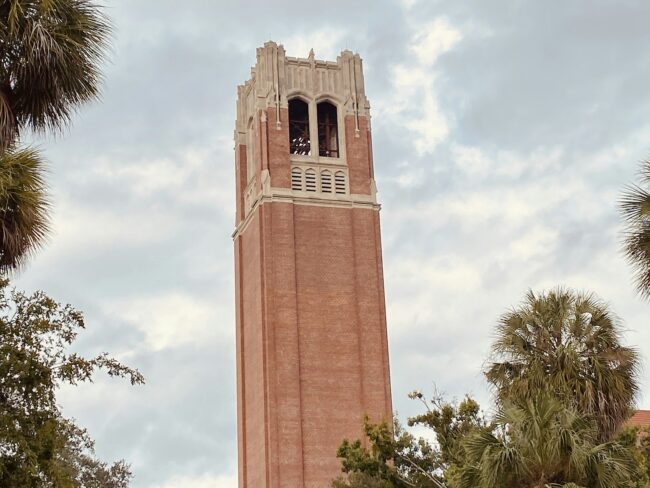
University of Florida campus, Gainesville. Photo: Antonio Lopez via Unsplash (Unsplash License).
Quick Answer: The University of Florida reported a record $1.34 billion in research spending for fiscal 2026, which ended June 30. The total rose 0.5% even as federally funded research fell 4.3%. Its commercialization arm also reported records: 463 invention disclosures, 162 issued patents and 12 startups. The money and the patents feed a life-sciences cluster in Alachua County. There, UF’s incubator clients have attracted $11.7 billion in cumulative funding and created more than 8,500 direct jobs.
The University of Florida says its faculty conducted a record $1.34 billion in research in fiscal 2026. That is $6.5 million more than the $1.33 billion record set a year earlier. Behind the headline, the mix changed. Federal research spending declined. State, industry and UF’s own money made up the difference.
The same year brought record technology-transfer results at UF Innovate and new manufacturing activity in the City of Alachua, home to UF’s Sid Martin Biotech incubator.
How much research did the University of Florida conduct in fiscal 2026?
UF reported $1.34 billion in research expenditures for the fiscal year that ended June 30, 2026. The university calls the figure an estimate based on its response to the National Science Foundation’s Higher Education Research and Development (HERD) Survey. UF expects the figure to be finalized early next year. It is the fifth straight year above $1 billion. UF first crossed that mark in fiscal 2022 with $1.076 billion. It then reported $1.25 billion in fiscal 2023, $1.26 billion in fiscal 2024 and $1.33 billion in fiscal 2025.
Growth slowed sharply. Fiscal 2025 spending rose about 4.5%, or $57.3 million, according to UF’s July 2025 announcement. Fiscal 2026 rose about 0.5%. UF researchers also won $1.09 billion in new federal awards in fiscal 2026. Many grants run for several years, so those awards turn into spending in later years.
Where did the research money come from?
Federal sources still provide the largest share. Their total fell to $586.2 million from $612.4 million the year before. State and local government support rose 5.8% to $245.4 million. Industry-funded research rose 10.5% to $45.8 million. UF’s institutional investment rose 9% to $306.4 million. Nonprofit funding slipped 5.7% to $56.9 million.
| Funding source | FY2025 | FY2026 | Change reported by UF |
|---|---|---|---|
| Federal | $612.4M | $586.2M | -4.3% |
| State and local government | $231.9M (state) | $245.4M | +5.8% |
| UF institutional investment | Not itemized | $306.4M | +9% |
| Nonprofit | $60.0M | $56.9M | -5.7% |
| Industry | $41.5M | $45.8M | +10.5% |
| Total research expenditures | $1.33B | $1.34B | +0.5% |
Source: University of Florida; Mainstreet Daily News. FY2026 figures are estimates pending NSF HERD finalization. Published source lines do not sum to the totals.
In one year the federal total fell about $26 million, and other sources more than offset it. A March 2026 Florida Phoenix report on Board of Governors and HERD data put research spending across the state university system at $3.24 billion in 2024-25, up 43% from 2019-20. It also noted that the fiscal 2024 HERD figures predate recent federal research cuts.
Which UF colleges spend the most on research?
UF says biomedical sciences accounted for nearly half of fiscal 2026 research spending. The College of Medicine led, while UF/IFAS posted the largest dollar gain.
| College or unit | FY2025 | FY2026 |
|---|---|---|
| College of Medicine (Gainesville and Jacksonville) | $369.4M | $368.0M |
| UF/IFAS | $286.5M | $302.8M |
| Herbert Wertheim College of Engineering | $181.6M | $181.1M |
| Wertheim UF Scripps Institute | $101.2M | $92.8M |
| Liberal Arts and Sciences | $62.3M | $64.1M |
| Veterinary Medicine | $33.5M | $35.5M |
Source: University of Florida; Mainstreet Daily News.
The medical school’s federal funding is also at a high. UF Health reported in February 2026 that the College of Medicine received a record $176 million from the National Institutes of Health in federal fiscal 2025. That ranked it No. 40 nationally and No. 20 among public institutions; its NIH funding is up 66% since fiscal 2020.
What major research awards did UF win this year?
Notable fiscal 2026 awards included $43 million from the NIH for the Clinical and Translational Science Award hub UF runs with Florida State University, $7.5 million from the Florida Department of Health for Gator MOMitor, a postpartum-complication reporting app, and $5 million from the U.S. Department of Agriculture to fight laurel wilt in Florida’s avocado industry.
For national context, NSF reported in December 2025 that U.S. higher-education R&D spending totaled $117.7 billion in fiscal 2024. Based on fiscal 2023 HERD data, UF said it ranked 15th among public universities and 25th overall.
How many startups and patents did UF Innovate produce in fiscal 2026?
UF reported preliminary fiscal 2026 technology-transfer results in July 2026 and called each of them a record: 463 invention disclosures, 500 patent applications, 162 issued patents, 320 licensing agreements and 12 startup companies. In fiscal 2025, UF Innovate’s licensing unit reported 446 disclosures, 455 patent applications, 125 U.S. patents granted and nine startups. The fiscal 2025 release also counted 131 licenses executed. That appears to be a narrower category than the fiscal 2026 “licensing agreements” count, so the two figures should not be read as a straight year-over-year change.
National comparisons come from AUTM, a technology-transfer association. Its 2025 licensing survey of about 200 universities, released in July 2026, ranked UF fifth in invention disclosures with 461, fifth in licenses and options executed with 338, eighth in patents issued with 145 and 10th in patent applications with 210. AUTM uses its own reporting definitions, so its counts differ from UF’s.
| UF Innovate snapshot | Figure |
|---|---|
| Invention disclosures, FY2026 (FY2025) | 463 (446) |
| Patent applications, FY2026 (FY2025) | 500 (455) |
| Patents issued, FY2026 (FY2025) | 162 (125) |
| Startups launched, FY2026 (FY2025) | 12 (9) |
| Licensing agreements, FY2026 | 320 |
| Total UF startups launched (as of July 2026) | 344 |
| Active UF-based startups / in Florida / in Alachua County | 231 / 139 / 66 |
| Incubator space (Accelerate, all sites) | About 130,000 sq ft |
| Cumulative client funding / direct jobs | $11.7B / 8,542+ |
Source: University of Florida News; UF Innovate.
How many UF startups stay in Alachua County?
As of July 2026, UF Innovate said it had helped launch 344 biomedical and technology companies. Of those, 231 are still active and based on UF research. In other parts of the same page, UF describes the total as more than 350. Of the active companies, 139, or 60%, are in Florida, and 66, or 29%, are in Alachua County. For the local economy, that means close to three in 10 surviving UF spinouts operate near the campus where the technology was invented.
UF’s roster includes exits such as ChaoLogix, acquired by Arm in 2018, and Sinmat, acquired by Entegris in 2020. Recent startup news highlighted by UF Innovate includes Atsena Therapeutics, TuHURA Biosciences and Ascribe Bio.
What is the Sid Martin Biotech incubator and how big is UF’s incubation program?
UF Innovate | Accelerate runs the university’s incubators. One is Sid Martin Biotech at 12085 Research Drive in Alachua. The other is the Innovate Hub in Gainesville’s Innovation District, between campus and downtown. According to UF, the Alachua facility was created in July 1990 at Progress Park and opened in 1995. It is named for former state Rep. Sid Martin, who pushed for its construction and funding.
UF says Accelerate covers about 130,000 square feet across its sites. It has served more than 300 clients and now supports more than 90 companies in incubation and second-stage programs. UF reports that its clients have attracted $11.7 billion in cumulative funding and created more than 8,542 direct jobs, with an average annual salary of $84,994. UF says that pay is 34% higher than the Florida average. Seventy-two percent of clients remain viable five years after graduating, and 27% of active clients license UF technology.
At Sid Martin Biotech, companies get lab space, animal facilities, greenhouses and more than $2.2 million in shared scientific equipment. UF reports a 78% survival rate for biotech clients. The incubator won the International Business Innovation Association’s Randall M. Whaley Incubator of the Year award in 2013, 2017 and 2020. The Innovate Hub is a mixed-use incubator with a 22-month program. It won InBIA’s Mixed-Use Entrepreneurship Center of the Year in 2018.
Which life-sciences companies are expanding in Alachua?
The Progress District includes Progress Park, Copeland Park and Foundation Park. Recent activity shows both expansion and turnover of existing plant space.
What is Strive Pharmacy doing with the former Resilience plant?
Strive Compounding Pharmacy, which is based in Arizona, announced in November 2025 that it had acquired a pharmaceutical manufacturing facility in Alachua. Strive described the plant as 275,000 square feet. It previously housed Ology Bioservices and then Resilience US Inc. Mainstreet Daily News reported that Resilience filed for bankruptcy and closed the Alachua site in July 2025, laying off more than 100 people, and that Strive bought the plant at auction. The county property appraiser valued the building and equipment at $56.07 million in 2025.
Mainstreet Daily News also reported that Strive plans a three-phase rollout running through September 2027. The plant had 30 full-time employees, with plans to grow to about 400. Strive said the acquisition adds 503B outsourcing and contract manufacturing to its business.
Which other life-sciences employers are growing in Alachua?
The Jackson Laboratory, a nonprofit research institute based in Maine, leased research space at the privately developed Momentum Labs building in Alachua. It uses the site to expand its preclinical services, which test the safety, efficacy and pharmacokinetics of experimental treatments in oncology, autoimmunity, neurology and rare disease. In January 2025, the Bangor Daily News reported that JAX had hired more than 30 people at the site and expected about 65 in total.
Axogen is one of the incubator’s best-known graduates. Its third-quarter 2026 earnings release, dated Oct. 28 from Alachua and Tampa, reported revenue of $75.8 million, up 26.2% from a year earlier. Axogen raised its full-year 2026 revenue guidance to at least $290 million, including at least $7 million from its BioCircuit acquisition. Other Sid Martin graduates named by UF include RTI Surgical, Sharklet Technologies and Nanotherapeutics.
What does the Gainesville labor market look like?
Bureau of Labor Statistics data show how heavily the Gainesville metro leans on the university and hospitals. Preliminary, not seasonally adjusted figures for September 2026 put total nonfarm employment at 167,900. That is 0.2% higher than a year earlier. Government, which includes UF, accounted for 48,200 jobs. The figure swings with the academic calendar: it fell to 42,400 in June and rose again when classes resumed. Education and health services had 34,500 jobs, up 3.3% from a year earlier and the fastest-growing major sector in the metro.
| Gainesville MSA, Sept. 2026 (preliminary) | Jobs | 12-month change |
|---|---|---|
| Total nonfarm | 167,900 | +0.2% |
| Government | 48,200 | -0.4% |
| Education and health services | 34,500 | +3.3% |
| Trade, transportation and utilities | 24,000 | -0.4% |
| Leisure and hospitality | 17,800 | +0.6% |
| Professional and business services | 17,500 | 0.0% |
| Mining, logging and construction | 7,200 | -2.7% |
| Manufacturing | 5,500 | 0.0% |
| Unemployment rate (not seasonally adjusted) | 4.9% | 5.4% in Aug. 2026 |
Source: U.S. Bureau of Labor Statistics, Economy at a Glance; data extracted Nov. 13, 2026.
The metro’s labor force was 171,600 in September, with 163,300 people employed. The unemployment rate fell to 4.9% from a summer high of 5.6% in July. Florida’s statewide rate was 4.4% in September on a seasonally adjusted basis. The two are not directly comparable. Manufacturing, the category that includes Alachua’s pharmaceutical and device plants, held at 5,500 jobs. That suggests the Strive ramp-up had not yet shown up in the metro’s manufacturing count.
What should businesses watch next?
The research base is still growing, but state, industry and UF’s own money, not federal dollars, are now carrying that growth. The commercialization pipeline is producing more patents and companies than ever, and a biomanufacturing plant idled by a 2025 bankruptcy found a new operator within months. Finalized NSF HERD data for fiscal 2026 will show whether the federal decline persists.
Frequently Asked Questions
How much did the University of Florida spend on research in fiscal 2026?
A record $1.34 billion for the year ended June 30, 2026, an estimate up 0.5% from fiscal 2025.
Did federal research funding at UF decline?
Yes. It fell 4.3% to $586.2 million, while state, industry and institutional sources grew.
How many startups did UF launch in fiscal 2026?
Twelve, up from nine in fiscal 2025.
Where is the Sid Martin Biotech incubator?
At 12085 Research Drive in Alachua’s Progress Park. It opened in 1995.
What is the Gainesville metro unemployment rate?
A preliminary 4.9% in September 2026, not seasonally adjusted.
Sources and Further Reading
- UF research spending hits record $1.34 billion in fiscal year 2026 — Mainstreet Daily News
- University of Florida research spending at record $1.33 billion for FY2025, new awards at $1.2 billion — University of Florida News
- Innovation impact (UF technology transfer, FY2026 and AUTM 2025 survey) — University of Florida News
- University of Florida sets new records in technology transfer metrics for fiscal year 2025 — University of Florida News
- Standing InnOvation celebrates 40 years of tech transfer and 30 years of biotech incubation — University of Florida News
- UF Innovate | Accelerate program overview — UF Innovate
- UF startups — UF Innovate
- UF’s Sid Martin Biotech Business Incubator Celebrates 25 Years — UF Innovate
- College of Medicine achieves record $176M in NIH research funding — UF Health
- Higher Education Research and Development: Fiscal Year 2024 (NSF 26-304) — National Center for Science and Engineering Statistics
- Universities’ research expenditures up 43% since 2019 — Florida Phoenix
- Strive acquires pharmaceutical manufacturing facility in Alachua, FL — Strive Pharmacy
- Strive Compounding Pharmacy brings new era of drug manufacturing to Alachua — Mainstreet Daily News
- Jackson Lab expanding to Florida — Bangor Daily News
- Axogen, Inc. Reports Third Quarter 2026 Financial Results — Axogen (GlobeNewswire)
- Economy at a Glance: Gainesville, FL — U.S. Bureau of Labor Statistics
- Florida jobless rate dips in September — WLRN
About The Author