Fort Meade Lands Florida’s First Hyperscale Data Center, A $2.6 Billion Vote of Confidence in Central Florida
Polk County just landed one of the largest single private investments in its history, and business leaders across Central Florida have good reason to celebrate. On April 15, the Fort Meade City Commission voted unanimously to approve a 20-year development agreement clearing the way for a $2.6 billion hyperscale data center campus — a project developers and state trackers describe as the first of its kind in Florida, and a strong early signal that the state’s smaller communities can compete for world-class capital.
A Phosphate Town Reinvents Itself
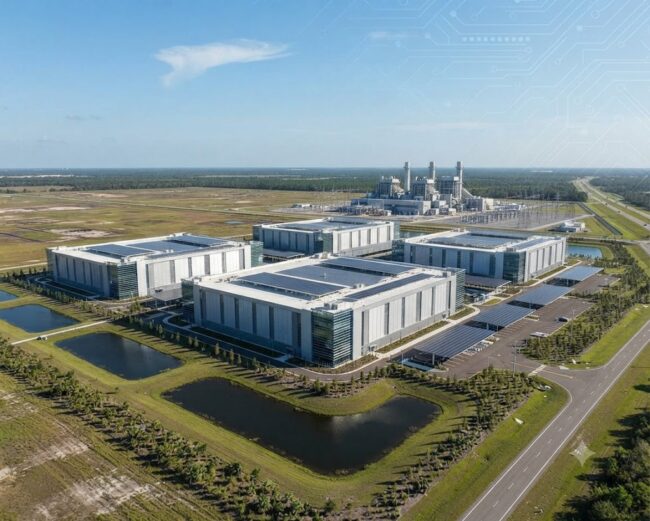
The scale of the deal is hard to overstate for a city of roughly 5,300 residents. Maryland-based developer Stonebridge, operating locally through the entity Bohler Places LLC, selected a former phosphate-mine property west of US-98 — flat, already industrially disturbed, and sitting near an existing high-capacity power source in Duke Energy’s Hines Energy Complex. Rather than developing raw farmland, the project repurposes legacy mining land into next-generation digital infrastructure, turning yesterday’s industry into tomorrow’s.
Following the Money: Incentives and Investment
For a region long associated with phosphate extraction, the project marks an encouraging pivot toward the data economy that has been reshaping site-selection decisions nationwide. Stonebridge has committed $10 million toward local infrastructure improvements, paid out in two phases, on top of the core capital investment. City officials also secured a 10-year, $150 million property and equipment tax incentive package designed to anchor the project locally while still capturing long-term tax base growth once the abatement period ends — a structure that lets the city grow now and cash in later.
450 Jobs, Six-Figure Paychecks
On jobs, Stonebridge is projecting about 450 permanent positions once the campus is fully operational, with average compensation cited at roughly $107,000 a year — well above Polk County’s median household income. For local officials weighing the deal, that combination of high-paying technical jobs, new tax base, and infrastructure dollars was central to the pitch. Planning Chair Richard Cason, one of the officials who backed the agreement, argued the project would operate under existing environmental and safety oversight from state and federal regulators alongside the city’s own review.
Power and Water: How Fort Meade Squares the Circle
Energy watchers are paying close attention too. The completed campus is expected to require about 1.2 gigawatts of electricity, supplied through Duke Energy rather than the city’s own municipal power provider — a structure intended to keep the buildout from directly affecting residential utility bills. On water, Stonebridge has already scaled back its original estimate from 150,000 gallons a day to 50,000 gallons by committing to closed-loop cooling technology, with the city agreeing to reserve that reduced allotment. It’s a thoughtful bit of engineering that lets a small city host a giant project without straining its resources.
The Road Ahead: Timeline to Groundbreaking
Timeline-wise, the project has moved briskly since Fort Meade first approved a zoning change for the site in June 2025. With the development agreement now signed, Stonebridge is targeting a groundbreaking by the end of 2026 and the first operational building by 2028. Vice Mayor Petrina McCutchen, describing the commission’s ultimate vote, called it “a leap of faith” — acknowledging that some unknowns remain even as the board chose to move forward.
The Fine Print: Permits and Pending Questions
Those unknowns are real and worth noting for a complete business picture: Stonebridge still needs a separate water-use permit from the Southwest Florida Water Management District before construction can begin, and as of the agreement’s signing, that application had not yet been filed. A handful of residents have also filed suit challenging the city’s approval process, and recall efforts have been launched against several commissioners on unrelated governance grounds. None of that has slowed the underlying economic momentum, however — permitting steps like these are a normal part of any project of this magnitude reaching the finish line.
Why Small, Rural Florida Towns Could Be the Biggest Winners of All
Fort Meade’s story points to something bigger and genuinely exciting for Florida’s small towns: hyperscale data centers don’t need a big city address to make a big impact. Rural communities often have exactly what these projects look for — inexpensive, already-disturbed land, proximity to major power infrastructure, and local governments eager to negotiate long-term partnerships rather than compete with dozens of other suitors.
For a town of a few thousand people, one campus can rewrite the local economy overnight: hundreds of six-figure technical jobs, a construction boom that ripples through local contractors and suppliers, a dramatically larger property tax base, and infrastructure upgrades — roads, water systems, broadband — that the town gets to keep long after the ribbon-cutting. Unlike a factory that can relocate when incentives expire, a data center is a decades-long fixture, giving small towns a rare shot at durable, high-wage economic anchors instead of the boom-and-bust cycles that have defined so many rural Florida economies. If Fort Meade’s gamble pays off, it offers a repeatable playbook for dozens of similarly sized Central Florida communities sitting on cheap land near strong power grids.
The Big Picture for Central Florida
For Central Florida’s broader business community, the Fort Meade project lands as a signal event worth celebrating. It’s being framed by state economic trackers as the leading edge of a wave of hyperscale and AI-driven data center investment moving into Florida’s interior counties — bringing with it construction contracts, utility infrastructure upgrades, and a new category of high-wage technical employment to a part of the state that hasn’t traditionally competed for that kind of capital. If Stonebridge clears its remaining permits on schedule, Fort Meade will have transformed a played-out phosphate tract into one of the largest digital infrastructure investments in the Southeast — and given Polk County a new identity as a serious player in Florida’s data economy, with plenty of smaller towns likely to follow its lead.
Analyst Perspective: About Brian French
Brian French is the publisher of Central FL Business News and its sister publications across the Florida Authority Network. He has spent decades as a portfolio manager directing separately managed accounts for high-net-worth families, foundations, and closely held operating businesses, with a focus on equity selection and bottom-up fundamental research. That institutional finance background now informs the network’s approach to regional business reporting, emphasizing primary-source documents — filings, permits, and public records — over consensus narrative.
Sources & Further Reading
- Fort Meade City Commission meeting records and the April 15 development agreement vote
- Polk County property and tax incentive filings related to the Stonebridge/Bohler Places LLC agreement
- Duke Energy Florida infrastructure and capacity filings for the Hines Energy Complex area
- Southwest Florida Water Management District permit database (pending water-use application)
- Florida Department of Commerce and state economic development data on hyperscale/AI data center investment trends
About The Author