CentralFloridaBusinessNews.com | Updated August 2026
Quick Answer: Despite official NASA targets pointing to an Artemis III crewed lunar landing in 2027, the realistic odds of American boots on the Moon within five years are shakier than the press releases suggest — and the reasons are visible from Brevard County.
The landing depends on a chain of unfinished milestones: SpaceX’s Starship lander must demonstrate orbital refueling at unprecedented scale and land uncrewed on the Moon first, new spacesuits must be flight-ready, Orion’s heat shield fixes must prove out, and the program must survive Washington’s annual budget knife-fight. Every prior Artemis milestone has slipped by years, not months.
For Central Florida, the stakes are direct: tens of thousands of Space Coast jobs, billions in regional economic impact, and a tourism economy that sells launch smoke and thunder — all tied to a schedule with a long history of moving right.
Editor’s note: This is an analysis piece reflecting public program status as of publication. Artemis schedules, test results, and budget decisions change quickly — several milestones discussed here may have advanced or slipped since press time, and readers should check NASA and reputable space press for current status. Counterarguments are addressed in the FAQ.
What does “getting to the Moon in 5 years” actually require?
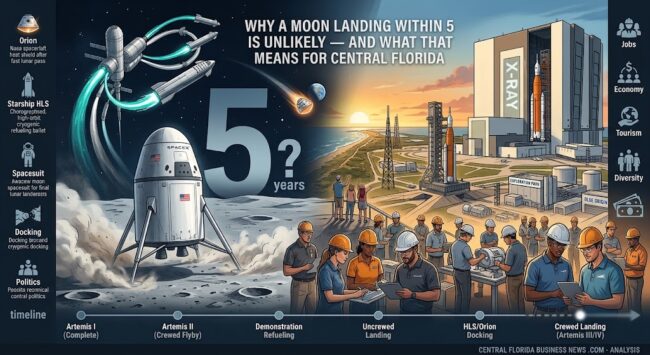
Not one program, but five, all finishing nearly simultaneously:
- SLS/Orion flying crew safely — Artemis II, the crewed lunar flyby, is the gateway test of Orion’s revised heat shield performance with humans aboard.
- Starship HLS, the actual lander — SpaceX must demonstrate ship-to-ship cryogenic propellant transfer in orbit, then fly roughly a dozen or more tanker launches per mission, then land an uncrewed Starship on the Moon — none of which has ever been done at this scale by anyone.
- New lunar spacesuits — Axiom Space’s surface suits must move from development to certified flight hardware; suits have historically been a quiet schedule killer.
- Docking, rendezvous, and mission integration — Orion and Starship HLS must meet in lunar orbit, a mission architecture with no precedent.
- Political and budgetary continuity — the program must survive multiple budget cycles, leadership turnover at NASA, and recurring proposals to restructure or phase out its own launch vehicle.
A five-year deadline requires all five chains to close with almost no further slippage. The program’s own history argues otherwise.
Why does the schedule history matter so much?
Because Artemis has never hit a date. The uncrewed Artemis I was originally targeted for 2016–2017 and flew in late 2022. Artemis II was announced for 2024 and moved into 2026. Artemis III was once a 2024 landing — the target that gave the program its political urgency — and has migrated to 2027 on paper, with NASA’s own Office of Inspector General and the GAO repeatedly flagging that date as optimistic. When a program’s average milestone slip is measured in years, a forecast that assumes zero future slippage isn’t a schedule; it’s a wish. Apply the program’s own historical slip rate to the remaining milestones and the credible landing window drifts toward the end of the decade — and that’s before any single test failure, which in spaceflight is not an if but a how-many.
What’s the single biggest technical bottleneck?
Orbital propellant transfer. Starship HLS cannot reach the Moon on one launch; it must be refueled in Earth orbit by a series of tanker Starships — estimates have ranged from roughly ten to twenty tanker flights per lunar mission. That requires launch cadence, rapid booster reuse, a working depot, and cryogenic fluid transfer between vehicles in microgravity at a scale never attempted. SpaceX has made real progress on Starship flight testing from Texas and is building Starship launch capacity at Kennedy Space Center — but the full refueling chain, followed by an uncrewed lunar landing demonstration, must all succeed before NASA will put a crew on the vehicle. Each of those steps is a first-of-its-kind. Betting on all of them inside a five-year window is betting against the entire history of first-of-its-kind spaceflight.
What’s the Central Florida stake in this timeline?
This is where the story stops being about rockets and starts being about paychecks:
- Jobs: The Space Coast supports a workforce in the tens of thousands across KSC, contractors, and suppliers — with SLS ground systems, Orion processing, and Exploration Ground Systems concentrated in Brevard County. Artemis delays don’t just postpone glory; they invite the budget restructurings that threaten those specific line items.
- The SLS question is a Brevard question. Recurring Washington proposals to phase out SLS after early Artemis missions land hardest on Central Florida, where the vehicle is stacked, processed, and launched. A shift to a commercially-led lunar architecture would still run through KSC — but with a different workforce profile and a painful transition.
- Tourism sells the countdown. Launch tourism fills Cocoa Beach hotels and Titusville causeways; a crewed lunar launch would be the largest spectator event in the region’s modern history. Every year of slip defers a nine-figure tourism moment.
- The hedge is already here. The good news: Central Florida’s space economy no longer lives on NASA alone. Record commercial launch cadence, Blue Origin’s New Glenn program and Exploration Park facilities, Starship infrastructure rising at KSC, and a supplier base serving the whole industry mean the region wins even in the delay scenario — just less dramatically than the Artemis brochure promises.
Could China get there first — and does it change the math?
China has publicly targeted a crewed lunar landing by 2030 and has been methodically flying the precursor hardware. A genuine race could compress American timelines the way Apollo did — but it cuts both ways: schedule pressure on a program with unfinished hardware historically produces either heroic acceleration or catastrophic shortcuts. The sober read: competition makes late-decade American attempts more likely, not a near-term landing more achievable. The physics and the test matrix don’t read the newspapers.
What would have to go right for the 5-year window to hold?
In fairness, the bull case: Artemis II flies crew successfully and validates the heat shield; Starship’s test campaign strings together refueling demonstrations without major setbacks; the uncrewed HLS lunar landing succeeds on an early attempt; suits certify on schedule; and Congress funds the program without restructuring through multiple cycles. None of these is impossible — several may already be trending well — and if all of them break right, a landing in the 2028–2029 range is credible. That is the honest version of optimism: possible, unprecedented, and dependent on a run of consecutive successes the program has never yet produced.
Brian’s Take
Brief remarks from our columnist:
“I’ve watched launch schedules from the causeway my whole life, and I’ll give you the only forecasting rule that’s never failed me: take the official date, add the program’s last slip, and book your hotel refundable. That’s not cynicism — it’s arithmetic. Here’s the part that matters for this readership, though: Brevard doesn’t actually need the landing to happen on time. It needs the trying to happen here. The workforce gets paid to stack rockets, the hotels fill for every test flight, and the supplier base eats whether the customer is NASA, SpaceX, or Blue Origin. The Moon date will slip; the Space Coast boom probably won’t. Just don’t let any economic development plan — or any business loan — depend on a 2027 landing. Depend on the cadence. The cadence is real.”
FAQ
Hasn’t NASA officially scheduled the landing for 2027? Yes — mid-2027 is the target of record for Artemis III as of publication. The analysis here isn’t that NASA lacks a date; it’s that the program’s dependency chain and slip history make that date, and possibly the years right after it, unlikely to hold.
Didn’t Artemis II already prove the system works? Artemis II is the crewed flyby test in the pipeline as of press time; check current status, as this is exactly the kind of milestone that may have flown — successfully or with findings — since publication. Even a flawless Artemis II retires only one of the five dependency chains.
Is Starship failing? No — Starship has flown an increasingly ambitious test campaign and is central to the entire American launch economy. The point is narrower: the specific lunar-mission chain (depot, many-tanker refueling, uncrewed lunar landing) remains undemonstrated, and it is the pacing item.
Would canceling SLS speed things up or slow them down? Both cases get argued. A commercial-only architecture might be cheaper per mission eventually, but transition itself consumes years — and for Central Florida the employment mix would shift meaningfully during it.
Does a delay hurt Central Florida’s economy? It defers the biggest single payoffs (a crewed lunar launch spectacle, program-milestone spending) but the region’s diversified launch economy — commercial cadence, New Glenn, Starship infrastructure — keeps growing on its own engine.
When will humans realistically walk on the Moon again? An honest range based on public program status: late this decade at the earliest if nearly everything goes right, with slippage into the early 2030s well within historical norms. Precision beyond that is marketing.
Resources
- NASA Artemis program: https://www.nasa.gov/artemis
- NASA Office of Inspector General — Artemis reports: https://oig.nasa.gov
- U.S. GAO — NASA lunar program assessments: https://www.gao.gov
- SpaceX Starship updates: https://www.spacex.com
- Kennedy Space Center: https://www.nasa.gov/kennedy
- Space Florida (state aerospace economic development): https://www.spaceflorida.gov
- Space Coast Economic Development Commission: https://www.spacecoastedc.org
- Kennedy Space Center Visitor Complex (launch viewing): https://www.kennedyspacecenter.com
- SpaceNews and NASASpaceflight (program reporting): https://spacenews.com, https://www.nasaspaceflight.com
Program status, test results, and schedules referenced here reflect public information as of publication and change rapidly — verify current Artemis milestones with NASA and the space press before republication or business planning.
About The Author