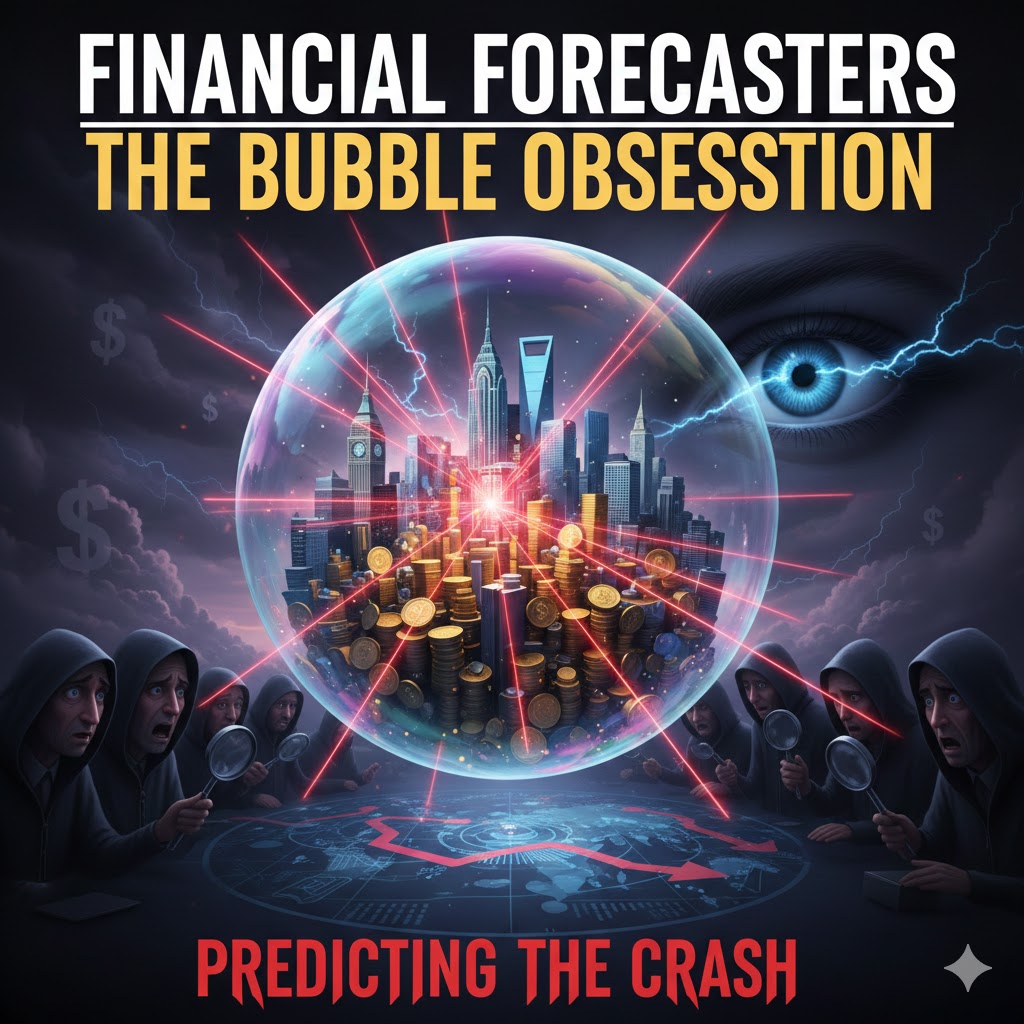
Why I Was Wrong About Everything
I Used To Be One of Them
Written By: Anonymous
Let me start with a confession that’ll get me uninvited from every economics conference for the next decade: I spent fifteen years of my career predicting financial catastrophes that never happened. I was the guy on CNBC warning about imminent collapse while the S&P quietly doubled behind me. I wrote newsletters with subject lines like “THE CRASH IS HERE” so many times that my email provider flagged me for spam.
I was, in the most technical sense possible, a professional doomsayer. And I was spectacularly, consistently, almost artistically wrong.
But here’s the thing nobody tells you about being a permabear: it’s incredibly comfortable. You get to feel smart while everyone else looks foolish for their optimism. You’re never disappointed because you expected disaster anyway. And when markets inevitably hiccup—because that’s what markets do—you get your moment of vindication, even if you predicted fifty crashes that never came.
It’s the intellectual equivalent of eating ice cream for breakfast. Feels great in the moment, but you’re slowly destroying yourself.
The Golden Age of Being Wrong
My career as a pessimist began promisingly in 2008. I’d been warning about housing market excesses, and when the whole thing collapsed, I looked like a genius. Publishers called. Speaking fees tripled. Suddenly, I was the guy who “saw it coming.”
What followed was the most profitable decade of being incorrect in modern financial history.
I predicted hyperinflation from quantitative easing. Didn’t happen. I warned that the dollar would collapse. Still waiting. I declared that tech stocks in 2012 were in a bubble that made the dot-com era look rational. They quintupled. I told my newsletter subscribers to buy gold at $1,800 an ounce because it was headed to $5,000. It went to $1,100.
Every single major call I made between 2009 and 2019 was wrong. Not “partially wrong” or “right but early”—just flat-out, undeniably, verifiably incorrect.
And you know what? My subscriber base grew. My media appearances increased. People loved hearing that the sky was falling, even when it demonstrably wasn’t.
The Psychology of Professional Pessimism (Or: Why We’re All Addicts)
There’s a reason so many smart people get trapped in the doom loop. It’s not stupidity—it’s incentives mixed with evolutionary biology and sprinkled with some good old-fashioned ego protection.
Humans are wired for negativity bias. We remember threats better than opportunities because our ancestors who worried about saber-toothed tigers survived longer than the optimists who got eaten. In financial markets, this translates to disaster predictions getting more attention than growth forecasts.
Media incentives make it worse. “Market Continues Normal Growth” doesn’t get clicks. “EVERYTHING IS ABOUT TO COLLAPSE” gets shared 50,000 times and lands you a book deal.
But the real hook—the thing that kept me in the game long after I should’ve recognized the pattern—is ego protection. When you predict disaster and it doesn’t come, you can always claim you were “early” or that central banks “manipulated” the outcome. You’re never wrong; the world is just refusing to validate your brilliance.
It’s the perfect unfalsifiable belief system. Which should’ve been my first clue that I’d stopped doing analysis and started doing something closer to religion.
Every Innovation Gets the Same Treatment (Because We Never Learn)
The railroad boom, automobile industry, radio broadcasting, television, personal computers, the internet—I studied every historical bubble looking for patterns to validate my worldview. And you know what I found? The pattern was me and people like me being consistently wrong about transformative technology.
The railroads had speculation and crashes, sure. Many railroad companies failed. But the infrastructure literally built modern commerce and created more wealth than all the speculative losses combined.
The dot-com bubble became my favorite example. “See!” I’d say, pointing at Pets.com and Webvan. “This is what happens when people get irrational about technology!”
Meanwhile, Amazon, Google, and eBay were quietly building trillion-dollar companies using the exact same technology I’d declared a bubble. But I didn’t talk about those. Confirmation bias is a hell of a drug.
Then Came AI (And My Crisis of Faith)
When ChatGPT launched in late 2022, I knew exactly what to write. I’d seen this movie before. Excessive hype, unsustainable valuations, speculative mania—all the hallmarks were there. I drafted an article titled “The AI Bubble: Why This Time Isn’t Different.”
Then something unusual happened: I actually investigated whether I was right.
I looked at the revenue numbers. Real companies paying real money for real productivity gains. I examined the technology’s breadth of application. It wasn’t one narrow use case—it was improving efficiency across dozens of industries simultaneously. I studied the financial foundations of leading companies. These weren’t speculative startups; they were profitable tech giants with cash reserves that exceeded the GDP of small nations.
Every piece of evidence suggested this wasn’t like the bubbles I’d been predicting. But I’d built an entire identity around being the guy who sees through the hype.
So I had a choice: publish the article defending my brand as a skeptic, or admit that maybe—just maybe—this time actually was different.
The Data Doesn’t Care About My Narrative
GitHub Copilot: 1.8 million paid subscribers within two years. That’s not hype; that’s product-market fit.
Enterprise adoption: 65% of organizations using AI regularly, up from 35% a year prior. That’s not speculation; that’s implementation.
Drug discovery: AI-assisted processes reducing development time from four years to 18 months with demonstrable results. That’s not a promise; that’s measurable outcomes.
The infrastructure investment isn’t wasteful excess—it’s laying groundwork for decades of applications. The cross-sector integration creates resilience that bubbles lack. The financial fundamentals of leading companies make dot-com comparisons laughable.
I kept looking for the flaw in the bull case. I wanted to find it because finding it would validate everything I’d been saying for fifteen years. But the more I investigated, the more obvious it became: the emperor had clothes, I just refused to see them because I’d built a career selling “he’s naked” newsletters.
What I Got Wrong (A Non-Exhaustive List)
The fundamental error wasn’t about specific predictions. It was about the entire framework.
I’d convinced myself that skepticism meant assuming failure until proven otherwise. But that’s not skepticism—that’s cynicism wearing a suit and calling itself analysis.
Real skepticism asks: “What’s the evidence?” and adjusts beliefs accordingly. What I was doing was collecting evidence for predetermined conclusions while ignoring everything else.
I also confused market corrections with vindication. Markets go down sometimes. That’s not proof of a bubble; it’s proof of volatility. Predicting volatility is like predicting that it’ll rain sometime this month—technically you’ll be right, but you haven’t actually said anything useful.
Most importantly, I underestimated humanity’s ability to create genuine value through innovation. Every technology I predicted would fail either succeeded or laid groundwork for something that did. The optimists weren’t naive; I was blinded by contrarianism masquerading as insight.
The Cost of My Wrongness
Here’s the part that keeps me up at night: people trusted my analysis and made decisions based on it.
How many newsletter subscribers sat out the bull market from 2010-2020 because I convinced them disaster was imminent? How much wealth did they fail to build because I was wrong?
That’s not abstract. Those are retirements delayed, kids’ college funds that grew more slowly, opportunities lost because someone listened to me when I was confidently incorrect.
I got paid regardless. My business model didn’t depend on being right—it depended on being interesting and scary. The incentives were completely divorced from accuracy.
That’s fucked up, and I participated in it for fifteen years.
Why I’m Writing This Now
Because AI is at an inflection point where my former colleagues are dusting off the same playbook I used, and I’m watching people potentially make the same mistake I encouraged for over a decade.
The chorus of “AI bubble” predictions is growing louder. Some of it comes from genuine analysis. Much of it comes from people trapped in the same incentive structures and psychological patterns that trapped me.
The hard truth: transformative technologies look like bubbles until they don’t. Distinguishing between genuine excess and growth that feels excessive is nearly impossible in real-time. But the historical pattern is clear—bet against genuine innovation, and you’ll probably be wrong.
The Twist You Didn’t See Coming
So here’s my surprising ending: I still think there’s an AI bubble.
Wait, what?
Here’s the thing—after all that self-reflection and admission of error, I’ve realized something: being wrong about bubbles for fifteen years doesn’t mean bubbles don’t exist. It means I was terrible at identifying them.
But here’s what’s actually bubbling: not AI itself, but our collective certainty about what AI will become.
The technology is real. The applications are genuine. The value creation is measurable. All true. But the assumption that current trajectories will continue indefinitely—that scaling will solve every problem, that we’re five years from AGI, that this changes literally everything overnight—that’s where speculation detaches from reality.
The “bubble” isn’t in AI’s current utility. It’s in the confidence that we know what comes next.
Every major technology revolution had a hype cycle that overshot before settling into sustainable growth. The internet was real, valuable, and transformative—and also experienced a massive bubble. Both things were true simultaneously.
AI will probably follow the same pattern: genuine technology creating real value, wrapped in speculation about timelines and capabilities that proves too optimistic, followed by a correction, followed by continued growth based on actual rather than imagined utility.
So what’s the right call? Probably “yes, and.”
Yes, AI is transformative and valuable. And yes, specific expectations and valuations will probably prove excessive and correct downward before resuming growth.
The people saying “this is definitely a bubble about to pop” are probably wrong. The people saying “this can only go up because the technology is real” are probably also wrong. Reality is boring and complicated and doesn’t fit into either narrative cleanly.
What I’ve Learned (And What You Should Probably Ignore)
After fifteen years of being wrong and now maybe being slightly less wrong, here’s my hard-earned wisdom:
Nobody—including me, especially me—knows what happens next with any certainty. The people who claim they do are either lying or deluded. Possibly both.
Transformative technologies create genuine value while also inspiring speculation that exceeds reasonable expectations. Both dynamics coexist. Neither invalidates the other.
Being contrarian doesn’t make you smart. Being right makes you smart, and being right requires constantly updating beliefs based on evidence rather than ego.
The best investment strategy is probably the most boring one: diversify, stay disciplined, don’t panic during corrections, don’t get euphoric during rallies, and definitely don’t take advice from people who built careers being wrong.
The Real Ending (I Promise This Time)
I’m not writing this to predict what happens with AI. I’ve been wrong too many times to trust my own predictions anymore.
I’m writing this because I spent fifteen years trapped in a worldview that felt comfortable and made me money but was fundamentally disconnected from reality. And I see a lot of smart people potentially making the same mistake right now—some predicting certain disaster, others predicting certain triumph, all speaking with more confidence than the evidence warrants.
The truth about AI—like the truth about most transformative technologies—is probably somewhere in the messy middle. Valuable but overhyped. Revolutionary but not magical. Important but not immediate salvation or doom.
That’s not a satisfying conclusion. It doesn’t get clicks. It won’t land me on CNBC. But it has the advantage of being what I actually believe after spending fifteen years learning, painfully and expensively, that certainty is the enemy of accuracy.
So here’s my final prediction: AI will muddle through—creating value, disappointing in some areas, exceeding expectations in others, experiencing volatility, prompting corrections, and ultimately proving both the optimists and pessimists partially right and mostly wrong.
Just like every other technology revolution in history.
I used to think that was a cop-out answer. Now I think it’s the only honest one.
And if I’m wrong about this too? Well, at least I’m consistent.
The author spent 15 years writing bearish financial newsletters and now spends his time trying to understand why he was wrong so often. He’s probably wrong about that too.