April 28, 2026
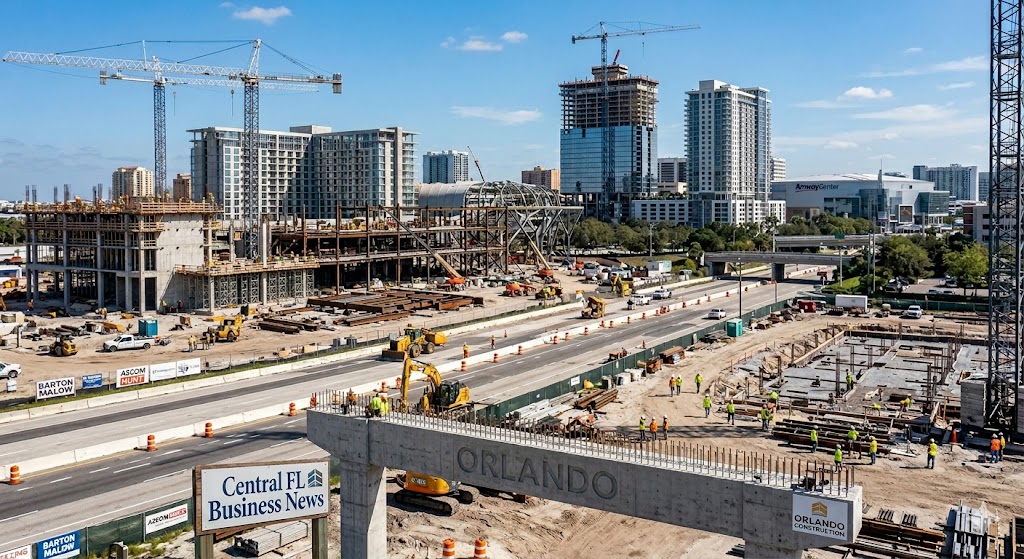
Stand at the top of any Orlando high-rise on a clear day and look out across the horizon. What you’ll see isn’t just sprawl — it’s a region literally itself in real time.
To the southwest, Universal’s Epic Universe opened in May 2025, a $7 billion mega-park that triggered a wave of surrounding hospitality, retail, and infrastructure construction the area is still absorbing. To the south, Lake Nona continues its decade-plus expansion as one of the most ambitious master-planned communities in America. To the east, Sunbridge is rising in southeast Orange County. To the southeast, Wellness Way in southern Lake County is gaining traction. To the north, Westcourt is preparing to demolish the long-vacant Orlando Sentinel site for a $2 billion redevelopment near the Orlando Magic arena. Camping World Stadium is undergoing a $400-$425 million transformation funded by tourism taxes. The Central Florida Expressway Authority has approved a $4.2 billion expansion plan adding 30 miles of expressways across five counties. The Osceola Parkway Extension alone carries a $2.1 billion budget. The I-4 Beyond the Ultimate project is a $2.5 billion highway reconstruction now compressed from 25 years to roughly 10. Then there’s Brightline’s continued integration, SunRail’s airport-to-Disney extension, the proposed Orlando Dreamers MLB stadium, NeoCity South’s 300-acre tech expansion in Osceola County, the RoseArts District’s $2 billion redevelopment of the former Lake Orlando Golf Club, Related Group’s 20-acre International Drive luxury apartment site, and dozens more.
Conservatively, more than $50 billion in confirmed investment is flowing into Central Florida — and it’s expected to support a population leap from 4.5 million to over 6 million residents by 2030.
That’s not “growth.” That’s a metro reinventing itself.
But here’s the inconvenient truth about all those gleaming renderings: none of it gets built without construction bonds. The financial instrument that virtually no Central Florida tourist or resident ever thinks about is the single biggest reason the region’s $50 billion pipeline is actually delivering instead of sitting on a shelf gathering dust. Let’s break down why.
Construction Bonds in Plain English
A construction bond — also called a surety bond or contract bond — is a three-way financial guarantee that a construction project will be completed according to its contract terms. Three parties are involved:
- The Principal — the contractor performing the work.
- The Obligee — the project owner who requires the bond. In Central Florida, this includes the City of Orlando, Orange County, Osceola County, Seminole County, Lake County, the Florida Department of Transportation, the Central Florida Expressway Authority, the Greater Orlando Aviation Authority, the Orange County School District, and a long list of private developers and construction lenders.
- The Surety — the bonding company that financially backs the contractor’s promise to perform.
If the contractor fails — by walking off the job, going bankrupt, doing defective work, failing to pay subcontractors, or otherwise failing to deliver — the surety steps in. They either pay damages, hire a replacement, finance project completion, or some combination thereof. Maximum exposure is capped at the bond amount, which on Florida public projects is typically 100% of the contract price.
In a tourism-driven economy where every project failure means hundreds of subcontractors don’t get paid and millions in tourist-tax dollars sit idle, the bond is the financial guardrail keeping it all on track.
The Four Construction Bonds Driving Central Florida’s Boom
Every meaningful Central Florida construction project deals with some combination of these four instruments:
- Bid Bonds. Submitted with a contractor’s bid. Guarantees they’ll actually sign the contract and provide performance and payment bonds if their bid wins. Without this, contractors could lowball their bids, win the project, and disappear when reality sets in.
- Performance Bonds. Guarantee the contractor will complete the work according to specs, on time, and to required quality. Performance failure triggers the surety to either finish the job or compensate the owner.
- Payment Bonds. Guarantee that subcontractors, laborers, and material suppliers will get paid even if the prime contractor fails them. This is the bond that protects the Central Florida small business backbone.
- Maintenance Bonds. Cover post-completion defects and warranty obligations, typically for one to two years. Critical on infrastructure projects where defects often surface only after months of use under load.
In a region where individual projects routinely exceed nine figures and where the failure of even a mid-sized contractor could cascade through hundreds of subcontractors and suppliers, all four bond types are everyday tools.
Brian’s Take: Central Florida’s Construction Boom Is Built on Tourism Tax Dollars That Demand Surety Discipline.
A massive percentage of the Orlando-area construction pipeline is funded directly or indirectly by tourism taxes — meaning ordinary visitors paying for hotel rooms, theme park tickets, and rental cars are essentially the financiers of Central Florida’s growth, and they deserve a rock-solid surety framework protecting that money. The reason this region’s mega-projects keep delivering instead of stalling is that the bonding industry has become a quiet financial filter that screens out the contractors who can’t actually execute on those publicly-funded promises.
— Brian
Florida’s Legal Framework: Why Bonds Are Mandatory on Most Central Florida Projects
Central Florida’s $50 billion construction pipeline doesn’t run on goodwill. It runs on a tightly defined legal framework that requires bonds on virtually every meaningful public project — and on most major private ones.
Section 255.05: Florida’s Little Miller Act
The cornerstone of Florida public bonding is Section 255.05 of the Florida Statutes, commonly called Florida’s Little Miller Act. It mirrors the Federal Miller Act (40 U.S.C. § 3131), which governs federal contracts of $100,000 or more.
For state and local public projects across Central Florida, Section 255.05 establishes:
- Public contracts of $100,000 or less may be exempt from bonding entirely.
- Contracts between $100,000 and $200,000 — the public agency may waive bonding at its discretion.
- Contracts of $200,000 or more — payment and performance bonds are required, generally in an amount equal to 100% of the contract price.
- Counties and municipalities can waive bonding on contracts of $200,000 or less, though most major Central Florida agencies require bonding regardless.
When you stack that against the reality that Central Florida’s combined municipal, county, school district, expressway authority, transit, and aviation construction spending easily exceeds billions of dollars annually, the conclusion is unavoidable: virtually every meaningful public construction project across the Orlando metro is bonded.
Section 337.18: FDOT and Expressway Bonding
Florida transportation projects operate under their own bonding regime via Section 337.18 of the Florida Statutes, which governs Florida Department of Transportation contracts. The framework:
- A surety bond is required of the successful bidder in an amount equal to the awarded contract price.
- FDOT may waive bonding for non-critical contracts of $250,000 or less.
- For mega-projects of $250 million or more, FDOT can use a hybrid approach — partial surety bond plus alternative security like letters of credit, U.S. bonds and notes, parent company guarantees, or cash collateral.
This matters intensely in Central Florida. Mega-projects like I-4 Beyond the Ultimate ($2.5 billion), the Osceola Parkway Extension ($2.1 billion), the Poinciana Connector linking SR 429 to I-4, the Central Florida Expressway Authority’s $4.2 billion regional expansion, and the various State Road 429 and 414 corridors are all bonded under Section 337.18. The Greater Orlando Aviation Authority runs its own intricate bonding requirements on the ongoing transformation of Orlando International Airport — including the rapidly expanding South Terminal, the Brightline rail integration, and the planned vertiport for future air taxi services.
Chapter 713: Florida’s Construction Lien Law for Private Projects
Public projects aren’t the only bonded work in Central Florida. Chapter 713 of the Florida Statutes — Florida’s Construction Lien Law — also creates bonding tools for private projects:
- Section 713.23 lets private developers use a payment bond as an alternative to facing potential lien claims from subcontractors and suppliers. For Orlando’s massive private developments — Westcourt, the RoseArts District, Sunbridge, the International Drive luxury apartment expansions, and the steady wave of theme park-adjacent hospitality projects — payment bonds are how owners keep clean title and keep construction lenders comfortable.
- Section 713.245 authorizes “Conditional Payment Bonds” with specific protections.
Every major hospitality and resort project around the Disney, Universal, and SeaWorld corridors carries layered bonding structures across their general, mechanical, electrical, plumbing, and finishing contractors. The complexity scales with the project — and the surety industry has scaled right alongside it.
How Construction Bonds Actually Power Central Florida’s Growth
Now let’s connect the legal framework to what’s literally happening across the Orlando metro right now.
Bonds Pre-Qualify the Contractors Who Can Actually Deliver
Before a surety company will issue a bond on a Central Florida project, they conduct rigorous underwriting: CPA-prepared financial statements, work-in-progress reports, project history, ownership structure, banking relationships, subcontractor depth, personal indemnity from principals. The surety effectively functions as a financial gatekeeper, screening out contractors who don’t have the experience or balance sheet to deliver.
This is enormous for Central Florida. With a pipeline this large, this complex, and this dependent on tourism timelines, the metro simply cannot absorb a wave of contractor failures. The surety underwriting process quietly filters out marginal players before they ever break ground on a major Orlando project. It’s the unsung quality-control layer of the entire boom.
This filtering is especially important for the spillover work around Epic Universe, expanded Disney resorts, growing Universal infrastructure, and the constellation of branded hospitality projects around theme parks. These are visible, public-facing, schedule-sensitive jobs where a contractor failure doesn’t just cost money — it can disrupt tourism flows, hotel openings, and major event calendars.
Bonds Protect Tourist-Tax Dollars
When the City of Orlando, Orange County, Osceola County, or the Greater Orlando Aviation Authority commits public dollars — much of it derived from tourist development taxes — to projects like the Camping World Stadium overhaul, expressway expansions, airport modernization, or the dozens of capital improvements in the City of Orlando’s Capital Improvement Plan, construction bonds are how taxpayer and tourist-tax dollars don’t get vaporized.
Camping World Stadium’s $400 million-plus transformation, led by Barton Malow Builders and AECOM Hunt, with DLR Group as architect, is funded largely through tourism taxes. Every single contractor on that project is bonded, because no city in Central Florida is going to gamble half a billion dollars in tourism revenue on a contractor’s handshake.
Across the United States, surety companies have collectively paid billions of dollars over the decades on bonded projects where contractors failed. Without bonding, every one of those losses would have hit project owners — and ultimately taxpayers and tourists — directly.
Bonds Protect Central Florida’s Subcontractor Backbone
Walk onto any active Central Florida job site — a Lake Nona research building, a Sunbridge residential phase, a Camping World Stadium demolition zone, a Brightline Orlando expansion, a new International Drive resort tower — and you’ll see who actually builds Central Florida: framers, electricians, plumbers, drywallers, glaziers, ironworkers, mechanical contractors, equipment rental companies, and material suppliers. The vast majority are family-owned, Central Florida-based small businesses with thin margins and limited cash reserves.
Without payment bonds, when a prime contractor goes bankrupt or refuses to pay, those subcontractors and suppliers can lose tens or hundreds of thousands of dollars overnight — often enough to kill the business. Payment bonds change that math entirely. A Central Florida subcontractor on a bonded project has legal recourse against the surety, provided they file proper notices within Florida Statute 255.05’s strict deadlines.
Bonds Make Central Florida’s Construction Lending Possible
This is the part most people miss when they marvel at all the cranes around Orlando: the cranes aren’t there because developers are writing personal checks. They’re there because banks, life insurance companies, family offices, and capital partners are issuing massive construction loans — and lenders financing nine and ten-figure projects do not fund unbonded work.
A lender backing a $400 million stadium renovation, a $2 billion mixed-use district, or a $500 million resort development needs to know the contractor cannot vanish mid-build, leaving the loan upside-down and the project a half-finished embarrassment near the world’s most photographed tourism corridor. The bond is part of what makes the loan possible. No bond, no loan. No loan, no project. No project, no growth.
That cascade is the secret architecture of Central Florida’s transformation: bond enables loan, loan enables project, project enables economic and population growth.
Brian’s Take: Central Florida’s Spillover Economy Lives or Dies on Bonded Schedule Discipline.
When a theme park announces a new attraction, hundreds of nearby hotel renovations, retail buildouts, road improvements, and tenant fit-outs all have to align with the opening date — and a single contractor failure can throw off a multi-million-dollar tourism campaign. The reason Central Florida’s hospitality and entertainment districts hit their dates with remarkable consistency is that the bonding industry is quietly enforcing schedule discipline on every contractor in the supply chain, whether the public realizes it or not.
— Brian
Real Central Florida Projects That Couldn’t Exist Without Construction Bonds
Let’s get specific about the headline developments reshaping Central Florida right now:
- Camping World Stadium Transformation. A $400-$425 million modernization led by Barton Malow Builders and AECOM Hunt with DLR Group as architect. Will accommodate college football playoff games, NFL games, major concerts, and potential international events including World Cup matches. New hurricane-resistant metallic exoskeleton, expanded capacity to 65,000+ seats, retractable concert stage, premium seating. Targeted completion 2027.
- Westcourt. A $2 billion redevelopment of the former Orlando Sentinel 20-acre downtown site near the Orlando Magic arena, with demolition starting in 2026 and a 10-20-year phased buildout.
- I-4 Beyond the Ultimate. A $2.5 billion complete reconstruction from Disney Springs to Polk County, with new express lanes and smarter interchanges. Originally a 25-year project, now compressed to roughly 10 years.
- Osceola Parkway Extension. A $2.1 billion, 15-mile expressway from State Road 417 to Narcoossee Road, supporting the more than 50,000 new homes planned in Osceola County over the next decade.
- Central Florida Expressway Authority Expansion. A $4.2 billion plan adding 30 miles of expressways across five counties, with new corridors, upgraded interchanges, solar-powered infrastructure, and wrong-way driver detection systems. Self-funded through toll revenue.
- Poinciana Connector. A 3.5-mile expressway connecting SR 429 directly to I-4, relieving congestion near ChampionsGate. Engineering accelerated with a $1.7 billion state contribution toward strategic roads.
- RoseArts District. Westside Capital Group’s $2 billion, three-phase, 128-acre redevelopment of the former Lake Orlando Golf Club, planned for 5,650 multifamily units, 350,000 square feet of commercial space, and 65 acres of green space.
- Sunbridge. Master-planned community spanning more than 24,000 acres in southeast Orange and Osceola counties — one of the largest active master-planned communities in the United States.
- Lake Nona. Continued expansion of the Tavistock Group’s 17-square-mile master-planned community in southeast Orlando, now home to the USTA National Campus, KPMG Lakehouse, the U.S. Tennis Association headquarters, the Sanford-Burnham Medical Research Institute, and a dense web of healthcare, technology, and educational facilities.
- Wellness Way. Southern Lake County master-planned development gaining major construction traction.
- Orlando International Airport (MCO) Expansion. Ongoing terminal upgrades, cargo facilities, Brightline integration, and the planned vertiport for future air taxi service.
- NeoCity South. Osceola County’s expansion of its semiconductor and technology innovation campus, recently acquiring more than 300 acres for new manufacturing facilities.
- Universal Epic Universe Spillover. Continuing surrounding hospitality, retail, road access, and tenant improvement work radiating outward from the May 2025 opening.
- 550 Shoma. Shoma Group’s 16-story high-rise on Mariposa Street with the Shoma Bazaar food hall, completion targeted in 2026.
- Related Group’s International Drive Project. 20 acres acquired for a luxury apartment development, signaling continued institutional interest from South Florida-based firms in the Central Florida market.
- SunRail Airport-to-Disney Extension. Major commuter rail expansion connecting Orlando International Airport to the Disney corridor.
- Brightline Continued Integration. High-speed rail tying Orlando into the broader Florida corridor with Miami, Fort Lauderdale, and West Palm Beach.
- Orlando Dreamers MLB Stadium. A proposed 45,000-seat stadium near SeaWorld in active development for an MLB expansion bid.
Multiply that headline list by the dozens of additional projects across Winter Garden, Winter Park, Maitland, Apopka, Sanford, Lake Mary, Altamonte Springs, Kissimmee, St. Cloud, Celebration, Davenport, Clermont, and the constellation of growing Central Florida communities, and you start to grasp the scope of bonded construction transforming the region.
What It Costs to Bond a Central Florida Project
For contractors trying to enter or expand in the Orlando metro market, here’s the practical math:
- Bond premiums typically run 1% to 3% of the bond amount for contractors with strong financials, solid credit, and meaningful project history.
- Higher-risk situations can run 3% to 15% — for newer contractors, weaker balance sheets, lower credit scores, or specialty/high-risk project types.
- Very large projects often run below 1% as economies of scale and creditworthy underwriting kick in.
For a contractor bidding on a $15 million bonded Central Florida public project, the bond premium might run anywhere from $150,000 to $450,000. A real cost — but one that gets baked into the bid and ultimately enables the contractor to compete for projects that would be inaccessible without bonding.
What Central Florida-Focused Sureties Want to See
Sureties evaluating contractors for major Orlando-area work typically require:
- Audited or CPA-reviewed financial statements for the most recent 2-3 fiscal years.
- Work-in-progress reports showing current commitments and capacity utilization.
- Bank reference letters demonstrating credit relationships and lines of credit.
- Personal financial statements from owners for personal indemnity.
- Resume of completed projects at the size and complexity of the target work.
- Organizational documents including operating agreements and key personnel bios.
- References from past project owners and other sureties.
Stronger financials and project history equal higher aggregate bonding capacity — and bigger Central Florida projects you can pursue. In a market where individual projects regularly exceed $50 million and where mega-projects clear $1 billion, your bonding capacity directly determines your competitive ceiling.
Brian’s Take: The Smartest Central Florida Contractors Treat Bonding Like a Long-Term Asset.
The contractors winning the biggest Orlando-area projects right now didn’t suddenly develop bonding capacity when the boom hit — they spent the previous decade building rock-solid surety relationships through smaller jobs, clean financials, and consistent performance, so they were positioned to scale when the $50 billion pipeline opened. If you’re a Central Florida contractor without a meaningful bonding relationship today, you’re effectively choosing to watch the next decade of growth from the sidelines.
— Brian
When Things Go Wrong: How a Central Florida Bond Claim Plays Out
Construction bonds aren’t theoretical. They get used. Here’s how a typical bond claim plays out on a Central Florida project:
- A default occurs. The contractor walks off, files bankruptcy, fails to pay subs, or delivers defective work the owner formally rejects.
- The owner declares default, gives proper notice to both contractor and surety, and terminates the contractor’s right to complete the work.
- The surety investigates — verifying the default’s legitimacy, examining the contractor’s defenses, calculating real cost-of-completion, and assessing total exposure.
- The surety chooses a remedy — financing the original contractor to finish, hiring a replacement contractor and paying the cost difference, negotiating a buy-out with the owner, or paying damages up to the bond limit.
- The surety pursues the principal under the indemnity agreement — virtually every Central Florida contractor has signed personal and corporate indemnity making them ultimately liable to the surety for any loss.
Florida Statute 255.05 strictly governs subcontractor and supplier claims on payment bonds for public projects. Subcontractors without a direct contract with the prime must serve a Notice to Contractor within 45 days of starting work, and a Notice of Nonpayment must typically be served within 90 days after the last furnishing of labor or materials. Missing these deadlines can void an otherwise valid claim. Every smart Central Florida subcontractor has a Florida construction attorney on speed dial precisely because of these unforgiving timelines.
What Every Central Florida Stakeholder Needs to Take Away
Construction bonds aren’t a peripheral detail of Central Florida’s growth story. They are the financial backbone holding it all up. Every developer, contractor, subcontractor, supplier, investor, lender, theme park operator, hospitality company, and taxpayer in the Orlando metro has a stake in understanding them.
For developers: bonding lets you finance, build, and protect your investment.
For contractors: bonding capacity directly determines how big your projects — and your business — can grow.
For subcontractors and suppliers: payment bonds are your insurance policy when the prime contractor fails.
For lenders and capital partners: bonded projects are dramatically safer bets than unbonded ones.
For Central Florida taxpayers and tourists: every public dollar invested in regional infrastructure is protected by a surety guarantee.
The expressways carrying you across the region, the airport handling 57 million-plus passengers a year, the resort hotels going up around theme parks, the master-planned communities reshaping suburban life from Lake Nona to Sunbridge to Wellness Way, the stadium being rebuilt in time for the next World Cup — every single one of them is supported by an unseen network of bonding companies, surety underwriters, and construction-finance professionals who never get the credit but always carry the risk.
The next time you drive across I-4, fly into Orlando International, sit in the upper bowl of Camping World Stadium, or marvel at how quickly an entirely new Sunbridge neighborhood seemed to appear, take a second to think about the financial infrastructure quietly supporting it all. Without construction bonds, the expressways don’t get expanded. The terminals don’t get modernized. The stadiums don’t get rebuilt. The new master-planned communities are just empty land with rendered signs.
With them, Central Florida is doing something almost no other American region is doing right now: scaling from a tourism-driven economy into one of the country’s most diversified, fastest-growing metros.
That’s the unglamorous, undersung financial story behind the most important growth chapter in Central Florida’s modern history.
The cranes you see today are tomorrow’s economy. And every one of them is held up by something most residents have never thought about — but should be deeply grateful for.
Bond by bond, project by project, Central Florida is building its future for real.
Resources & Further Reading
- Florida Surety Association: 10 Things About Surety Bonds — State-level overview of how surety bonds work in Florida construction.
- Florida Statute 255.05 (Florida’s Little Miller Act) — The full text of Florida’s primary public works bonding statute.
- Florida Statute 337.18 (FDOT Bond Requirements) — Governs surety bonds on Florida transportation projects, including major Central Florida infrastructure.
- City of Orlando City Projects — Active list of Orlando’s bonded public construction projects across the city.
- Central Florida Expressway Authority — Tracks the bonded expressway and toll road projects driving Central Florida’s $4.2 billion transportation expansion.
About The Author