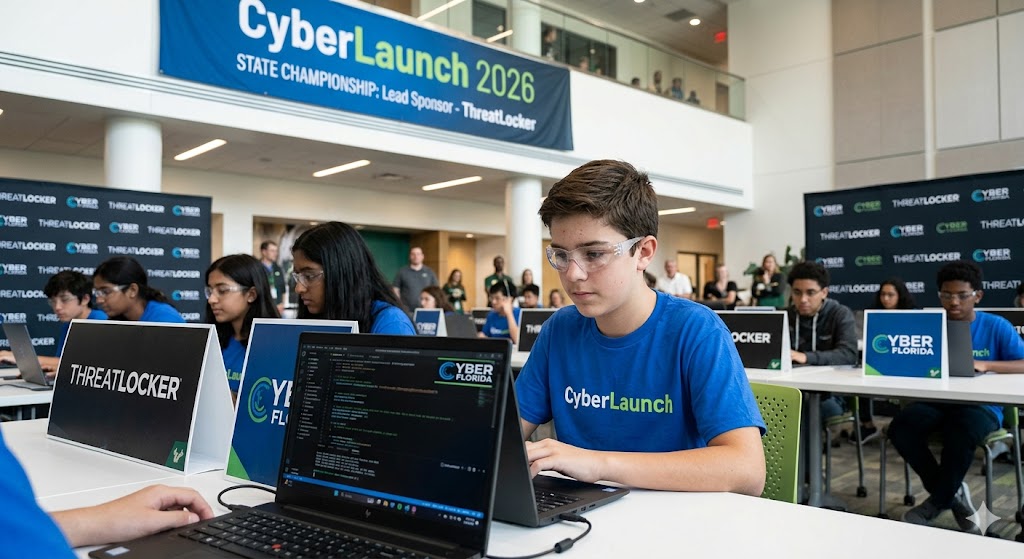
ORLANDO, Fla., April 11, 2026 — In a region already recognized as one of the fastest-growing technology markets in the United States, one Orlando company is making a calculated investment in the next generation of cybersecurity professionals. ThreatLocker, the Orlando-headquartered global leader in Zero Trust endpoint security, has been named the lead sponsor of CyberLaunch 2026 — the annual statewide cybersecurity competition organized by Cyber Florida at the University of South Florida. The partnership, announced April 1, 2026, represents more than a financial commitment: it signals ThreatLocker’s belief that closing the cybersecurity talent gap begins not in college recruiting pipelines but in middle school hallways and high school computer labs.
CyberLaunch is no niche event. This year’s competition drew more than 1,300 students from across Florida for a statewide virtual qualifier, out of which 500 top performers representing 63 Florida high schools earned invitations to the in-person State Championship. That event is scheduled for April 24 at the University of South Florida’s Tampa campus, featuring beginner, intermediate, and advanced competition tracks designed to challenge students at every experience level. ThreatLocker’s lead sponsorship will directly fund travel and lodging costs for participating teams — a practical intervention that ensures geography and financial circumstance don’t disqualify talented students from competing.
Why Is ThreatLocker Investing in Middle and High School Cybersecurity Education?
The answer, according to Danny Jenkins, ThreatLocker’s CEO and Co-Founder, is both personal and strategic. “Cybercriminals and nation-state actors aren’t slowing down, and we need more people ready to stop them,” Jenkins said. “Building that workforce starts with getting students interested early and giving them opportunities like CyberLaunch to develop real skills. My own interest in cybersecurity began in grade school, and we’re proud to support a program that helps foster that same interest in the next generation of cybersecurity professionals.”
That statement reflects a hard reality facing the cybersecurity industry. The global shortage of qualified cybersecurity professionals is estimated in the millions, and the problem is acutely felt in Florida, where both private enterprise and state government have dramatically expanded their digital footprints. For a company like ThreatLocker — which currently protects more than 70,000 organizations worldwide and operates offices in Orlando, Dublin, Dubai, and Brisbane — the urgency of building a domestic talent pipeline is not theoretical. It is existential.
What Is ThreatLocker and What Does Zero Trust Cybersecurity Mean?
Founded in Orlando and still headquartered there, ThreatLocker has built its reputation on a deceptively simple security philosophy: instead of trying to identify and block every bad actor, allow only explicitly trusted software and activity to run across endpoints, networks, and cloud systems. This is the core of Zero Trust architecture — a model that assumes no user, device, or application should be trusted by default, regardless of whether they are inside or outside the network perimeter.
In practice, ThreatLocker’s platform stops cyberattacks — including ransomware, supply chain exploits, and insider threats — before they can execute. The company’s approach is particularly valuable in an era when known malware signatures account for only a fraction of the threats businesses actually face. By focusing on allowlisting rather than blocklisting, ThreatLocker provides a layer of protection that traditional antivirus and endpoint detection tools cannot reliably deliver. The result is a product that deploys quickly, scales across complex enterprise environments, and reduces the operational overhead that cybersecurity teams typically face.
Florida’s Growing Role as a National Cybersecurity Hub
ThreatLocker’s involvement in CyberLaunch is also a statement about Florida’s evolving identity in the national technology landscape. Cyber Florida — formally known as the Florida Center for Cybersecurity, established by the Florida Legislature in 2014 and housed at the University of South Florida — was created with a specific mandate: position Florida as a national leader in cybersecurity through education, research, and workforce development.
“Florida is becoming the epicenter of forward-thinking cybersecurity companies, driven in part by the growth of organizations like ThreatLocker,” said Ernie Ferraresso, Senior Director of Cyber Florida. “To sustain that momentum, we must invest in the next generation by creating opportunities for students interested in cybersecurity careers. CyberLaunch plays a key role in expanding access to cybersecurity education across the state.”
Ferraresso’s framing is important: ThreatLocker is not simply writing a check. The company is being cited as a model for what the Florida cybersecurity ecosystem can produce — and its sponsorship of CyberLaunch is a deliberate act of reinforcing the conditions that created it. The logic is circular in the best possible way: a company born and built in Florida invests in the students who will one day staff the next wave of Florida cybersecurity companies.
What This Means for Orlando’s Technology Sector
For Orlando specifically, ThreatLocker’s continued growth and public investment carry economic significance beyond the company’s own headcount. The city has been quietly building one of the most impressive technology employment footprints in the southeastern United States. With tech employment in the Orlando metropolitan area exceeding 74,000 workers and growing at the second-highest rate among the nation’s 30 most populous regions, the region has earned comparisons to better-known tech corridors. That growth is not accidental — it reflects deliberate choices by companies like ThreatLocker to plant deep roots in Orlando rather than relocating to Silicon Valley or Austin when scale demanded it.
ThreatLocker’s global reach — 70,000+ client organizations, offices on four continents — alongside its decision to remain headquartered in Orlando is itself a signal to the broader business community. It demonstrates that world-class cybersecurity products can be built and scaled from Central Florida, and that the talent, infrastructure, and business climate necessary to do so exist here. The CyberLaunch sponsorship extends that thesis forward in time: ThreatLocker is actively working to ensure those conditions remain in place a decade from now.
About ThreatLocker
ThreatLocker is a global cybersecurity leader that stops cyberattacks before they happen. The company’s Zero Trust Platform prevents breaches from both known and unknown threats by allowing only explicitly trusted software and activity across endpoints, networks, and cloud systems. Built to deploy quickly and scale across complex environments, the platform reduces operational overhead while keeping business running uninterrupted. Headquartered in Orlando, Florida, with offices in Dublin, Dubai, and Brisbane, ThreatLocker currently protects more than 70,000 organizations worldwide. For more information, visit threatlocker.com.
Further Reading: Orlando Tech, Cybersecurity Workforce & Florida’s Innovation Economy
ThreatLocker’s decision to anchor its global operations in Orlando reflects a broader trend that has been building for years. A closer look at how Orlando’s tech employment surged past 74,000 workers — growing at the second-fastest rate among the nation’s 30 most populous metro areas — reveals the competitive talent market that companies like ThreatLocker both benefit from and actively help to build through programs like CyberLaunch.
The pipeline for Orlando’s next wave of technology professionals runs directly through the region’s universities, and no institution shapes that pipeline more than Central Florida’s flagship research university. An in-depth profile of how the University of Central Florida is preparing students for STEM and technology careers illustrates the academic infrastructure that makes Orlando an attractive home base for global cybersecurity companies seeking local talent with national-caliber credentials.
Sponsoring a statewide competition that covers travel and lodging for 500 student competitors is a significant corporate investment in community access — and it fits within a pattern of Florida companies deploying strategic grants and partnerships to strengthen the region’s long-term economic competitiveness. The story of how the Duke Energy Foundation deployed $200,000 in targeted workforce development grants across Central Florida offers a parallel model, showing how responsible corporate investment in skills-building creates measurable ripple effects across local economies.
To fully appreciate why ThreatLocker chose Orlando as its global headquarters and continues to invest in the city’s talent ecosystem, it helps to understand the economic forces at work across the broader metro area. A detailed breakdown of Orlando’s employment sectors, wage trends, and the industries driving Central Florida’s economic growth puts ThreatLocker’s community commitment — and the city’s appeal as a tech hub — in the context of the dynamic, diversifying economy that surrounds it.