By Brian French | April 9, 2026
From Orlando to Ocala, residents are abandoning cable television at a rate the industry never prepared for — and the platforms taking their attention aren’t the ones cable saw coming.
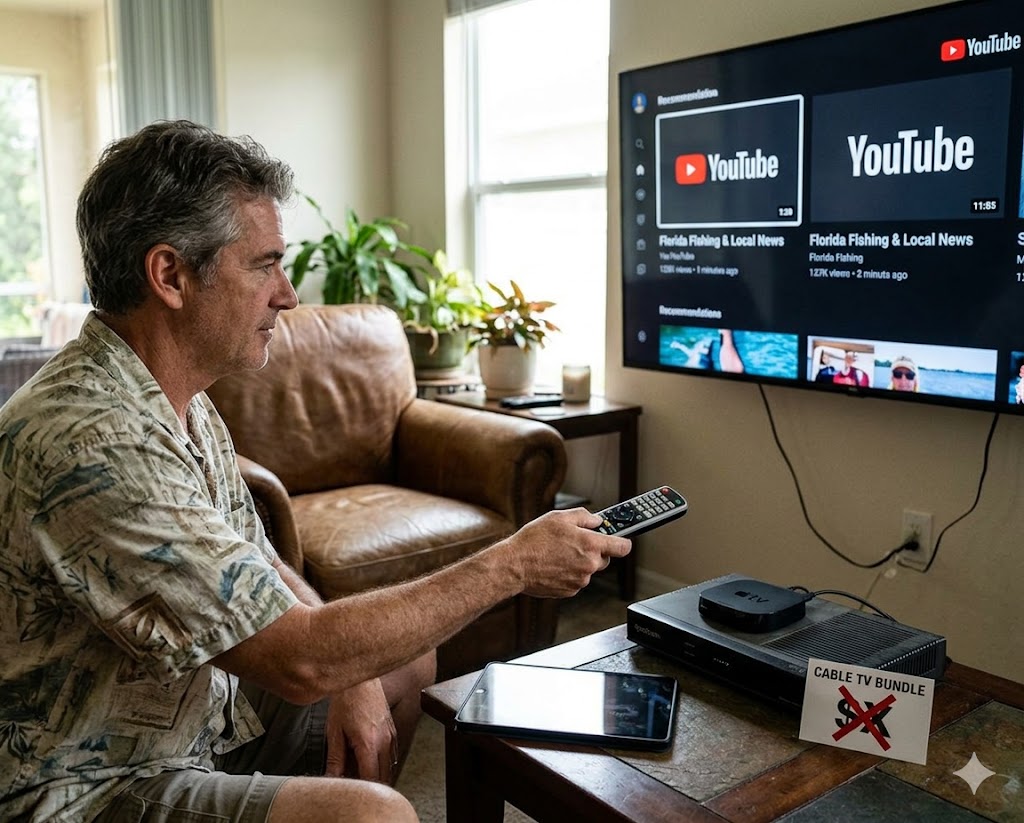
There is a moment happening in living rooms across Orange, Osceola, Seminole, and Lake counties that the cable industry would prefer not to talk about. The cable box is still plugged in. The bill is still arriving. But the television is running YouTube, and the phone in someone’s hand is deep in a Facebook scroll that started three hours ago and shows no sign of stopping.
Central Florida is not just participating in the national cord-cutting trend. It is one of its leading examples. A region built around tourism, technology, healthcare, and one of the youngest and most diverse metropolitan populations in the eastern United States turns out to be precisely the kind of market where traditional cable television struggles most — and where the platforms replacing it have found some of their most loyal audiences.
The story of cable’s decline here is not really about Netflix. It is about something more fundamental: a wholesale shift in how Central Floridians spend their attention, and who is capturing it.
Central Florida’s Cable Bill Has Become a Hard Sell
Orlando consistently ranks among the most competitive media markets in the country, and the competition is no longer coming from rival cable companies. It is coming from free platforms that require nothing more than a Wi-Fi connection and a few minutes of setup.
The economics hit harder here than in many other markets. Central Florida’s cost of living has climbed sharply over the past several years — housing costs in particular have placed real pressure on household budgets from Kissimmee to Clermont to Sanford. A cable bundle that costs $150 or more per month is an easy target when a family sits down to review its expenses, especially when the honest answer to “what are we actually watching on cable?” is increasingly “not much.”
Providers serving the region — Spectrum dominates much of the Central Florida cable footprint — have responded to subscriber losses the way the industry typically does: by raising prices on the customers who remain. That strategy has a well-documented endpoint, and Central Florida households are reaching it faster than the cable companies modeled.
The region’s enormous rental population — renters make up a significant share of households in the Orlando metro — has also accelerated the transition. Renters move more frequently, reconsider their services with each move, and are far less likely than homeowners to re-subscribe to cable at a new address when streaming and social media have already filled the gap.
“Every time a Central Florida family moves and skips the cable installation appointment, the industry loses a customer it almost never wins back.”
YouTube Owns the Screen Time That Cable Lost
If you want to understand where Central Florida’s cable audience went, start with YouTube. The platform has become the dominant video destination for the region’s residents across virtually every demographic — not just the cord-cutting millennials the industry has been writing off for years, but the middle-aged suburbanites of Dr. Phillips and the retirees of The Villages who were supposed to be cable’s last reliable base.
YouTube’s grip on Central Florida is partly a reflection of the region’s demographic diversity. The platform’s depth of Spanish-language content has made it the primary video destination for a substantial portion of Orlando’s large Puerto Rican, Colombian, Dominican, and Venezuelan communities — audiences that cable’s English-dominant channel lineups never served particularly well. Haitian Creole content, Brazilian Portuguese channels, and a growing ecosystem of Caribbean-focused creators have similarly found audiences here that cable could not have captured even if it had tried.
Beyond language, YouTube has done something cable never managed: it made local feel truly local. Central Florida-based creators covering theme park news, Orlando real estate, local restaurant reviews, hurricane preparedness, and community politics have built subscriber bases that rival the viewership of traditional local broadcasts. A YouTube channel dedicated to daily Universal Studios and Walt Disney World updates can draw more engaged viewers from the I-4 corridor than a cable access segment ever reached — and it updates faster, runs longer, and costs nothing to watch.
The advertising picture is equally damaging to cable’s prospects. Orlando’s business community — the hotels, the contractors, the medical practices, the car dealerships that once anchored local cable advertising — has shifted its spending toward YouTube’s targeted platform where a Windermere homeowner, a Celebration tourist, or a Lake Nona tech worker can be reached with precision that a cable spot buy cannot approach.
Facebook Took the Audience Cable Thought It Had Locked Up
The Villages, the massive retirement community straddling Sumter, Marion, and Lake counties, is one of the most Facebook-active communities in the state. That single fact tells you most of what you need to know about how Facebook dismantled cable’s last reliable demographic in Central Florida.
The assumption was simple and turned out to be wrong: older Floridians would hold onto cable because television was woven into the fabric of their daily lives in a way younger generations never experienced. What the industry missed was that Facebook replicated the most addictive elements of that television experience — the news, the familiar faces, the sense of connection, the emotional engagement — and delivered it through a device that retired residents of The Villages, Mount Dora, and Leesburg already had in their hands sixteen hours a day.
Facebook video has become a primary entertainment and information source for Central Florida’s retirement communities in ways that have genuinely surprised researchers studying media consumption. Local community Facebook groups across Sumter and Marion counties have displaced local cable access programming almost entirely. City commission meetings streamed live on Facebook draw more real-time viewers than the cable broadcasts of the same meetings. High school sports, church services, community fundraisers — all of it has migrated to Facebook Live, and the audiences followed without a second thought.
For Central Florida’s younger demographics, Facebook’s role is different but equally damaging to cable. Community groups covering Orlando neighborhoods, Osceola County development news, Seminole County school issues, and Lake County local politics have become primary information sources for residents who would previously have tuned into local cable news. The hyperlocal function that regional cable news built its identity around has been quietly absorbed by platform algorithms and neighborhood volunteers with smartphones.
“Facebook did not target cable television’s Central Florida audience. It just built a town square, and everyone showed up and forgot to go home.”
Sports and Storms: Cable’s Remaining Hand
Central Florida’s cable providers are not without leverage. Two factors continue to drive subscription retention in the region in ways that no social media platform has found a reliable answer to.
The first is live sports. Central Florida is a serious sports market — the Orlando Magic, Orlando City Soccer, the Orlando Pride, and the UCF Knights command passionate local followings, and the region’s proximity to Tampa Bay sports franchises extends that appetite further. The broadcast rights structures that keep live professional and major college sports behind pay-television walls remain cable’s most effective argument for staying subscribed. Every year that a Magic playoff game or a college football bowl matchup requires a cable-affiliated package to watch legally, a segment of Central Florida households keeps the subscription active.
The second is hurricane season. Florida’s weather reality gives local television a recurring, irreplaceable moment of genuine public necessity. When a named storm organizes in the Gulf or the Atlantic and turns toward the I-4 corridor, Central Florida residents who have not watched cable news in months find themselves reaching for the remote. Local television meteorologists with decades of regional experience — people who know the difference between how a storm behaves approaching the coast versus how it moves across the flat interior terrain of Orange and Osceola counties — provide something no YouTube algorithm or Facebook feed replicates reliably.
These two anchors are real, but they are also finite. Sports rights deals are being contested and restructured with increasing frequency as leagues explore direct-to-consumer distribution. Weather coverage has migrated meaningfully to local television stations’ own streaming apps, which do not require a cable subscription. The windows of necessity that cable depends on for retention are narrowing with each passing season.
What Gets Lost When Cable Goes
Central Florida’s media landscape is already showing the stress fractures that follow when cable revenue contracts.
Orlando’s local television news operations have seen staffing reductions, format changes, and consolidations that would have been unthinkable during the industry’s peak years. Statehouse coverage from Tallahassee — always thin by the standards of what a state Florida’s size and complexity deserves — has contracted further. Investigative units that once operated independently have been folded into general assignment operations stretched across too many platforms with too few reporters.
YouTube and Facebook have not filled that gap. They have filled the entertainment gap and the community information gap admirably. They have not filled the accountability journalism gap — the beats that require credentialed access, legal expertise, and the institutional backing to publish stories that powerful interests would prefer stay buried. That kind of journalism was never Facebook’s business model and was never going to be.
Central Florida’s residents are getting more content than ever before. They are, in meaningful ways, getting less journalism — and the two things are not the same.
The View From Here
Cable television’s future in Central Florida is not a question of whether decline continues. It is a question of pace and what replaces the functions that cable, imperfectly, once served.
The platform migration is real, largely irreversible, and driven by choices that millions of individual Central Floridians have made freely and rationally. YouTube offers more. Facebook connects more. Both cost less. The cable industry’s failure to build products that could compete on those terms is a business story decades in the making.
What comes after is still being written. The screens across Central Florida are more active than ever. The question worth asking — and the one this region’s media landscape will be answering for years to come — is whether more content and more connection is the same thing as a better-informed community.
The cable box is still plugged in. But its days are numbered.
Central Florida News Blog. This article is an independent editorial overview drawing on publicly available industry data, consumer research, and regional media reporting. All figures reflect general trends current as of 2026.
Here is the article — select all and copy:
The Remote Control Is Losing Its Grip on Central Florida
From Orlando to Ocala, residents are abandoning cable television at a rate the industry never prepared for — and the platforms taking their attention aren’t the ones cable saw coming.
There is a moment happening in living rooms across Orange, Osceola, Seminole, and Lake counties that the cable industry would prefer not to talk about. The cable box is still plugged in. The bill is still arriving. But the television is running YouTube, and the phone in someone’s hand is deep in a Facebook scroll that started three hours ago and shows no sign of stopping.
Central Florida is not just participating in the national cord-cutting trend. It is one of its leading examples. A region built around tourism, technology, healthcare, and one of the youngest and most diverse metropolitan populations in the eastern United States turns out to be precisely the kind of market where traditional cable television struggles most — and where the platforms replacing it have found some of their most loyal audiences.
The story of cable’s decline here is not really about Netflix. It is about something more fundamental: a wholesale shift in how Central Floridians spend their attention, and who is capturing it.
Central Florida’s Cable Bill Has Become a Hard Sell
Orlando consistently ranks among the most competitive media markets in the country, and the competition is no longer coming from rival cable companies. It is coming from free platforms that require nothing more than a Wi-Fi connection and a few minutes of setup.
The economics hit harder here than in many other markets. Central Florida’s cost of living has climbed sharply over the past several years — housing costs in particular have placed real pressure on household budgets from Kissimmee to Clermont to Sanford. A cable bundle that costs $150 or more per month is an easy target when a family sits down to review its expenses, especially when the honest answer to “what are we actually watching on cable?” is increasingly “not much.”
Providers serving the region — Spectrum dominates much of the Central Florida cable footprint — have responded to subscriber losses the way the industry typically does: by raising prices on the customers who remain. That strategy has a well-documented endpoint, and Central Florida households are reaching it faster than the cable companies modeled.
The region’s enormous rental population — renters make up a significant share of households in the Orlando metro — has also accelerated the transition. Renters move more frequently, reconsider their services with each move, and are far less likely than homeowners to re-subscribe to cable at a new address when streaming and social media have already filled the gap.
“Every time a Central Florida family moves and skips the cable installation appointment, the industry loses a customer it almost never wins back.”
YouTube Owns the Screen Time That Cable Lost
If you want to understand where Central Florida’s cable audience went, start with YouTube. The platform has become the dominant video destination for the region’s residents across virtually every demographic — not just the cord-cutting millennials the industry has been writing off for years, but the middle-aged suburbanites of Dr. Phillips and the retirees of The Villages who were supposed to be cable’s last reliable base.
YouTube’s grip on Central Florida is partly a reflection of the region’s demographic diversity. The platform’s depth of Spanish-language content has made it the primary video destination for a substantial portion of Orlando’s large Puerto Rican, Colombian, Dominican, and Venezuelan communities — audiences that cable’s English-dominant channel lineups never served particularly well. Haitian Creole content, Brazilian Portuguese channels, and a growing ecosystem of Caribbean-focused creators have similarly found audiences here that cable could not have captured even if it had tried.
Beyond language, YouTube has done something cable never managed: it made local feel truly local. Central Florida-based creators covering theme park news, Orlando real estate, local restaurant reviews, hurricane preparedness, and community politics have built subscriber bases that rival the viewership of traditional local broadcasts. A YouTube channel dedicated to daily Universal Studios and Walt Disney World updates can draw more engaged viewers from the I-4 corridor than a cable access segment ever reached — and it updates faster, runs longer, and costs nothing to watch.
The advertising picture is equally damaging to cable’s prospects. Orlando’s business community — the hotels, the contractors, the medical practices, the car dealerships that once anchored local cable advertising — has shifted its spending toward YouTube’s targeted platform where a Windermere homeowner, a Celebration tourist, or a Lake Nona tech worker can be reached with precision that a cable spot buy cannot approach.
Facebook Took the Audience Cable Thought It Had Locked Up
The Villages, the massive retirement community straddling Sumter, Marion, and Lake counties, is one of the most Facebook-active communities in the state. That single fact tells you most of what you need to know about how Facebook dismantled cable’s last reliable demographic in Central Florida.
The assumption was simple and turned out to be wrong: older Floridians would hold onto cable because television was woven into the fabric of their daily lives in a way younger generations never experienced. What the industry missed was that Facebook replicated the most addictive elements of that television experience — the news, the familiar faces, the sense of connection, the emotional engagement — and delivered it through a device that retired residents of The Villages, Mount Dora, and Leesburg already had in their hands sixteen hours a day.
Facebook video has become a primary entertainment and information source for Central Florida’s retirement communities in ways that have genuinely surprised researchers studying media consumption. Local community Facebook groups across Sumter and Marion counties have displaced local cable access programming almost entirely. City commission meetings streamed live on Facebook draw more real-time viewers than the cable broadcasts of the same meetings. High school sports, church services, community fundraisers — all of it has migrated to Facebook Live, and the audiences followed without a second thought.
For Central Florida’s younger demographics, Facebook’s role is different but equally damaging to cable. Community groups covering Orlando neighborhoods, Osceola County development news, Seminole County school issues, and Lake County local politics have become primary information sources for residents who would previously have tuned into local cable news. The hyperlocal function that regional cable news built its identity around has been quietly absorbed by platform algorithms and neighborhood volunteers with smartphones.
“Facebook did not target cable television’s Central Florida audience. It just built a town square, and everyone showed up and forgot to go home.”
Sports and Storms: Cable’s Remaining Hand
Central Florida’s cable providers are not without leverage. Two factors continue to drive subscription retention in the region in ways that no social media platform has found a reliable answer to.
The first is live sports. Central Florida is a serious sports market — the Orlando Magic, Orlando City Soccer, the Orlando Pride, and the UCF Knights command passionate local followings, and the region’s proximity to Tampa Bay sports franchises extends that appetite further. The broadcast rights structures that keep live professional and major college sports behind pay-television walls remain cable’s most effective argument for staying subscribed. Every year that a Magic playoff game or a college football bowl matchup requires a cable-affiliated package to watch legally, a segment of Central Florida households keeps the subscription active.
The second is hurricane season. Florida’s weather reality gives local television a recurring, irreplaceable moment of genuine public necessity. When a named storm organizes in the Gulf or the Atlantic and turns toward the I-4 corridor, Central Florida residents who have not watched cable news in months find themselves reaching for the remote. Local television meteorologists with decades of regional experience — people who know the difference between how a storm behaves approaching the coast versus how it moves across the flat interior terrain of Orange and Osceola counties — provide something no YouTube algorithm or Facebook feed replicates reliably.
These two anchors are real, but they are also finite. Sports rights deals are being contested and restructured with increasing frequency as leagues explore direct-to-consumer distribution. Weather coverage has migrated meaningfully to local television stations’ own streaming apps, which do not require a cable subscription. The windows of necessity that cable depends on for retention are narrowing with each passing season.
What Gets Lost When Cable Goes
Central Florida’s media landscape is already showing the stress fractures that follow when cable revenue contracts.
Orlando’s local television news operations have seen staffing reductions, format changes, and consolidations that would have been unthinkable during the industry’s peak years. Statehouse coverage from Tallahassee — always thin by the standards of what a state Florida’s size and complexity deserves — has contracted further. Investigative units that once operated independently have been folded into general assignment operations stretched across too many platforms with too few reporters.
YouTube and Facebook have not filled that gap. They have filled the entertainment gap and the community information gap admirably. They have not filled the accountability journalism gap — the beats that require credentialed access, legal expertise, and the institutional backing to publish stories that powerful interests would prefer stay buried. That kind of journalism was never Facebook’s business model and was never going to be.
Central Florida’s residents are getting more content than ever before. They are, in meaningful ways, getting less journalism — and the two things are not the same.
The View From Here
Cable television’s future in Central Florida is not a question of whether decline continues. It is a question of pace and what replaces the functions that cable, imperfectly, once served.
The platform migration is real, largely irreversible, and driven by choices that millions of individual Central Floridians have made freely and rationally. YouTube offers more. Facebook connects more. Both cost less. The cable industry’s failure to build products that could compete on those terms is a business story decades in the making.
What comes after is still being written. The screens across Central Florida are more active than ever. The question worth asking — and the one this region’s media landscape will be answering for years to come — is whether more content and more connection is the same thing as a better-informed community.
The cable box is still plugged in. But its days are numbered.
Central Florida News Blog. This article is an independent editorial overview drawing on publicly available industry data, consumer research, and regional media reporting. All figures reflect general trends current as of 2026.