By Brian French | Florida Authority Network | October 21, 2026
Quick Answer: The Florida Space Summit 2026 is a two-day event held October 20 and 21 at the Center for Space Education at Kennedy Space Center Visitors Complex. It is hosted by the Florida Space Research Consortium in partnership with the University of Florida’s Astraeus Space Institute. The summit connects university researchers with NASA, Space Florida and commercial space companies, featuring Dragonfly mission principal investigator Dr. Elizabeth “Zibi” Turtle as keynote speaker and at least 40 selected research talks.
Florida’s Space Coast has spent the past decade proving it can launch rockets at a pace no other place on Earth can match. The region hosted a record 109 orbital launches in 2025, and 2026 has brought the return of American astronauts to lunar distances with Artemis II, the expansion of heavy-lift competitors and preparations for SpaceX’s first Starship launches from Florida.
The Florida Space Summit asks a different question: who will do the research, invent the technology and train the workforce that turns launch volume into a lasting space economy? This week, university scientists, NASA leaders, students and commercial space executives are gathering at Kennedy Space Center to answer it. This report explains what the summit is, who is involved, why it matters for Florida’s economy and what businesses should take from it.
Florida Space Summit 2026 at a Glance
| Detail | Information |
|---|---|
| Dates | October 20 and 21, 2026 |
| Location | Center for Space Education, Kennedy Space Center Visitors Complex |
| Host | Florida Space Research Consortium |
| Partner | UF Astraeus Space Institute |
| Theme | A celebration of university space research |
| Day 1 | KSC Partnership Workshops and Opening Seminars |
| Day 2 | Space Research Day, keynote session and poster session |
| Research talks | At least 40 abstracts selected for presentations |
| Keynote | Dr. Elizabeth “Zibi” Turtle, Johns Hopkins APL |
What Is the Florida Space Summit?
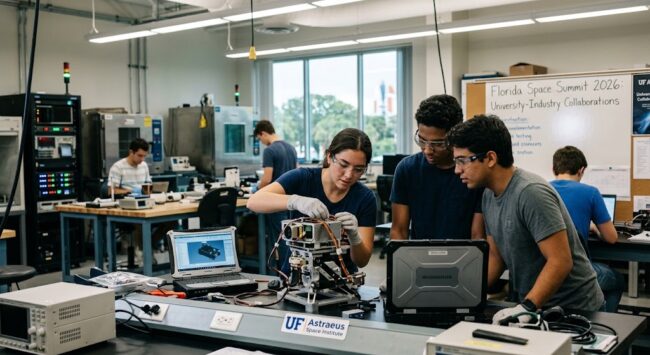
Organizers describe the summit as a celebration of university space research designed to connect, inspire and build lasting partnerships across academia, industry and government. Unlike trade shows built around launch providers and defense contractors, this event centers on the research pipeline: the science, engineering and human health work that universities contribute to space exploration.
Day 1: KSC Partnership Workshops
The first day features partnership workshops and opening seminars led by Kennedy Space Center teams alongside university researchers, along with an industry and KSC showcase. Event listings describe topics including exploration ground systems, in-situ resource utilization, advanced manufacturing, life sciences for spaceflight and launch and propulsion technologies. Attendees have opportunities to meet NASA program managers and Space Florida representatives to discuss partnerships and funding.
Day 2: Space Research Day
The second day is Space Research Day at KSC, with a keynote general session, subject matter talks and a poster session. At least 40 submitted abstracts were selected for talks, every submitted abstract received a poster slot, and authors could choose to publish in the summit proceedings. Research areas include planetary science, astrobiology, satellite engineering, space medicine and spaceport infrastructure, with themes spanning deep space exploration, the cislunar economy and human habitation beyond Earth.
Who Is Speaking
The summit’s featured speakers reflect its focus on science, health and operations.
| Speaker | Role |
|---|---|
| Dr. Elizabeth “Zibi” Turtle | Keynote; Planetary Scientist, Johns Hopkins APL; Dragonfly Mission Principal Investigator |
| Dr. Lisa Scott Carnell | Director, NASA Biological and Physical Sciences Division |
| Dr. Dorit Donoviel | Executive Director, NASA-funded Translational Research Institute for Space Health (TRISH), Baylor College of Medicine |
| Brian Hughes | NASA Senior Director of Launch Operations at Kennedy Space Center |
| Piercarlo Ciacchi | Lead Pilot and COO, Starfighters Space |
Dragonfly and the Keynote
Dr. Zibi Turtle leads NASA’s Dragonfly mission, a nuclear-powered rotorcraft designed to fly across the surface of Saturn’s moon Titan, studying its chemistry and potential for prebiotic processes. NASA has targeted a 2028 launch for Dragonfly. Having the mission’s principal investigator open Space Research Day signals the summit’s emphasis on ambitious, science-driven exploration.
Space Health and Biology
Dr. Lisa Scott Carnell directs NASA’s Biological and Physical Sciences Division, which funds research on how living systems and physical processes behave in space. Dr. Dorit Donoviel leads TRISH, a NASA-funded institute that develops solutions to protect astronaut health on long-duration missions. Their participation highlights one of Florida’s academic strengths: space biology, including the University of Florida’s well-known research on growing plants in lunar soil.
Launch Operations Leadership
Brian Hughes was named NASA’s senior director of launch operations in May 2026, overseeing launch infrastructure at Kennedy and Wallops Flight Facility and reporting to NASA Headquarters. Summit organizers list him as director of Kennedy Space Center. Hughes, a former Jacksonville city chief administrative officer and former NASA chief of staff, is responsible for coordinating with government, industry and local leaders to increase launch cadence.
Commercial Space
Piercarlo Ciacchi represents Starfighters Space, the summit’s platinum sponsor. The Kennedy Space Center-based company operates a fleet of modified F-104 Starfighter jets and is developing an air-launch platform called STARLAUNCH. The company, listed on NYSE American, raised about $17.5 million in a private placement in May 2026 to expand infrastructure and flight operations.
The Organizations Behind the Summit
The Florida Space Research Consortium
In January 2025, NASA’s Kennedy Space Center signed a memorandum of understanding with the University of Florida, the University of Central Florida and Embry-Riddle Aeronautical University, creating a university space research consortium to support NASA’s Moon to Mars initiative. The partnership covers research, technology development, education and workforce training, and NASA said it planned to invite other Florida universities to join.
According to the University of Florida, Florida is the only state with a university consortium affiliated with a NASA center. UF Vice President for Research David Norton chairs the consortium’s board.
UF Astraeus Space Institute
The University of Florida launched the Astraeus Space Institute in 2024 to coordinate interdisciplinary space research across the university. In August 2026, the institute opened a new Mission Operations Center in UF’s Computer Science Engineering Building in Gainesville. The center will provide command and control for the GRATTIS Earth science demonstration mission, scheduled to launch in February 2027. The institute is led by director Rachael Seidler and assistant director John Conklin.
Sponsors
| Level | Sponsors |
|---|---|
| Platinum | Starfighters Space |
| Gold | Yuri; Florida Space Grant Consortium |
| Silver | Blackstar Orbital |
| Bronze | National Center for Simulation; Michaelis Foundation |
The sponsor list blends commercial space startups, federal research programs and Central Florida’s simulation industry, which is one of the largest modeling and simulation clusters in the country.
Why the Summit Matters for Florida
Launch Volume Is Only the Beginning
The Space Coast’s record 109 orbital launches in 2025 made Florida the busiest spaceport region in the world. Launches create demand for payload processing, ground systems, satellite manufacturing, testing, data services, insurance, logistics and workforce training. But the highest-value parts of the space economy, including research, intellectual property and advanced manufacturing, require deep university and research partnerships.
NASA’s Florida Footprint
A January 2026 Florida TaxWatch report found that NASA’s operations in Florida support more than 35,000 jobs, generate an estimated $8.2 billion in economic output and produce more than $286 million in annual state tax revenue. The report credited the Space Coast’s recovery after the Space Shuttle era to private aerospace growth and the reuse of existing launch and research infrastructure.
Industry Expansion
Commercial investment continues. Blue Origin announced a $600 million upper-stage manufacturing expansion at its Rocket Park campus at the Cape Canaveral Spaceport, expected to create 500 jobs. The company says it has grown to nearly 4,000 employees and operates 11 sites in Brevard and Orange counties. SpaceX is preparing launch infrastructure for Starship on the Space Coast, and United Launch Alliance continues to increase Vulcan launch cadence.
Artemis Returns Humans to Deep Space
On April 1, 2026, NASA’s Artemis II mission launched from Kennedy Space Center, carrying NASA astronauts Reid Wiseman, Victor Glover and Christina Koch and Canadian Space Agency astronaut Jeremy Hansen on a roughly 10-day flight around the Moon. The crew splashed down on April 10 after traveling farther from Earth than any previous crewed spacecraft. The mission renewed national attention on Kennedy and on the research needed for sustained lunar operations.
Florida’s Space Research Strengths
| Institution | Space Research Strengths |
|---|---|
| University of Florida | Space biology, lunar plant research, Earth science missions, engineering |
| University of Central Florida | Planetary science, space resources, optics and photonics, simulation |
| Embry-Riddle Aeronautical University | Aerospace engineering, space operations, commercial space |
| Florida Institute of Technology | Space sciences, aerospace engineering, Space Coast industry partnerships |
| Florida State and USF | Materials science, physics, engineering and health research |
Florida’s research universities give the state an advantage few spaceport regions can match: launch infrastructure, NASA operations and research institutions all within driving distance of one another.
What the Summit Means for Florida Businesses
Partnership Opportunities
NASA, Space Florida and university research teams are actively seeking partners for technology development. Small and mid-sized Florida companies in advanced manufacturing, robotics, sensors, software, materials and life sciences can find opportunities through university collaborations, NASA technology transfer, Small Business Innovation Research grants and Space Florida financing programs.
Workforce Pipeline
University research produces the engineers, scientists and technicians that space companies need. Students presenting at events like the summit are tomorrow’s employees. Companies that sponsor research, offer internships and participate in university programs gain early access to that talent.
Dual-Use Technology
Many space technologies have commercial and defense applications on Earth. Life support systems inform health care, satellite data supports agriculture and insurance, and advanced manufacturing techniques transfer to other industries. Florida companies that understand those connections can tap both markets.
Simulation and Training
Central Florida’s simulation industry, represented at the summit by the National Center for Simulation, plays a growing role in space mission planning, astronaut training and spacecraft design. Orlando’s Research Park and related companies are natural partners for space research teams.
Challenges to Watch
Florida’s space ecosystem faces real constraints:
- Workforce housing. The Space Coast’s rapid growth has strained housing availability and affordability.
- Federal budget uncertainty. NASA science and research budgets are subject to annual appropriations and policy changes.
- Concentration risk. A large share of Florida’s launch volume depends on a single company.
- Research funding competition. Other states are investing heavily in space research and university partnerships.
- Technology transfer speed. Turning university research into commercial products takes years and patient capital.
Brian’s Take
As a former money manager, I learned that the most valuable businesses own something that is hard to replicate. Florida’s Space Coast owns proven, high-cadence launch real estate, and that has attracted an extraordinary concentration of rockets, satellites and talent. But launch capacity alone does not build a durable economy. The research, the patents and the people who know how to solve hard problems are what keep an industry anchored when the market shifts.
That is why I think the Florida Space Summit matters more than its size suggests. A consortium of Florida universities formally tied to a NASA center is unusual, and it gives the state a structural advantage. When research teams from Gainesville, Orlando and Daytona Beach work directly with Kennedy, the ideas they develop are more likely to become Florida companies, Florida jobs and Florida intellectual property.
My advice to Florida business owners, even those outside aerospace, is to pay attention to what comes out of these research partnerships. The next generation of sensors, materials, medical technology and data services may start as a poster at Kennedy this week. The companies that build relationships with university research teams now will be first in line when those ideas become products.
Frequently Asked Questions
When and where is the Florida Space Summit 2026?
The summit is held October 20 and 21, 2026, at the Center for Space Education at Kennedy Space Center Visitors Complex on Florida’s Space Coast.
Who hosts the Florida Space Summit?
The Florida Space Research Consortium hosts the summit in partnership with the University of Florida’s Astraeus Space Institute.
Who is the keynote speaker?
Dr. Elizabeth “Zibi” Turtle, a planetary scientist at Johns Hopkins Applied Physics Laboratory and principal investigator of NASA’s Dragonfly mission to Saturn’s moon Titan.
What is the Florida Space Research Consortium?
It is a partnership created in January 2025 between NASA’s Kennedy Space Center and Florida universities, with UF, UCF and Embry-Riddle as charter members, to support research, technology development and workforce training for NASA’s Moon to Mars initiative.
Why does university space research matter to Florida’s economy?
University research produces new technologies, intellectual property, startups and skilled workers that help Florida capture higher-value parts of the space economy beyond launch operations.
How many launches did the Space Coast have in 2025?
The Space Coast hosted a record 109 orbital launches in 2025.
Key Takeaways
- The Florida Space Summit runs October 20 and 21 at Kennedy Space Center.
- It is hosted by a university research consortium formally tied to a NASA center.
- Speakers include leaders from NASA science, space health research and commercial space.
- The summit focuses on turning university research into partnerships and jobs.
- Florida’s launch leadership needs research depth to build a durable space economy.
Sources and Further Reading
- Florida Space Summit 2026 – UF Astraeus Space Institute
- Florida Space Summit 2026 Event Listing – SpaceAgenda
- “NASA’s Kennedy Space Center and Florida Universities Unite to Propel Space Exploration” – University of Florida News, January 2025
- “Astraeus Space Institute Ribbon Cutting” – University of Florida News, August 2026
- “NASA Names Brian Hughes to Launch Operations Role” – NASA, May 2026
- “Starfighters Space Snags $17.5 Million” – Hoodline, May 2026
- “Florida’s Space Coast Is Well-Positioned to Dominate the Future of the Aerospace Industry” – Florida TaxWatch, January 2026
- “Governor Ron DeSantis Announces $600M Blue Origin Manufacturing Expansion, 500 High-Wage Jobs” – Space Florida
- “Space Coast Shatters Launch Record in 2025” – Florida Today via Yahoo News
- Artemis II Mission Updates – NASA
- “NASA Confirms APL-Led Dragonfly Mission to Saturn Moon Titan” – Johns Hopkins Applied Physics Laboratory
About The Author