By Brian French | Central Florida Business News | October 17, 2026
Quick Answer: Some will. Plant City and Lake Wales are already on track, driven by I-4 logistics, large approved subdivisions, and annexation. Mulberry is close behind on industrial land along SR 60. Okeechobee is growing slowly but steadily. Fort Drum is a highway crossroads to watch, not a town about to boom.
What Makes a Florida Town “Third-Tier” or “Second-Tier”?
Quick Take
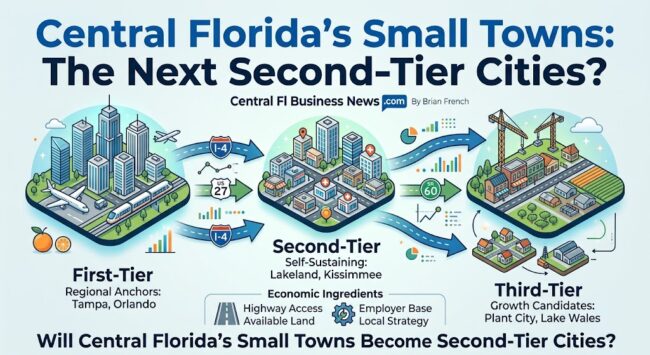
- First-tier cities are regional anchors like Tampa and Orlando.
- Second-tier cities have their own job base, retail, and services, such as Lakeland or Kissimmee.
- Third-tier towns are smaller communities that depend on larger neighbors for jobs and shopping.
Florida’s growth conversation usually centers on its big metros. But much of the state’s real momentum in 2026 is happening one level down, in small towns that sit between the large cities and the open country.
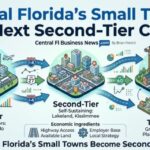
For this analysis, Central Florida Business News uses a simple three-tier framework:
| Tier | Typical Population | Economic Profile | Central Florida Examples |
|---|---|---|---|
| First tier | 300,000+ city, multi-million metro | Regional hub for jobs, finance, airports | Tampa, Orlando |
| Second tier | 50,000 to 200,000 | Own employment base, regional retail, hospitals | Lakeland, Kissimmee, Winter Haven area |
| Third tier | Under 50,000 | Commuter or legacy economy, limited services | Plant City, Lake Wales, Mulberry, Okeechobee |
A town moves from third tier to second tier when it stops being only a place people sleep and becomes a place people work, shop, and invest. That shift usually requires five ingredients: highway access, available land, water and sewer capacity, a stable employer base, and local leadership willing to manage growth instead of fighting it.
The question for Central Florida is which small towns have those ingredients, and which are simply absorbing overflow from larger neighbors.
Why Is Central Florida Growth Spilling Into Small Towns?
Quick Take
- Polk County grew about 20.7% from 2020 to 2025, reaching roughly 875,000 residents.
- Housing in Polk remains far cheaper than in Tampa or Orlando.
- Land along I-4, US 27, and SR 60 is drawing warehouses and subdivisions.
The Polk County Engine
The clearest evidence of the spillover is Polk County, which sits between Tampa and Orlando. U.S. Census Bureau estimates put Polk’s population at 874,790 in July 2025, up from about 725,000 at the 2020 Census. That is growth of roughly 20.7% in just over five years, and an increase of about 22,000 people in a single year.
Polk’s appeal is largely about cost and location. Census figures show a median owner-occupied home value of about $266,500 for 2020 to 2024, well below values in the neighboring metro cores. Interstate 4 places much of the county within an hour of both Tampa and Orlando.
The Logistics Magnet
The I-4 corridor between Tampa and Orlando has become one of Florida’s most important distribution zones. Warehouses need large, flat, affordable parcels near interstates, and small towns along the corridor have them. Industrial investment often comes first, then rooftops follow, then retail and services.
The Housing Push
As home prices and rents rose in the metro cores, buyers moved outward. Builders followed with large master-planned subdivisions in towns that, a decade ago, rarely saw more than a few dozen new homes a year.
Is Plant City Becoming a Second-Tier City?
Quick Take
- Plant City has added more than 12 million square feet of industrial space in about a decade.
- Planners expect its population to roughly double by 2050.
- It is the strongest candidate on this list to cross into second-tier status.
Where Plant City Stands
Plant City, in eastern Hillsborough County, is best known for strawberries and the Florida Strawberry Festival. Its economic identity is changing fast.
According to Plan Hillsborough, the city’s population has grown from about 36,700 at the start of the decade to an estimated 45,300, with a long-range forecast of about 76,700 residents within city limits by 2050. That would be roughly a 69% increase from current levels. Planners have said Plant City is expected to lead Hillsborough County in population and job growth rates through 2050, and the broader Plant City area, including surrounding unincorporated land, could grow from about 60,000 to more than 150,000 people.
The Industrial Foundation
Plant City’s growth is built on industry, not just housing. In a July 2026 interview, Plant City Economic Development Corporation President and CEO Steve Morey said the city has seen more than 12 million square feet of new industrial investment over the last 10 years. He noted that one existing industrial park still has more than 100 acres available, and two new parks are moving forward: Stalwart Industrial Park on the northwest side and the Blue Steel development on County Line Road between Plant City and Lakeland.
Shovel-ready sites continue to come to market. One example is a roughly 58.8-acre industrial site on Coronet Road, marketed for up to about 442,000 square feet of logistics or manufacturing space near I-4.
Why Plant City Is Ahead
| Factor | Plant City Status |
|---|---|
| Highway access | Direct I-4 access between Tampa and Lakeland |
| Land supply | Multiple industrial parks, more in pipeline |
| Employer base | Logistics, distribution, food, manufacturing |
| Population trend | Steady growth, doubling forecast by 2050 |
| Local strategy | EDC focused on balancing industry with downtown and quality of life |
The Challenges
Growth has a cost. Longtime residents have voiced concerns about traffic and the loss of small-town character. Morey has emphasized that the city cannot grow only in response to industrial needs, and that business investment must translate into parks, downtown revitalization, and workforce readiness.
Verdict: Plant City is the most likely town on this list to become a true second-tier city within the next 10 to 15 years.
Is Lake Wales the Fastest-Growing Small City in Polk County?
Quick Take
- Lake Wales has approved more than 15,000 new homes that could house over 40,000 residents.
- City property valuations have passed $1.5 billion.
- Annexation is pushing the city south and east along US 27.
Explosive Residential Approvals
Lake Wales, in southeastern Polk County, has seen one of the most dramatic residential pipelines in the state relative to its size. As of 2024, LakeWalesNews.net counted more than 15,660 new homes approved by city commissioners, expected to house about 42,000 new residents. Earlier estimates from city planners suggested new development could double or more than double the city’s population.
A major piece of that growth came from an agreement between the city and Winter Haven Corp. to develop about 1,800 acres. City officials described annexation as a way to keep control of growth that would happen anyway, ensuring new neighborhoods meet city standards.
Rising Property Values
Lake Wales property valuations passed $1.5 billion, according to Polk County Property Appraiser figures reported in July 2026. The city added about $187 million in valuation in a year, posting the second-fastest growth rate in Polk County behind Lake Hamilton. Annexations, new apartments, restaurants, and new homes all contributed.
Planning for Quality
To prevent sprawl, Lake Wales developed a plan called Lake Wales Envisioned, which calls for traditional neighborhood design rather than walled subdivisions. The city is also investing in infrastructure, including a third fire station, a police annex, and utility expansions.
The Gaps
| Factor | Lake Wales Status |
|---|---|
| Highway access | US 27 and SR 60, but no interstate |
| Land supply | Large annexed tracts to the south and east |
| Employer base | Citrus heritage, health care, retail; limited large employers |
| Population trend | Very strong residential pipeline |
| Local strategy | Annexation plus design standards |
Lake Wales’ challenge is the opposite of Plant City’s. It has abundant housing growth but a thinner job base. Without more employers, it risks becoming a large bedroom community rather than a self-sustaining city. City planners have also warned that the growth will require several new schools, and US 27 congestion has prompted transportation planners to study an alternate parallel route.
Verdict: Lake Wales will grow in population, but its move to second-tier status depends on attracting employers, not just homebuilders.
Can Mulberry Turn Its Mining Past Into an Industrial Future?
Quick Take
- Mulberry sits at the junction of SR 60 and SR 37, between Lakeland and Tampa.
- Industrial parks and highway frontage are attracting logistics users.
- Its small size means growth is visible, but it starts from a low base.
A Crossroads Town
Mulberry is a small city in southwestern Polk County with deep roots in phosphate mining. Historically, its housing served mining workers. City leaders have worked to diversify, describing Mulberry as a crossroads rather than a town at a crossroads.
Industrial Land Along SR 60
Mulberry’s advantage is industrial land with highway frontage. Multiple sites along State Road 60, the main east-west route between Lakeland and Tampa, have been marketed for logistics, outdoor storage, and light manufacturing, including tracts of about 26 acres designed for up to roughly 150,000 square feet of space. Some industrial land in Mulberry falls within a designated Opportunity Zone. Brokers note the city sits about 33 miles from Tampa and 67 miles from Orlando.
Housing Diversification
The Central Florida Development Council has reported that Mulberry is moving from almost exclusively affordable mining-era housing to a mix of upscale single-family homes, apartments, and workforce housing. Bridgeport Lakes was described as the city’s first large-scale development. Two industrial parks have also added businesses.
| Factor | Mulberry Status |
|---|---|
| Highway access | SR 60 and SR 37; near Polk Parkway and I-4 |
| Land supply | Industrial land and Opportunity Zone sites |
| Employer base | Phosphate legacy, emerging logistics |
| Population trend | Small but growing |
| Local strategy | Streamlined approvals, annexation incentives |
Verdict: Mulberry is unlikely to reach second-tier size on its own, but it could become an important industrial node within a larger Lakeland-area economy.
Is Okeechobee Positioned for Growth?
Quick Take
- Okeechobee County grew about 1.8% from 2023 to 2024, driven by people moving in from other counties.
- Its economic development group reports more than $38 million in committed private investment.
- Growth is steady and deliberate, not explosive.
A Rural Hub
Okeechobee sits at the north end of Lake Okeechobee, in the region often called South-Central Florida or the Heartland. Agriculture, cattle, and dairy have long anchored the economy, and the lake drives tourism and fishing.
Measured Growth
Okeechobee is growing, but slowly compared with Polk. USAFacts data based on Census estimates show the county added 766 residents from 2023 to 2024, an increase of about 1.8%, with growth over the prior decade of about 7.1%. Domestic migration from other U.S. counties was the main driver.
Economic Development Pipeline
The Okeechobee County Economic Development Corporation reported that more than $38 million in private investment has been committed through new business locations and expansions. It said its pipeline could exceed $60 million if current projects proceed. A key focus is the Okeechobee County Airport Commerce Park, where pending projects could bring about $22 million in investment and roughly 80 jobs. By mid-2026, the organization reported 27 active projects.
The county also has several private industrial parks and has emphasized workforce programs, including a junior leaders program for local students. A new facility converting landfill gas into power opened in the county as well.
| Factor | Okeechobee Status |
|---|---|
| Highway access | US 441, SR 70, SR 78; near Florida’s Turnpike |
| Land supply | Abundant rural and industrial land |
| Employer base | Agriculture, health care, small manufacturing |
| Population trend | Modest, steady growth |
| Local strategy | Industrial site readiness, airport commerce park |
Verdict: Okeechobee is becoming a stronger regional service center, but second-tier status is a long-term prospect, not a near-term one.
What About Fort Drum?
Quick Take
- Fort Drum is an unincorporated crossroads in northern Okeechobee County.
- Its main asset is the Fort Drum Service Plaza on Florida’s Turnpike.
- Turnpike widening studies could raise its profile, but there is no town government driving growth.
Fort Drum is a different case from the other communities in this article. It is not an incorporated city. It is a small rural community in Okeechobee County best known to travelers for the Fort Drum Service Plaza at about mile marker 184 on Florida’s Turnpike.
There are signs of infrastructure attention. Florida’s Turnpike Enterprise has studied widening the Turnpike between SR 70 and SR 60, a segment that passes through the Fort Drum area, and state work programs include parking improvements at the service plaza.
But highway improvements alone do not create a town. Fort Drum has no municipal government to annex land, extend utilities, or recruit employers. Any significant development would depend on Okeechobee County’s land-use decisions and private investors.
Verdict: Fort Drum is worth watching as a corridor location if Turnpike improvements spur interchange-oriented development, but it is not on a path to become a second-tier city.
How Do These Towns Compare?
Quick Take
- Plant City leads on industry and planning.
- Lake Wales leads on housing growth.
- Mulberry and Okeechobee are emerging industrial nodes; Fort Drum is a corridor watch.
| Town | Interstate Access | Industrial Base | Housing Pipeline | Utility Capacity | Second-Tier Outlook |
|---|---|---|---|---|---|
| Plant City | Strong (I-4) | Strong | Strong | Expanding | Likely, 10–15 years |
| Lake Wales | Moderate (US 27) | Limited | Very strong | Expanding | Possible, if jobs follow |
| Mulberry | Moderate (SR 60) | Emerging | Moderate | Developing | Industrial node |
| Okeechobee | Limited | Emerging | Modest | Limited | Long-term |
| Fort Drum | Turnpike only | Minimal | Minimal | Minimal | Unlikely |
What Will Decide Which Towns Move Up?
Quick Take
- Jobs matter more than rooftops.
- Water, sewer, and roads are the real bottlenecks.
- Local leadership and planning quality separate winners from sprawl.
1. Employment, Not Just Housing
A town that adds thousands of homes without employers becomes a commuter suburb. Second-tier status requires local jobs, which is why Plant City’s industrial base gives it an edge over Lake Wales.
2. Infrastructure Capacity
Water and sewer capacity is often the hidden limit. Lake Wales’ purchase of a private water utility and its interconnections show how small cities must invest ahead of growth. Central Florida’s long-term water supply is also a regional concern.
3. Transportation
Interstate access is the strongest predictor of industrial investment. Towns on I-4 have a structural advantage. Towns on US 27 or state roads face congestion as they grow and depend on state funding for new capacity.
4. Schools and Services
Rapid residential growth requires new schools, fire stations, and police. Cities that plan for these early, as Lake Wales is doing, avoid the worst growing pains.
5. Land Use Quality
Design standards determine whether growth creates real neighborhoods or disconnected subdivisions. Lake Wales Envisioned is a notable attempt to set higher standards.
6. Regional Partnerships
Economic development organizations such as the Plant City EDC, the Central Florida Development Council in Polk County, and the Okeechobee County EDC play a central role in recruiting employers and preparing sites.
What Should Businesses and Investors Watch?
Quick Take
- Industrial sites near I-4 and SR 60 remain the strongest commercial plays.
- Retail and services will follow rooftops in Lake Wales and Plant City.
- Infrastructure announcements are leading indicators.
For business owners and investors evaluating Central Florida’s small towns, these signals matter most:
- Annexation decisions: New city boundaries open land to utilities and development.
- Utility extensions: Water and sewer lines often precede major projects by several years.
- Industrial park openings: New parks indicate where employers will cluster.
- School construction: New schools confirm sustained residential growth.
- Retail anchors: Grocery stores and national chains signal that a town has crossed a population threshold.
- Transportation projects: Interchanges, road widenings, and new corridors shape where growth flows.
Brian’s Take
The idea that small Florida towns will simply “grow up” into second-tier cities is too simple. Population alone does not make a city. Jobs, infrastructure, and planning do.
Plant City is the clearest example of how it works. It built an industrial base first, used that base to fund amenities, and is now growing residentially on a stronger footing. Ten years from now, Plant City is likely to function as a true small city with its own economic gravity between Tampa and Lakeland.
Lake Wales is the more interesting test. Its housing pipeline is enormous for a city its size. If it can attract employers to match, it could become a genuine anchor for southeastern Polk. If it cannot, it risks becoming a very large bedroom community with traffic on US 27 and residents commuting to jobs elsewhere.
Mulberry and Okeechobee are building something more modest but still valuable: industrial nodes that create local jobs in places that historically had few. That matters for the people who live there, even if neither becomes a Lakeland.
Fort Drum is a reminder that highways alone do not create towns. Without a local government and utilities, a crossroads stays a crossroads.
For Central Florida as a whole, the bigger lesson is that growth is moving outward whether communities plan for it or not. The towns that plan well will capture the jobs and tax base. The towns that do not will get the traffic without the benefits.
Frequently Asked Questions
Which small towns in Central Florida are growing the fastest?
Lake Wales and Plant City are among the fastest-growing small cities in the region. Lake Wales has approved more than 15,000 new homes, and Plant City is forecast to roughly double its population by 2050.
Will Plant City become a major city?
Plant City is likely to become a second-tier city within 10 to 15 years. It has added more than 12 million square feet of industrial space in a decade and is forecast to reach about 77,000 residents by 2050.
Why is Polk County growing so fast?
Polk County offers lower housing costs than Tampa or Orlando and sits along the I-4 corridor between them. Its population grew about 20.7% from 2020 to 2025, reaching roughly 875,000.
Is Okeechobee growing?
Yes, but slowly. Okeechobee County grew about 1.8% from 2023 to 2024, and its economic development corporation reports more than $38 million in committed private investment.
What is Fort Drum, Florida?
Fort Drum is an unincorporated community in Okeechobee County, best known for the Fort Drum Service Plaza on Florida’s Turnpike. It is a corridor to watch but not a town positioned for major growth.
Sources and Further Reading
- U.S. Census Bureau, QuickFacts: Polk County, Florida
- Plan Hillsborough, Jurisdictions Demographic and Economic Profiles, 2026
- Plan Hillsborough, Plant City 2050 Long Range Growth Forecasts
- WUSF, “Plant City’s Population Is Booming”
- Capital Analytics / Invest:, Interview with Steve Morey, Plant City EDC, July 2026
- CommercialCafe and CommercialSearch, Coronet Road Industrial Site, Plant City
- LakeWalesNews.net, “Lake Wales Growth Tops 20% During Past Year as Valuations Pass $1.5 Billion”
- LakeWalesNews.net, “More Than 15,660 New Homes Approved by Lake Wales City Commissioners”
- Central Florida Development Council, “Lake Wales and Winter Haven Corp. Agree to Develop 1,800 Acres”
- Central Florida Development Council, “Mulberry Embraces Its Quality of Life While Growing”
- Crexi and LoopNet, Mulberry SR 60 Industrial Land Listings
- Okeechobee County Economic Development Corporation, “OCEDC Finishes FY 2025 Strong”
- Okeechobee County Economic Development Corporation, 2026 Q2 County Presentation
About The Author